TL;DR: Key Takeaways
• The digital credential management market will reach a value of $2.91 billion in 2026.
• Leading platforms and digital credential providers in 2026 include Credly, Accredible, BCdiploma, and Hyperstack.
• Your choice among platforms will depend on your need for privacy, automation, and network visibility.
• Organizations are shifting to decentralized tech to guarantee compliance and validity.
• The top digital credential platforms and digital badges providers prioritize seamless learner access, zero-fraud assurance, and 100% white-label control.
Issuing platforms vs. verification tools: what is the difference?
Before comparing specific solutions, it is crucial to understand the distinction between credential issuing platforms and identity verification tools.
- Issuing platforms (e.g., BCdiploma, Credly, Accredible, Sertifier) are used by universities, corporations, and training centers to create, manage and distribute digital certificates or badges to learners.
- Verification tools (e.g., iDenfy, Proof, Veriff, ID.me) are typically used by employers, auditors and institutions to validate a person’s identity, cross-check submitted documents, or perform background checks.
Historically, verifiers had to contact issuers directly to validate a document’s legitimacy. Today, top decentralized issuing platforms bridge this gap. By producing mathematically tamper-proof credentials, these platforms natively include one-click verification built right into the certificate, bypassing the need for employers to use expensive third-party verification software.
What are the best platforms to obtain or verify certificates online?
The best certificate issuing and verification platforms in 2026 include market leaders like Credly, Accredible, BCdiploma, and Hyperstack, as well as specialized identity verification tools like iDenfy and Proof. These solutions fall into two main categories: established centralized networks, and highly protected decentralized systems.
Whether relying on proprietary databases for broad visibility, or leveraging open Web3 standards for issuer sovereignty and end-user ownership, these tools empower businesses, universities and training institutions to create, administer, and instantly confirm qualifications.
Professionals, students and trainees need verifiable proof of their skills, while employers are calling for absolute legitimacy in combating fraud. Modern solutions have answered this call by replacing paper files with cryptographically secured assets.
Top digital credential platforms give recipients easy online access, allowing them to share their successes with a single click. Most importantly, they build reputation for the issuing institution. In this article, we will explore best digital credential management solutions available in 2026, comparing their distinct strengths, critical weaknesses, and technological approaches.
What features define the leading solutions on the market?
The features that define the leading solutions on the market include robust protections, streamlined processes, and an exceptional experience for users. Also, the software should effortlessly scale with your certification program, without adding administrative burden.
Why is security the main priority for digital credential providers?
Security is the main priority because certificate fraud is rising globally, making basic PDFs no longer sufficient. Top digital credential platforms must offer uncompromising information protection, such as tamper-proof, cryptographic public key infrastructure (PKI) and electronic signature validation, to ensure each and every award institutions sign has undeniable validity.
How does user experience impact program growth?
The experience of learners and administrators impacts the development of programs by, respectively, directly driving learner engagement and software adoption.
A seamless web interface helps learners claim their documents quickly. And it encourages them to share their credentials on professional networks. This sharing creates a powerful marketing loop for the issuer. Furthermore, intuitive tools save countless administrative hours for teams working to create and manage these programs.
How do the top digital credential platforms compare?
The top digital credentials platforms that dominate the corporate and educational ecosystems approach credentialing from different angles. Some focus on building massive talent networks, others prioritize digital marketing, and yet others focus on institutional sovereignty and high-grade security.
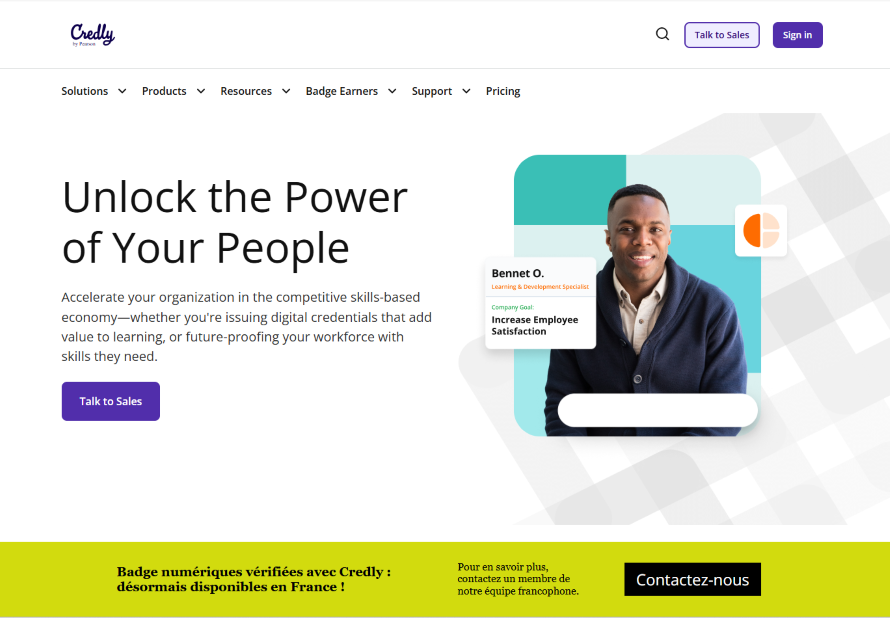
Credly: The network-centric leader
Widely adopted network-based systems like Credly (now part of Pearson) lead the segment for corporate IT instruction and standardized tech credentials.
What are Credly’s main strengths?
Credly performs by prioritizing massive visibility. Its primary advantage is its unmatched global ecosystem, which integrates tightly with corporate HR systems and talent directories. For massive tech companies, like AWS or IBM, looking to make their certifications easily discoverable by recruiters, Credly is highly effective.
What are Credly’s main limitations?
Organizations often seek a reliable Credly alternative when they need stricter control over their own brand. Since Credly is a centralized network, the platform’s branding can sometimes overshadow the awarding entity’s own identity. Additionally, Credly pricing can be prohibitive for straightforward use cases with limited budgets.
Accredible: The marketing-centric platform
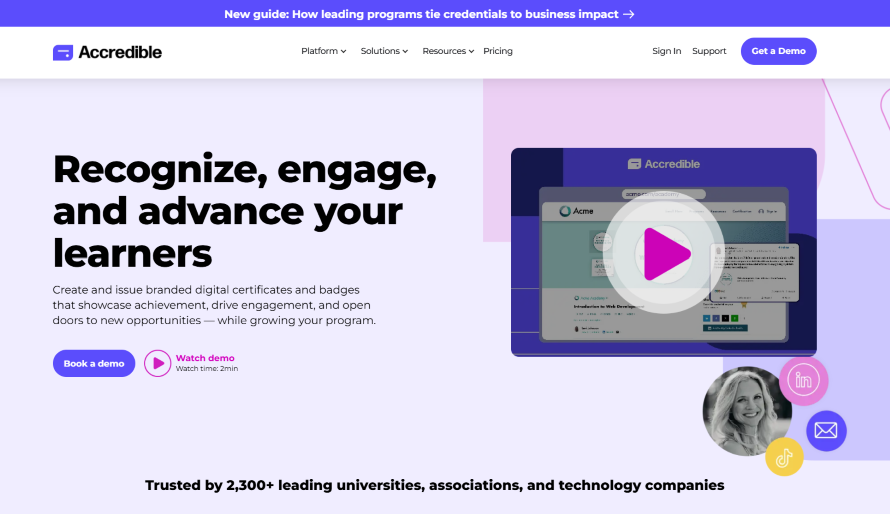
Among top digital badges providers, platforms like Accredible focus heavily on comprehensive digital marketing features and graphic badges adhering to the Open Badges standard.
What are Accredible’s main strengths?
Accredible provides an extensive visual design studio and robust marketing capabilities. They excel at helping organizations build their public reputation through shared learner achievements, offering rich analytics on social media sharing and engagement. Ultimately, when comparing Credly vs Accredible, organizations usually weigh network size against these marketing capabilities.
What are Accredible’s main limitations?
When institutions actively search for an Accredible alternative, they are often looking for stricter data compliance, such as native European GDPR alignment, or for more flexible limits than Accredible pricing regarding premium features. Often, the financial barrier to entry for essential features like deep analytics or full, uncompromised white-labeling is high. Additionally, if absolute data sovereignty and immutability are the top priorities, institutions often turn to decentralized Web3 alternatives.
BCdiploma: The sovereignty and security leader
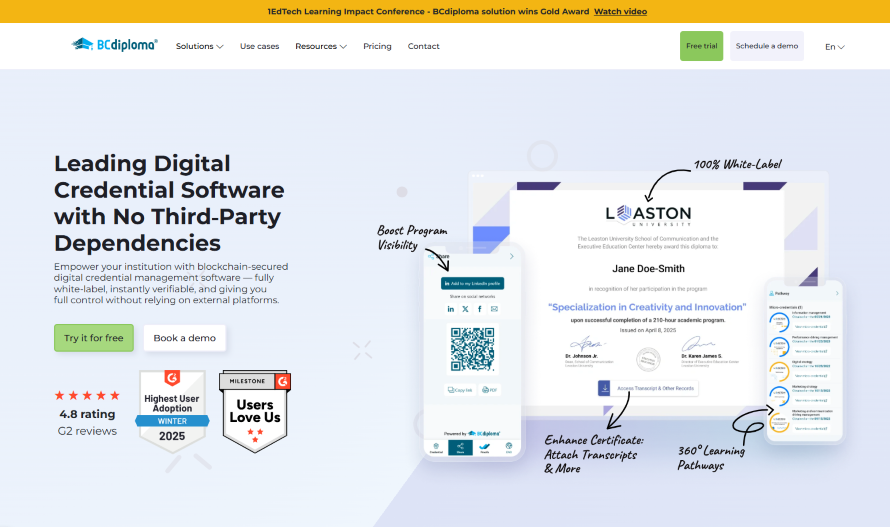
As one of the leading digital credential providers, BCdiploma caters specifically to higher education institutions and rigorous corporate training programs that prioritize absolute trust, data compliance, and reputation control.
What are BCdiploma’s main strengths?
BCdiploma uses a decentralized architecture to guarantee that records cannot be altered. Its primary strengths are 100% true white-labeling (ensuring the institution’s brand is the only one visible), and native ‘Privacy by Design’ compliance with stringent data laws like GDPR and FERPA.
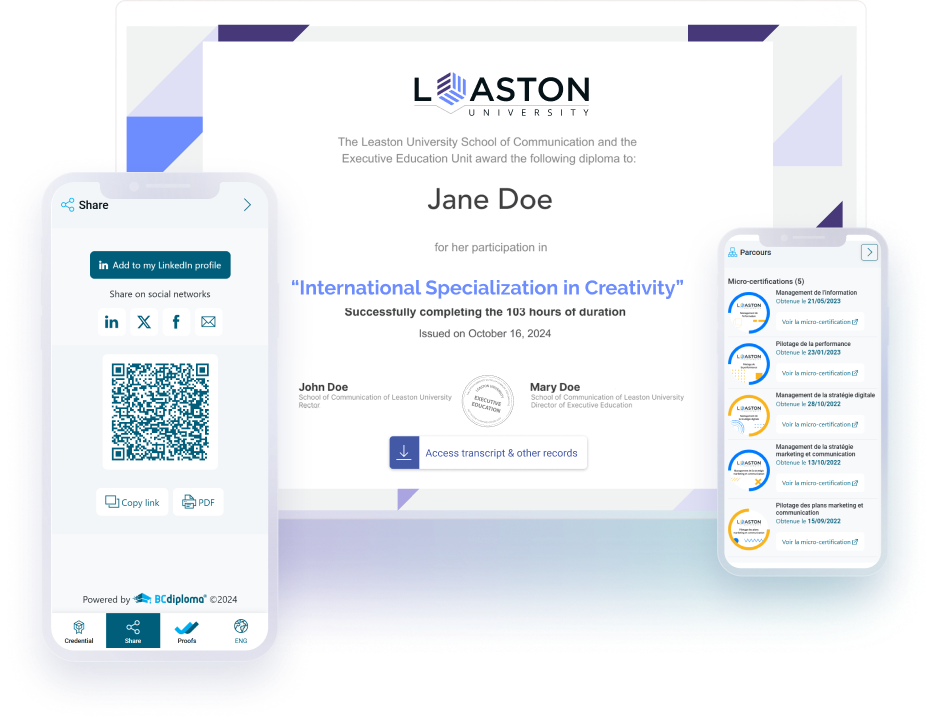
BCdiploma’s White label credential – Exemple of Leaston University
What are BCdiploma’s main limitations?
Since BCdiploma focuses heavily on high-value degrees, blockchain anchoring, and enterprise-grade security, it may offer more infrastructure than is necessary for casual issuers or small clubs looking to issue simple participation badges.
What are the key differences between the top credentialing solutions at a glance?
| Feature | Credly (network-centric) | Accredible (marketing-centric) | BCdiploma (security-centric) |
|---|---|---|---|
| Primary strength | Massive global talent ecosystem and HR integrations | Rich visual design, marketing analytics, and Open Badges | 100% white-labeling, automated issuance, and Web3 security |
| Best suited for | Large-scale global tech companies | Marketing-driven certification programs | High-value university degrees and corporate certifications |
| Verification method | Centralized proprietary database | Centralized proprietary database | Web3-backed cryptography |
| Data residency focus | Primarily US-focused | Primarily US-focused | Choice of European GDPR or US Hosting / Global Privacy by Design |
| Brand focus | Platform brand is prominent to drive network effects | Strong branding, but premium white-labeling is tiered | 100% institutional white-label natively available |
Go deeper: Download our free Comparison Guide. Choosing the right platform is a strategic decision. To help you avoid common pitfalls like vendor lock-in or poor UX, we’ve created a practical toolkit including:
- 6 key criteria to effectively compare solutions.
- Practical evaluation grids to secure your project.
- A printable checklist and project roadmap.
What are the best platforms to obtain or verify certificates digitally in terms of security?
The best platforms to securely obtain and verify digitalized certificates are those using decentralized infrastructure. This is because traditional centralized databases remain vulnerable to hacks and data breaches, whereas decentralized technology guarantees absolute immutability.
How does the web3 technology change the credentialing market by ensuring instant certificate verification ?
Web3 technology, and especially decentralization and blockchain technology, is changing the market because it guarantees that a document cannot be altered or forged.
Once generated, each record is permanent, and safeguarded by the wider network. This provides absolute assurance to employers, and entirely eliminates time wasted on manual validation processes. As the certification sector continues to grow exponentially, adopting such locked-down protocols has become essential in preserving absolute trust at scale.
How do Web3 systems solve data compliance?
Decentralized Web3 systems solve information and privacy compliance by adopting a ‘Privacy by Design’ approach.
European institutions, in particular, worry deeply about GDPR rules, and need to maintain full sovereignty over learner records. Modern decentralized systems do not hold sensitive information in proprietary, centralized silos. Instead, they encrypt records and allow learners to securely hold their own certificates as they learn and advance in their careers.
| Security technology | Centralized databases | Decentralized architecture |
|---|---|---|
| Data immutability | Vulnerable to server hacks | Mathematically tamper-proof |
| Verification speed | Requires contacting the issuer | Instant, one-click validation |
| Learner ownership | Platform controls the data | Learner holds the cryptographic key |
How are micro-achievements shaping the future of learning?
Micro-achievements are shaping the future of learning by offering agile, stackable proofs of specific skills. As global business accelerates and evolves, the demand for fast, verifiable programs has skyrocketed.
Why do learners prefer bite-sized learning?
Learners often prefer bite-sized learning because it allows them to quickly update expertise without committing to multi-year programs.
Modern learners are looking for an electronic product they can earn in weeks and share immediately. By using a top digital credential platform, these micro-achievements become easily verifiable assets, and drive immediate career advancement and training.
How does this affect traditional diplomas?
This affects traditional diplomas by transforming them into dynamic, continuously updated digital portfolios.
Universities no longer just release a single piece of paper upon graduation. Instead, they deliver a series of digital certificates throughout the student’s journey. This credentialing strategy provides employers a clearer picture of actual, certified, individual capabilities.
How do decentralized tools compare against legacy centralized systems?
Decentralized tools have improved on legacy systems by offering targeted, highly-secured features, rather than relying on generalized, mass-market networks. They specifically cater to higher education and rigorous training institutions that prioritize absolute trust and reputation control over mass networking.
What are the benefits of decentralized tools for educational institutions?
The benefits of decentralized tools for educational entities include extreme effort savings, significantly lower operational costs, and enhanced degree protection.
While legacy networks also automate basic workflows, decentralized tools pair this efficiency with absolute issuer sovereignty.
Universities can deliver thousands of critical files annually, making this advanced automation absolutely vital for program expansion. Among the benefits of modern decentralized tools are:
- Decentralized automation: Beyond standard API integrations, these tools automatically send cryptographically protected files directly to recipients.
- Instant legitimacy: A simple click provides instant, undeniable confirmation for global employers, without relying on responses from a centralized vendor database.
- Dramatic cost reduction: Traditional paper printing, physical signing, and international mailing costs are completely eliminated.
Are there real-world examples of the success of these tools?
There are certainly plenty of real-world examples of this success of these tools used at leading global universities and in specialized continuing learning programs.
Case study 1: large-scale university deployment
The University of Lille successfully implemented a highly-protected, decentralized solution, which they used to automatically issue over 80,000 bilingual digital certificates in the first year of deployment alone. This digital transformation resulted in exceptional administrative time savings, and provides a valuable, verifiable product for alumni entering the workforce.
Case study 2: global continuing education
The Stanford Center for Professional Development (SCPD) partnered with a trusted provider to transform its certification process. Fully automated issuing reduced delivery time from five days to under one hour. This major transformation saved over 75% in administrative resources by completely eliminating manual entry and global shipping.
Case study 3: international corporate training
AFNOR Certification, a leading training player, sought an alternative to basic PDFs. They transitioned to a highly-secure digital certificate platform to manage their international certifications. The automation drastically reduced email support requests regarding lost documents, and saves their admin team hundreds of hours annually.
Why are organizations moving toward 100% white-label solutions?
In 2026, organizations are moving toward 100% white-label solutions to maintain complete, uncompromised control over their identity and reputation. When a student proudly shares an achievement, the awarding institution’s identity should be front and center.
How does brand control affect perceived value?
Brand control affects perceived value by projecting absolute institutional authority and prestige.
Many legacy tools force the awarding institution to share the visual spotlight. The software platform’s logo frequently appears on the delivery message and the final validation page. This significantly dilutes the institution’s hard-earned public image.
What is the true cost of vendor lock-in?
The true cost of vendor lock-in is a fundamental loss of independence and institutional sovereignty. A true, 100% white-label solution ensures that every single touch-point reflects only the awarding organization. This encompasses everything from the first email through to the final document access page. This professional approach builds far deeper trust with learners, prospective students, and recruiters.
What are the most secure decentralized platforms to choose among in 2026?
As explored throughout this guide, decentralized architecture inherently provides a significantly higher level of security, privacy, and tamper-resistance than both traditional paper diplomas and centralized databases. Consequently, the market is seeing a surge in specialized Web3 tools.While several platforms offer strong blockchain anchoring, their focus areas and feature sets vary. Here is a summary of the top decentralized credentialing solutions available in 2026:
| Decentralized platform | Primary strength | Best suited for |
|---|---|---|
| VerifyEd | Strong education-focused features and seamless LMS integration. | Academic courses and MOOCs looking for accessible entry points. |
| Hyperstack | Multi-ledger support (Hashgraph, Blockchain) and robust API architecture. | Tech-heavy enterprise deployments prioritizing tech flexibility. |
| Sertifier | Blends traditional badging interfaces with blockchain anchoring smoothly. | Small to mid-sized training centers needing user-friendly tools. |
| BCdiploma | 100% white-labeling, native GDPR/FERPA compliance, and automated issuance. | High-value university degrees and corporate certifications requiring absolute sovereignty. |
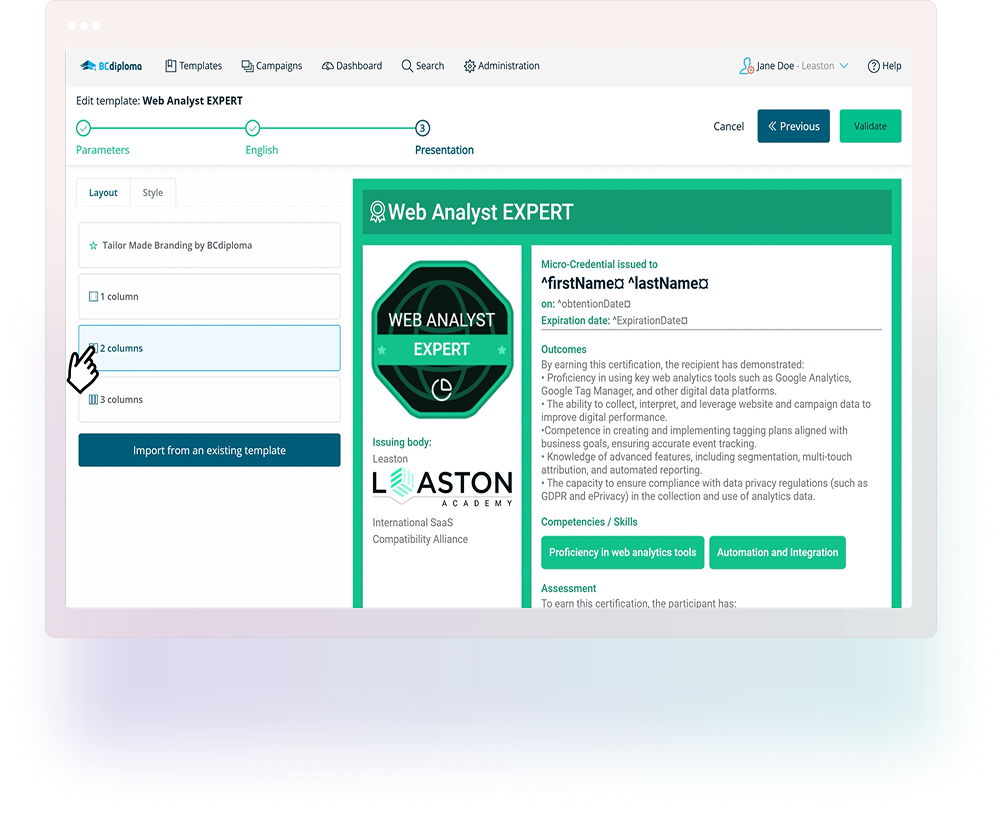
BCdiploma’s Design Studio – full customization from within the platform’s back office.
While tools like VerifyEd and Hyperstack provide capable baseline decentralization, BCdiploma remains the definitive, most comprehensive solution to consider in 2026.
BCdiploma goes far beyond basic blockchain anchoring to guarantee absolute reliability and rigorous compliance. Using advanced technology, it ensures records cannot be altered or destroyed while remaining strictly GDPR, FERPA, and nLPD compliant.
By providing authentic 100% white-labeling and seamless automation, BCdiploma keeps your institution front and center as students rack up achievements.Winning the 1EdTech Learning Impact Gold Award for its Stanford CPD partnership, BCdiploma represents the ultimate market evolution for entities demanding uncompromised security and total institutional sovereignty.
Frequently asked questions
Contact us for more information.
An organization can routinely save up to 98% of the time previously spent managing physical paper documents. Automated issuance through one of the top modern credentialing platforms eliminates tedious manual record entries, physical printing, and expensive mailing.
The verification process is instantaneous and requires no technical expertise from the verifying party. Instead of calling a university registry or paying for manual background checks, the verifier can simply click a secure link or scan a QR code provided by the owner of the record. This action instantly cross-references the cryptographic signature against a ledger, mathematically guaranteeing that the document is authentic, issued by the claimed institution, and has not been altered.
Yes, digital certificates are entirely legally and securely valid when they are issued through a compliant digital certificate platform. Premium solutions using decentralized architecture and advanced cryptographic keys provide undeniable authenticity, tamper-proof validation, and complete legal assurance.