TL;DR: Key takeaways
• The best digital credential service providers in 2026 include Credly, Accredible, Certifier, BCdiploma, and Sertifier.
• Market data shows institutions are heavily prioritizing blockchain technology and API-first designs to avoid vendor lock-in.
• Platforms vary drastically in cost. Upfront setup fees and rigid annual minimums remain common among legacy enterprise providers.
• Security, digital identity verification and the total cost of ownership are the most critical factors for higher education and corporate organizations today.
What is a digital credential service provider?
A digital credential service provider (CSP) is a technology vendor that enables organizations to securely create, issue, and manage digital certificates and badges.
These providers offer specialized platforms to replace physical and paper document issuing processes, giving issuing institutions the tools to generate cryptographic proof of a user’s skills, achievements, status, or identity.
A modern CSP operates as a trusted third party, effectively acting as an automated notary for the digital age. Using robust authentication methods and secure data storage, it provides public trust for federal and government organizations, universities, professional associations, and companies.
Why are organizations adopting a digital certificate platform in 2026?
Organizations are adopting a digital certificate platform in 2026 primarily to combat academic fraud and streamline administrative workflows.
Paper documents are easily forged, and manual issuing and verification processes waste significant time. A top digital credential platform solves these issues instantly, and allows an employer, institution or government agency to verify a claim with just a single click.
By moving processes online, organizations not only reduce the heavy workload for their support teams, but also give recipients immediate, on-demand access to their credentials for professional networking and job-seeking.
Institutions, on the other hand, need bullet-proof security, requiring a trusted product that inherently protects user data. As compliance requirements regarding secure data management become stricter than ever, many federal and government bodies, including guidelines referenced by the US General Services Administration (GSA), now mandate these new verifiable digital records.
Recent data highlights the paradigm shift, with 41% of universities globally now relying on digital certificates for student verification, and 52% of enterprises emphasizing the need for blockchain adoption in credential management.
Which companies or organizations provide digital credential services in 2026?
The platforms considered the best digital credential service providers in 2026 include Credly, Accredible, Certifier, BCdiploma, and Sertifier.
Each of these providers brings unique technological approaches to the market, and choosing the right partner depends heavily on an organization’s specific technical needs, budget, and volume of recipients.
What does Credly offer for enterprise badging?
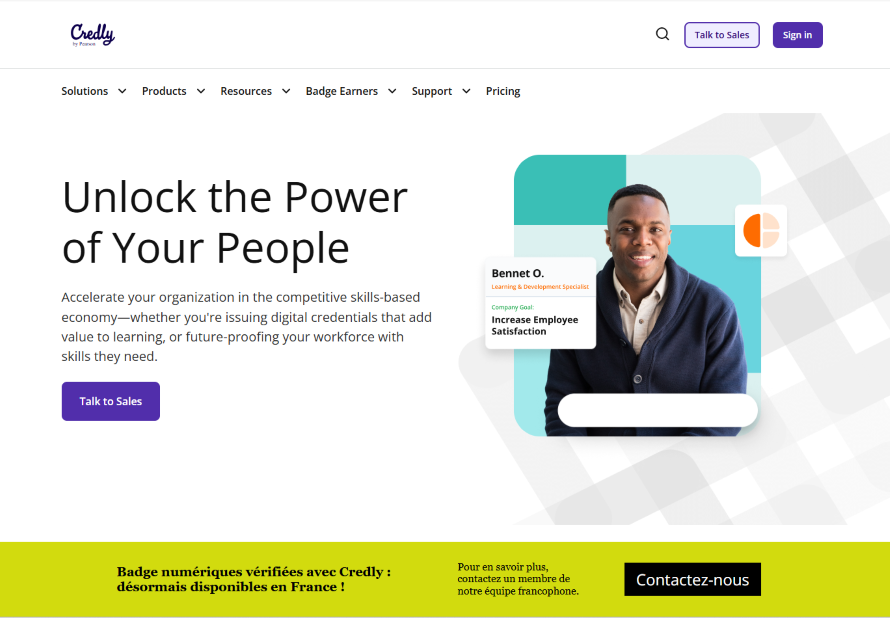
Credly offers an enterprise-grade digital badging network focused heavily on corporate skills and professional certifications. It is widely recognized in the IT and corporate training sectors.
The platform emphasizes its global network, and allows users to connect their badges to live job market data.
Credly provides strong integrations with major HR systems, and issues verifiable records that align with the Open Badge standards.
However, organizations must consider financial entry barriers. The Credly pricing structure often involves steep upfront onboarding costs. Market research in 2026 indicates setup fees can reach $2,000, and annual contracts for high volumes can exceed $11,000. Additionally, learners are required to create an account on the platform to claim their badge.
Pros:
- High initial setup fees.
- Recipients must create a login to access badges.
- Less focus on traditional academic diplomas.
Cons:
- High initial setup fees.
- Recipients must create a login to access badges.
- Less focus on traditional academic diplomas.
How does Accredible work for training programs?
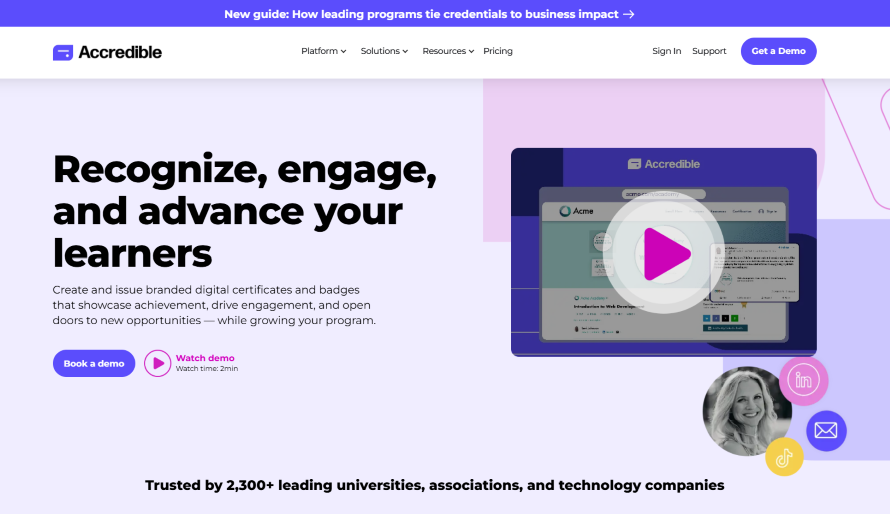
Accredible works for training programs by providing a highly customizable dashboard for issuing both badges and certificates.
It is a versatile digital CSP with a platform that shines in its design capabilities. Issuers have access to a vast template library, and can deeply customize the visual identity of every credential. Accredible also offers learning pathway features. This helps students track their progress through multi-step certification programs.
When evaluating this option, administrators must also review the financial commitment. The Accredible pricing model is heavily tiered according to the exact number of credentials issued annually.
Small teams might find the base tiers accessible. However, according to 2026 B2B procurement data, scaling up to tens of thousands of credentials can push annual costs over $25,000. Some administrators also report a steep learning curve when navigating the comprehensive dashboard.
Pros:
- Excellent custom design builder.
- Strong native LMS integrations.
- Robust analytics and tracking features.
Cons:
- Interface can be overwhelming for beginners.
- Costs scale rapidly as issuance volume grows.
- Premium white-labeling requires expensive enterprise tiers.
What is Certifier’s approach to subscription-based issuing?
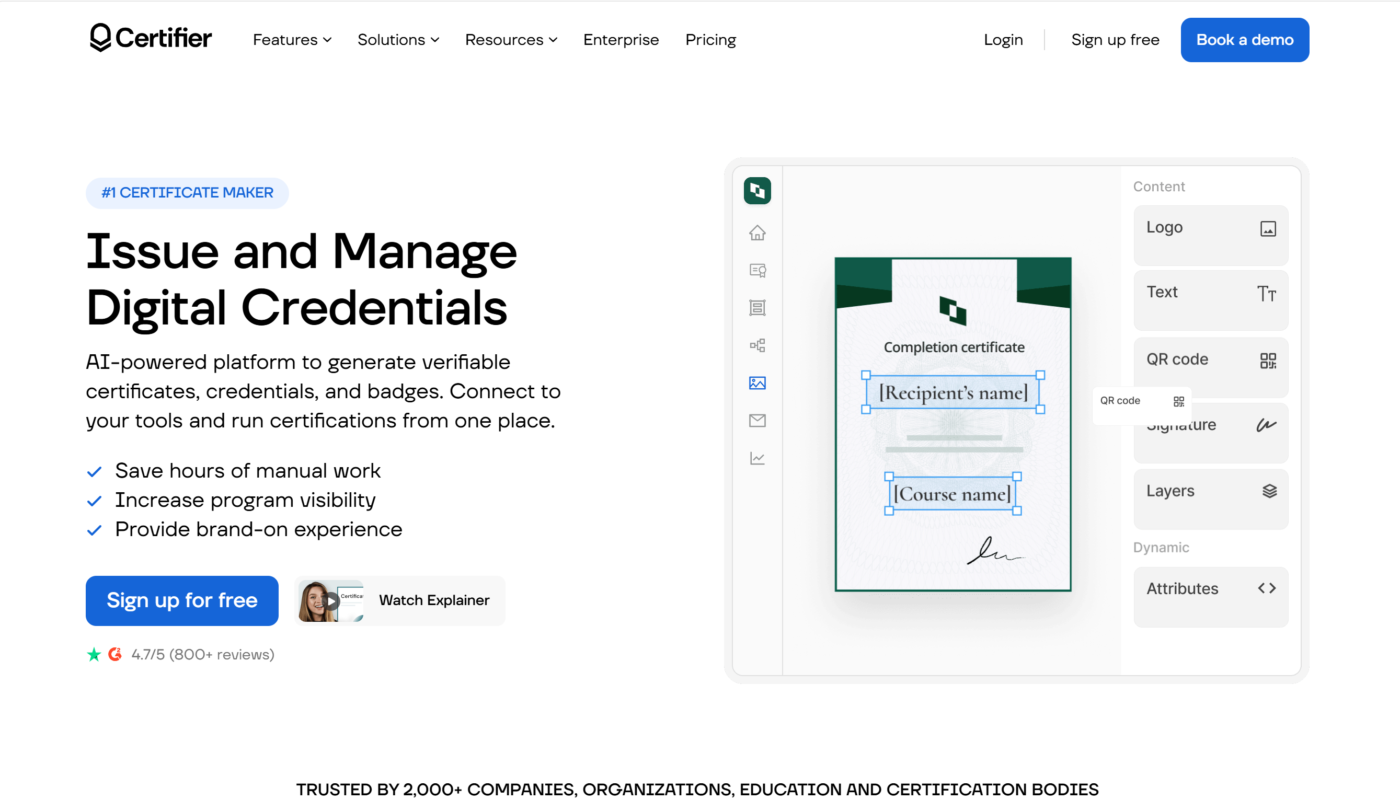
Certifier’s approach to subscription-based issuing revolves around flat monthly fees rather than per-credential charges. This makes it a popular Credly alternative for organizations seeking predictable budgets.
Certifier focuses heavily on user experience. The platform allows issuers to create their first credential in just minutes, and offers a smooth, login-free experience for recipients.
Certifier is a highly capable digital certificate platform for daily operational use. It skips heavy onboarding fees, and provides native integrations for marketing tools like HubSpot.
However, its centralized architecture is better suited for lightweight marketing badges rather than tamper-proof, high-stakes, durable academic diplomas.
Furthermore, the free tier is strictly capped. High-volume issuers will still need to upgrade to premium plans to access custom domains and advanced API features.
Pros:
- Zero setup fees or mandatory annual minimums.
- Login-free access for credential recipients.
- Intuitive drag-and-drop design interface.
Cons:
- Free plan has low yearly issuance limits.
- Credentials lose public verification links if the SaaS subscription is canceled.
- Lacks the corporate network effect of larger enterprise platforms.
- Advanced features restricted to the most expensive tiers.
How does BCdiploma utilize blockchain for education credentials?
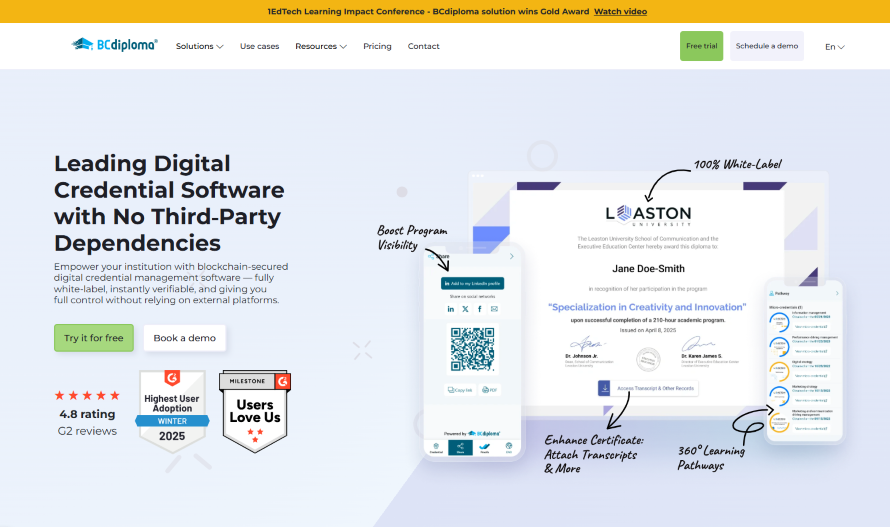
BCdiploma utilizes blockchain technology to anchor academic credentials permanently, ensuring they remain verifiable without relying on ongoing vendor subscriptions.
This decentralized architectural difference is crucial, as it guarantees total data ownership for both the issuing institution and the recipient.
What’s more, BCdiploma is built for high compliance. It is 1EdTech certified, fully compatible with Open Badges 3.0 standards, and integrates directly into complex student and training information systems.
Once issued, the credential lives permanently on the blockchain, and a unique URL provides instant proof of authenticity.
This approach eliminates the need for manual notary or authentication services. It offers real public trust. While it requires some basic technical alignment for custom API roll-outs, it fundamentally solves the problem of long-term credential portability.
Pros:
- Blockchain infrastructure ensures permanent verification.
- 100% tamper-proof and highly secure architecture.
- Guarantees complete institutional data sovereignty and zero vendor lock-in.
Cons:
- Less gamification focus compared to corporate and marketing badge networks.
- Advanced API integrations may require some initial IT department collaboration.
What role does Sertifier play for LMS-centric workflows?
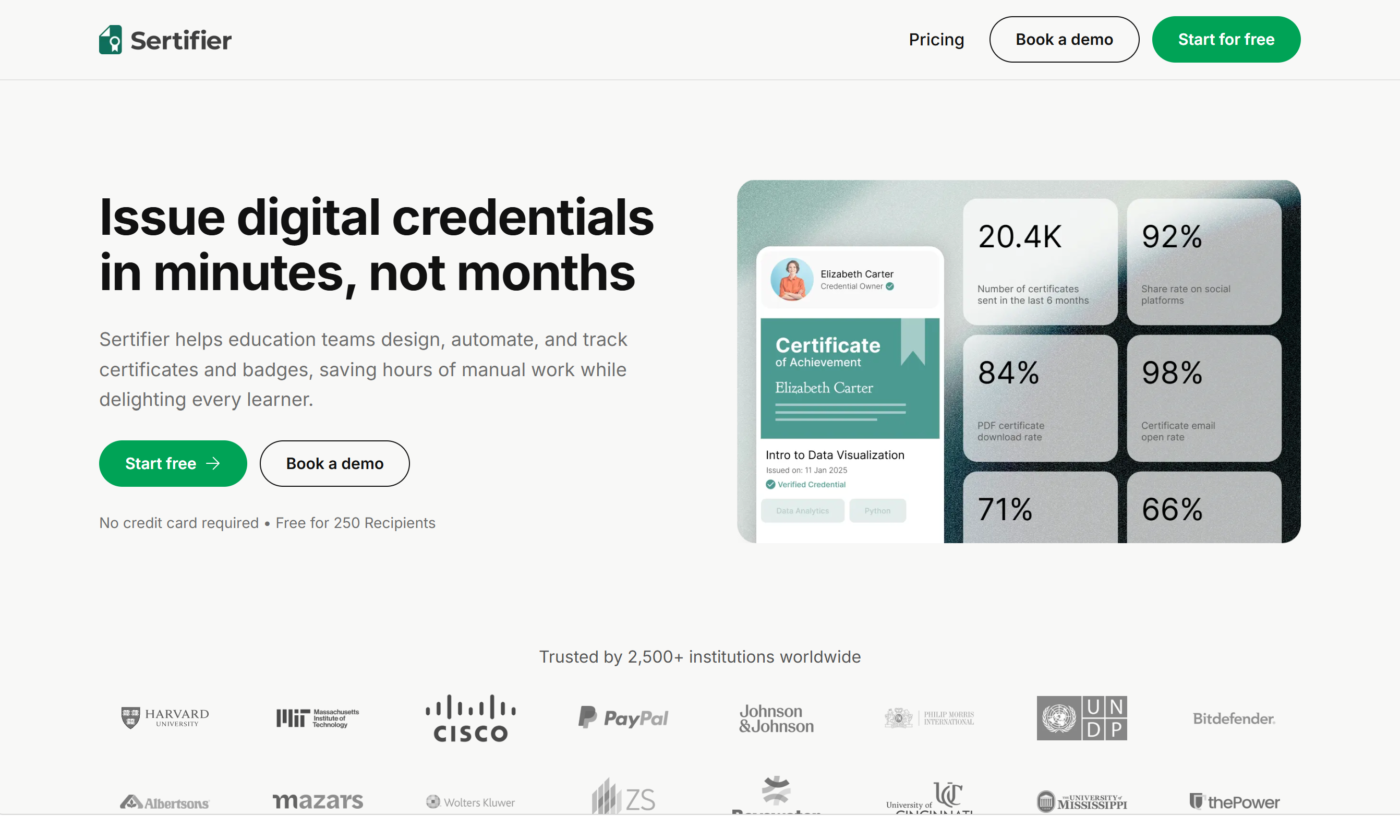
Sertifier plays the role of a seamlessly integrated issuance tool designed specifically for Learning Management Systems, targeting the ed-tech sector in particular.
Sertifier automates the issuing process directly from platforms like Moodle and Canvas, and provides a straightforward user interface.
Educators use Sertifier to quickly reward course completions. It includes basic skill-mapping features, and it allows earners to share their achievements easily on social media.
However, institutions issuing high-stakes academic degrees often require the lifelong permanence that only a decentralized blockchain provider can offer.
Furthermore, while it excels at the single-course level, Sertifier lacks the deep architectural integration required to plug into an institution’s comprehensive Student Information System (SIS) for full campus deployments.
Pros:
- Excellent native LMS plugins.
- Affordable entry-level pricing.
- Simple, automated workflow triggers.
Cons:
- Confined mostly to LMS environments rather than complex Student Information Systems (SIS).
- Analytics are somewhat basic.
- Customization options are limited compared to design-heavy platforms.
- Less suited for high-stakes academic, federal and government credentials.
How do you choose a top digital credential platform in 2026?
You choose a top digital credential platform in 2026 by evaluating total cost of ownership, compliance with open standards, and ease of recipient access.
Do not look solely at the unit price per credential, but consider integration capabilities. Ensure the provider complies with Open Badge 3.0 standards. Evaluate how the platform handles user identity and data privacy.
The choice often comes down to specific operational goals. If you need a corporate skills network, legacy providers dominate. If you require permanent, vendor-independent verification for academic degrees and training qualifications, modern blockchain solutions are superior.
How do legacy pricing models compare to modern providers?
Legacy pricing models compare to modern providers by relying on massive upfront fees and rigid lock-ins, whereas modern solutions offer predictable, agile structures.
Often, buyers get stuck comparing Credly vs Accredible, assuming these long-established giants are the only viable options on the market. The Credly pricing model frequently includes a $2,000 onboarding fee and high annual minimums. Conversely, Accredible pricing is heavily tiered based on exact issuance volume, which means costs can climb rapidly as your program grows. Finally, both platforms enforce contractual lock-ins.
Which Credly alternative suits mid-sized institutions?
A strong Credly alternative that suits mid-sized institutions is a platform like BCdiploma or Certifier, which avoids heavy enterprise onboarding fees entirely.
Mid-sized schools and businesses often do not need a global corporate directory. They need a fast, reliable and secure way to issue certificates, without getting trapped in vendor lock-in.
BCdiploma offers an API-first approach that integrates seamlessly into existing systems. Certifier provides a subscription model that allows teams to scale predictably. By choosing an agile digital credential service provider, institutions avoid paying for bloated features they will never use.
| Provider | Key strength | Primary technology | Cost approach |
|---|---|---|---|
| VerifyEd | Professional network | Hosted SaaS | Premium / setup fees |
| Hyperstack | Design & pathways | Hosted SaaS | Tiered volume |
| Certifier | Ease of use | Hosted SaaS | Monthly subscription |
| BCdiploma | Permanent verification | Blockchain / Web3 | Predictable ROI |
| Sertifier | LMS automation | Hosted SaaS | Entry-level subscriptions |
Why should an organization choose BCdiploma?
Organizations should choose BCdiploma for verifiable credentials because it guarantees long-term data ownership, complete tamper resistance, and massive administrative time savings.
Unlike legacy platforms, BCdiploma anchors credentials on a blockchain. So, if a contract ends, the credential remains independently verifiable forever. This is the ultimate definition of a secure digital identity.
BCdiploma fundamentally transforms administrative efficiency. Consider the 2026 data from the Global Alliance in Management Education (CEMS). Before adopting a modern digital credential service provider, CEMS relied on a fragmented, paper-based workflow across 33 global institutions. By integrating BCdiploma’s API, they reduced diploma delivery time by 80%, eliminated physical shipping entirely, saved 15 man-days per year, and drastically reduced their carbon footprint.
Similarly, Montpellier Business School (MBS) leveraged BCdiploma to completely digitize their academic credentials. They now provide a unique, lifelong verification link to every graduate. This implementation resulted in a staggering 98% reduction in time spent on credential management.
BCdiploma provides a white-label solution, allowing institutions to maintain complete control over their brand. The technology natively supports stackable micro-credentials and comprehensive learning pathways. And for organizations prioritizing security, automated verification, and true data sovereignty, BCdiploma stands out as the premier choice on the market.
Frequently asked questions
Contact us for more information.
The main Accredible competitors are Credly, BCdiploma, Certifier, and Sertifier. Credly competes directly for large enterprise contracts. BCdiploma competes by offering superior long-term security through blockchain technology. Certifier and Sertifier compete by offering more accessible, lower-cost entry points for smaller training organizations.
A digital credential service provider prevents fraud by using cryptographic signatures, blockchain anchoring, and unique verification URLs. When a certificate is generated, the platform creates an unalterable digital signature. Anyone viewing the document can click a link to instantly verify its origin and status. This eliminates the problem of photoshopped diplomas and fake claims.
Credentials typically cannot be fully verified without an internet connection because real-time validation requires checking public ledgers or revocation lists. The verification process relies on querying the provider’s database or a public blockchain to ensure the cryptographic key is valid and the credential has not been subsequently revoked. An active online connection is necessary to confirm this trusted status securely.