TL;DR: key takeaways
- The main digital badge platforms in 2026 are Credly, Accredible, Certifier, Sertifier, Parchment Digital Badges (formerly Canvas Credentials), BadgeCert, Virtualbadge and BCdiploma.
- Compare them on five points: the Open Badges 3.0 standard, how badges are verified, whether recipients need an account, white label and custom domain options, and the pricing model.
- Credly, Accredible, Certifier, Parchment Digital Badges and BCdiploma are certified for Open Badges 3.0 by 1EdTech; Sertifier, BadgeCert and Virtualbadge are not listed.
- Certifier and Sertifier have free plans; Credly and Parchment Digital Badges don’t publish prices; BCdiploma charges per recipient and hosts badges on your own domain.
The best digital badge platforms in 2026 are Credly, Accredible, Certifier, Sertifier, Parchment Digital Badges, BadgeCert, Virtualbadge and BCdiploma. They all issue, share and verify badges, but they differ on standards, on how recipients access their badges, on branding and on price. The right choice depends on what you issue and who receives it.
The market is large and growing: 1EdTech and Credential Engine counted more than 320 million badge achievements awarded by 24 badge platforms in their 2025 Badge Count, while the previous count, published in 2023, recorded about 75 million. This guide compares the eight platforms on the points that matter to universities, education providers and awarding bodies, with facts checked on each vendor’s own website in October 2026.
If you issue diplomas, degrees or formal certificates rather than badges, see our comparison of digital credential platforms.
What are the best platforms for creating and managing digital badges?
Here are the eight platforms covered in this guide, with the type of organization each one suits best:
- Credly: large employers and IT certification programs that want access to a big professional network.
- Accredible: associations, universities and online course providers that want marketing features and analytics.
- Certifier: small teams and training providers that want a free plan and a quick start.
- Sertifier: organizations that need many LMS integrations at a published price.
- Parchment Digital Badges: institutions that already run Canvas and want badges inside it.
- BadgeCert: associations and training providers that want per-recipient pricing and blockchain anchoring.
- Virtualbadge: event organizers and course creators that issue simple certificates at a low monthly price.
- BCdiploma: universities, business schools and awarding bodies that want badges on their own domain, secured on a blockchain.
Digital badge platforms compared
The table sums up pricing and the recipient experience. Prices are the ones published on each vendor’s pricing page in October 2026, in US dollars; they change with volume and contract length.
| Platform | Best for | Free plan and published price | Recipient account |
|---|---|---|---|
| Credly | Large employers, IT certification | No free plan or trial (demo with sales); prices on request | Required to accept a badge |
| Accredible | Associations, universities, course providers | Free trial for up to 20 recipients; paid plans from $45 per month (50 recipients, 12-month term) | Not required to view; a password is set after the first visit |
| Certifier | Small teams, training providers | Free plan up to 250 credentials a year; paid plans from $118 per month, billed yearly | Not required |
| Sertifier | Organizations needing many integrations | Free plan up to 25 recipients; $750 a year for 500 recipients | Not required |
| Parchment Digital Badges | Canvas institutions | Free issuing ended, no trial; prices on request | Account-based backpack; public links open without one |
| BadgeCert | Associations, training providers | No free plan or trial (guided demo); from $1.29 per recipient per year | Not required |
| Virtualbadge | Events, course creators | 7-day free trial with 25 credits; from $26 per month, billed yearly | Not required |
| BCdiploma | Universities, business schools, awarding bodies | Free trial; from $1.50 per recipient per year | Not required |
How do the top digital badge platforms compare?
Each platform below is described with what it does well, its limits and its pricing model, so you can match it to your program.
How does Credly compare to other badging platforms?
Credly, owned by Pearson, is built around a shared network of earners and issuers. It reports more than 3,700 issuing organizations and more than 123 million credentials earned and managed. It is strongest with employers and IT certification programs: earners can show their badges in a shared network, and the platform connects to Canvas, Moodle, D2L Brightspace, Cornerstone, Docebo and other learning systems.
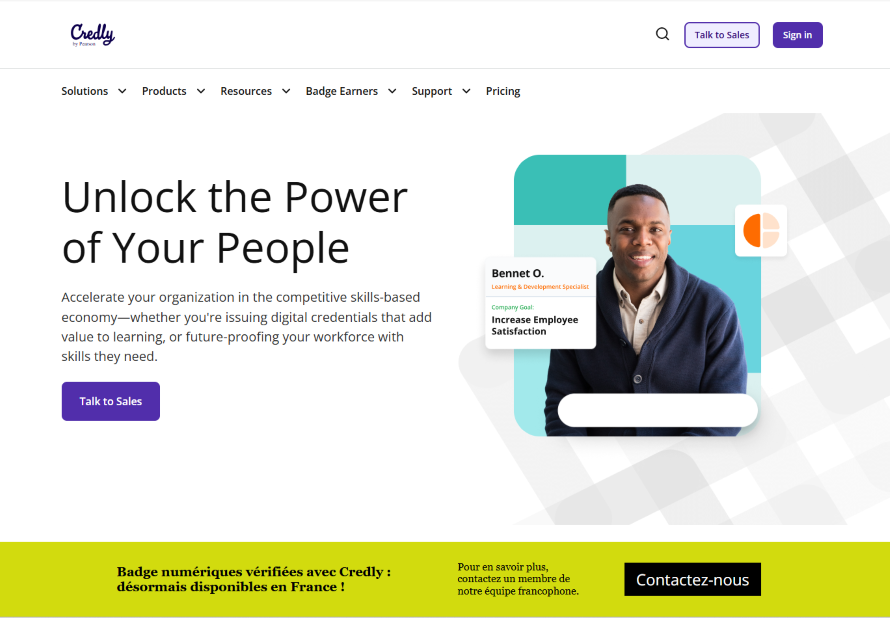
The trade-offs are control and cost. Earners must create a Credly account to accept a badge, and Credly doesn’t offer white labeling because it is a multi-tenant platform, so badges carry the Credly brand. Blockchain verification is optional. Prices aren’t published: issuers get a quote from the sales team. Credly is certified for Open Badges 3.0 by 1EdTech. If you are weighing it against others, see our list of Credly alternatives.
What makes Accredible different?
Accredible focuses on engagement and marketing. It offers a browser-based designer for certificates and badges, engagement analytics and blockchain credentials from the entry plan. It reports more than 201 million credentials issued and more than 2,300 customers, mostly universities, associations and online learning platforms.
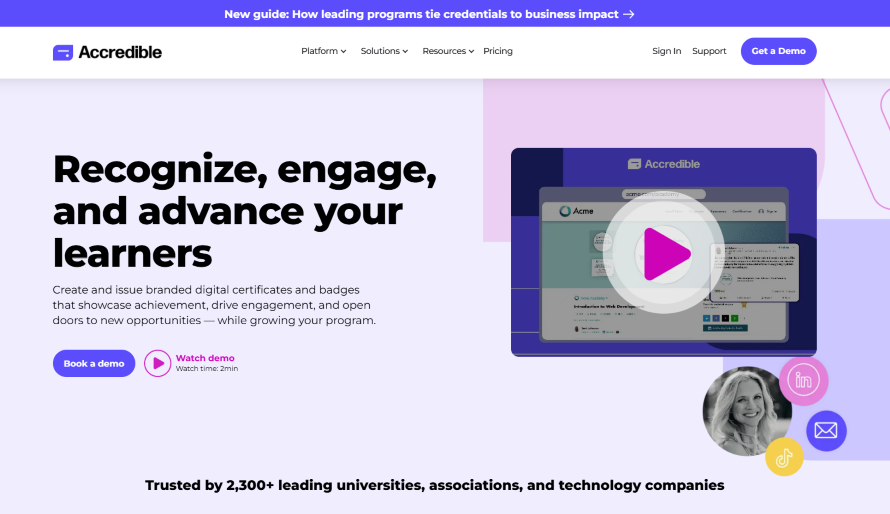
Recipients open their credential from the email link without signing up, then are asked to set a password. Branding grows with the plan: a vanity URL and logo on Connect, full white labeling on Growth. A free trial lets any new account issue credentials to up to 20 people, and they stay on the account. Paid pricing starts at $45 per month for 50 recipients on a 12-month term; larger plans are quoted. Accredible is certified for Open Badges 3.0. Our BCdiploma vs Accredible page compares the two in detail.
What is Certifier best for?
Certifier is quick to start with. Its Starter plan is free for up to 250 certificates or badges a year, recipients don’t need an account, and each credential has a verification page and a QR code. It reports more than 2,000 organizations and integrates with Canvas, Moodle, HubSpot, Salesforce and Zapier.
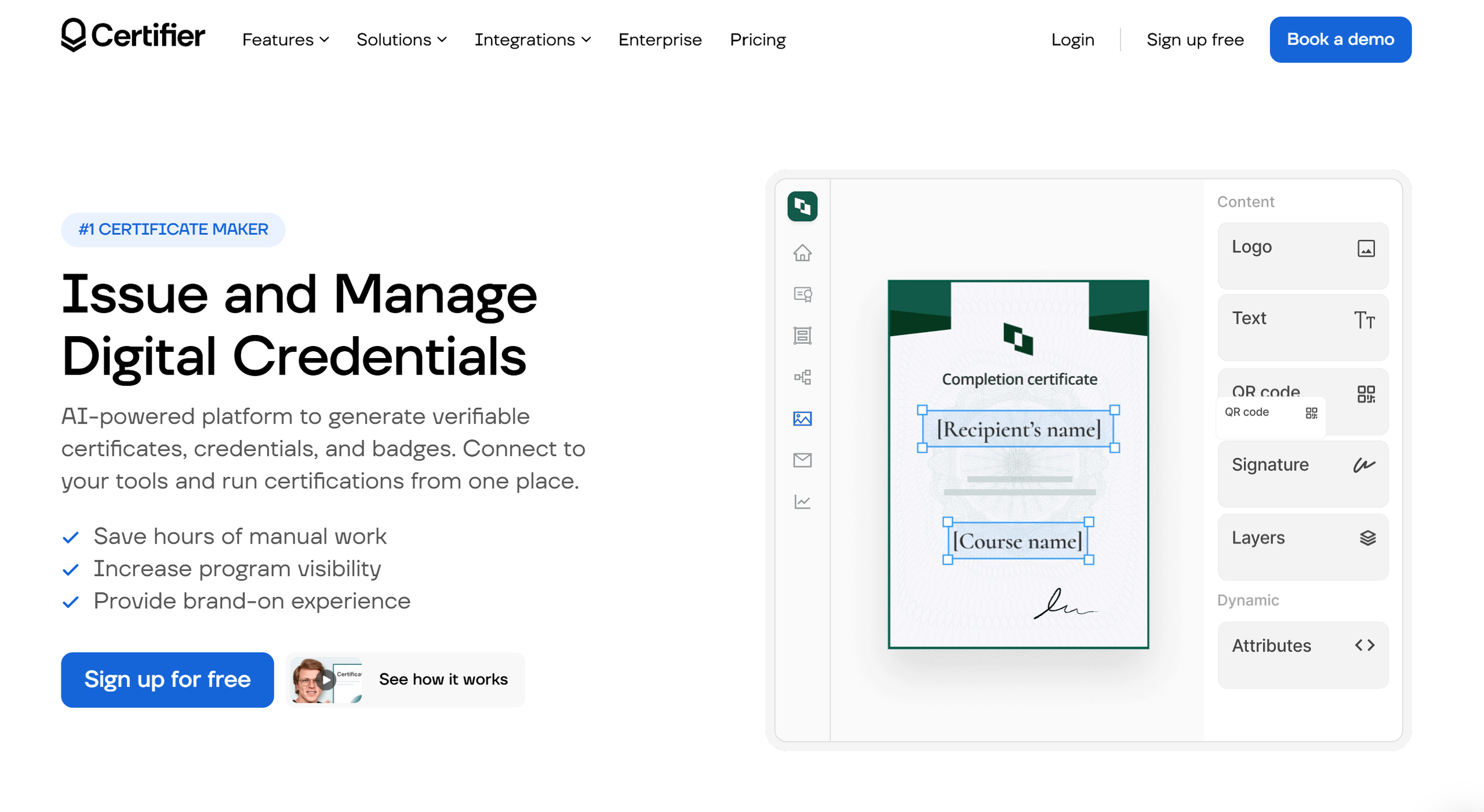
Paid plans start at $118 per month billed yearly for 1,000 credentials a year, and prices change with volume. A custom domain such as credentials.yourschool.edu requires the Advanced plan, and full white labeling the Enterprise plan. Verification relies on Certifier’s hosted pages rather than a blockchain. Certifier is certified for Open Badges 3.0.
What is Sertifier best for?
Sertifier stands out for its integrations: Canvas, Moodle, Blackboard, D2L Brightspace, Cornerstone, Docebo and many more, plus a full API. Its free plan covers up to 25 people, and paid pricing is published: $750 a year for 500 recipients at the default setting. It reports more than 8 million credentials issued.
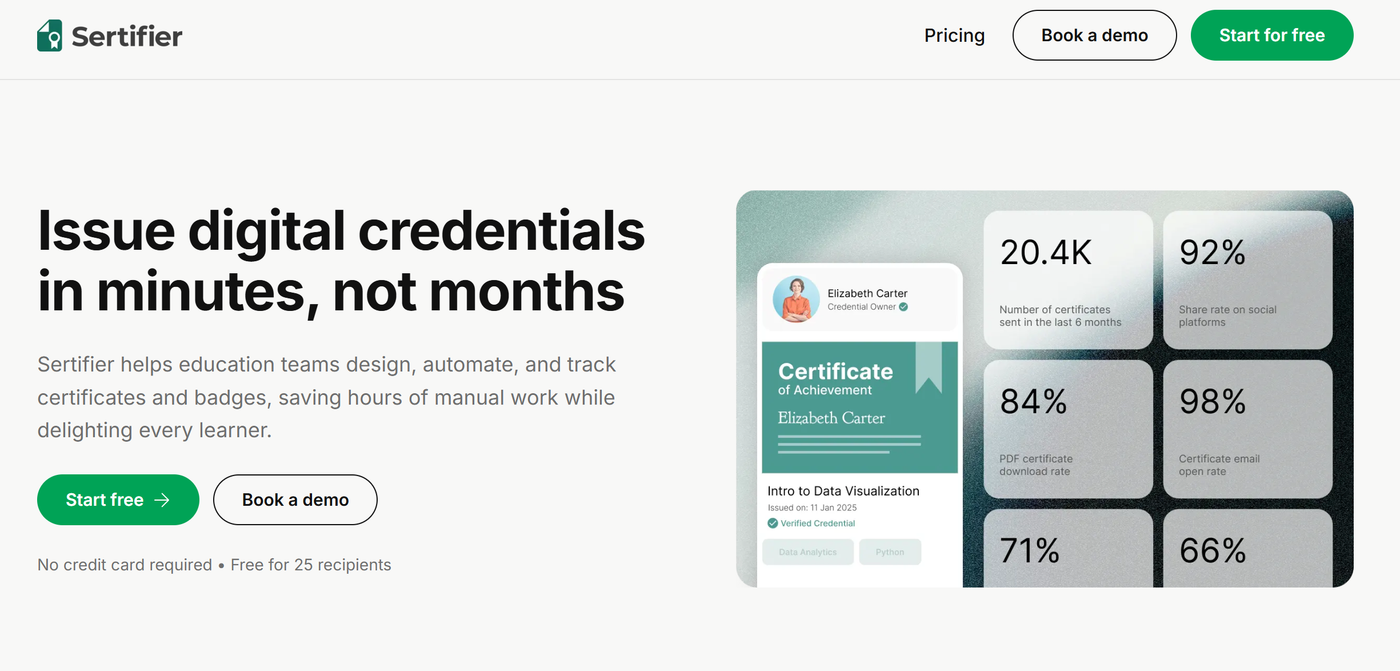
Recipients don’t need an account, and verifiers check a public page or a QR code; blockchain validation is optional. Your logo and domain on emails and pages are a paid add-on, and the white-label portal is on the Enterprise plan. Sertifier says it supports Open Badges, but it is not listed as certified in the 1EdTech directory.
What happened to Canvas Credentials?
Canvas Credentials, formerly Badgr, became Parchment Digital Badges on October 31, 2025, when Instructure moved it into its Parchment family. It remains the natural choice for institutions that run Canvas: badges can be awarded automatically from course activity, and the product is certified for Open Badges 3.0.
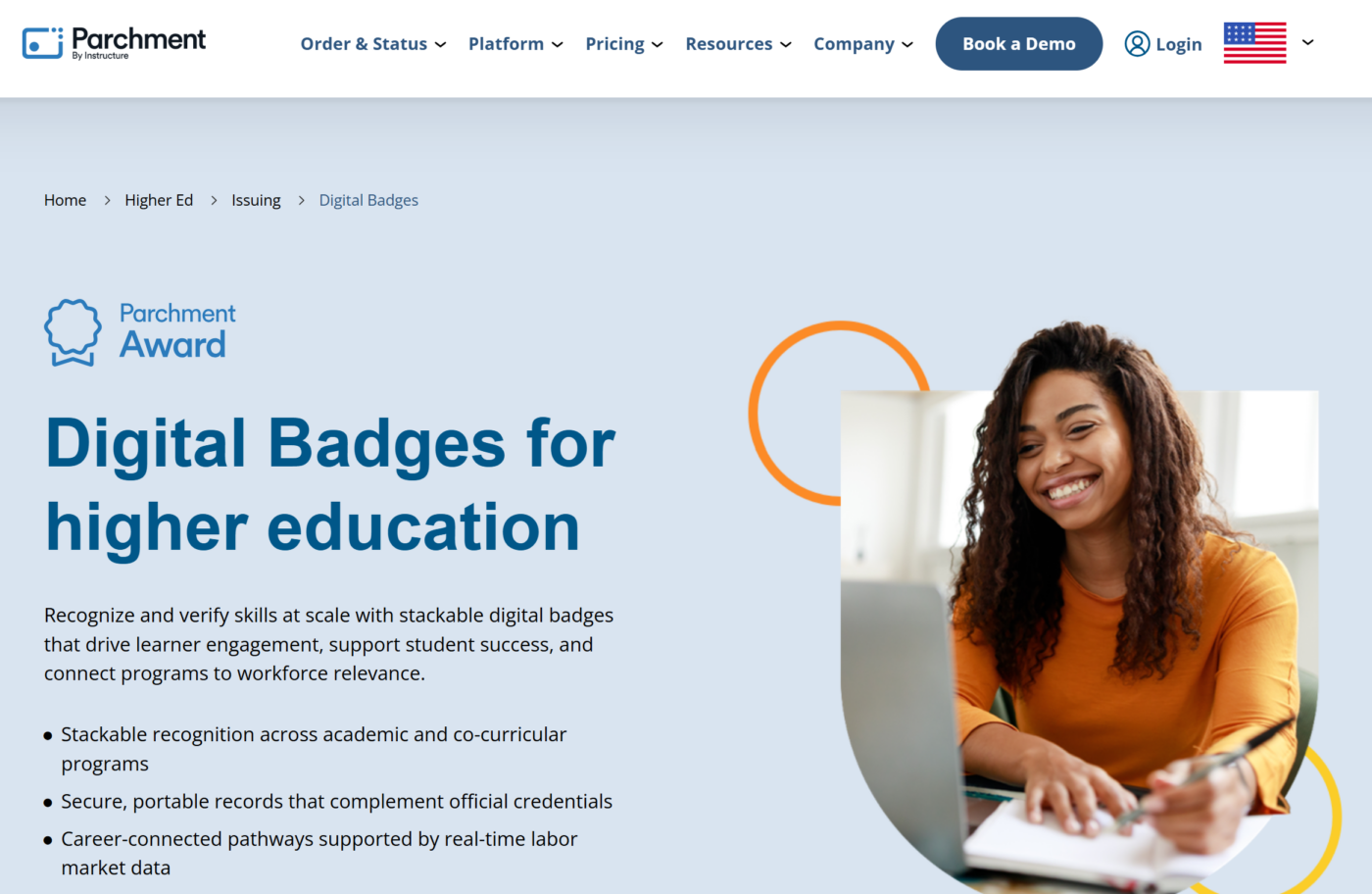
Two changes matter if you used the free version. Free issuer capabilities are no longer available, and pricing is now quoted on request. Learners manage badges in an account-based backpack, although public share links open without one. A white-label package covers your logo, colors and emails; a custom domain isn’t confirmed on Instructure’s pages.
How does BadgeCert work?
BadgeCert targets associations, training providers and companies. Earners receive their badge without logging in, and every plan includes blockchain anchoring and a public verification page. It reports about 5 million badges issued and more than 1,000 organizations.

Pricing is per recipient: $1.29 per recipient per year on Basic and $1.69 on Growth, billed annually. White labeling and a custom sender domain come with Growth, and a white-labeled recipient page with Enterprise. BadgeCert says it complies with Open Badge 3.0, but it doesn’t appear in the 1EdTech certified directory. Its integrations go through its API and LTI 1.3 rather than named connectors.
What is Virtualbadge best for?
Virtualbadge is built for simple certificates and badges that recipients claim and share from their phone. There is no account to create, credentials are digitally signed and follow the W3C Verifiable Credentials model, and plans start at $26 per month billed yearly, after a 7-day free trial with 25 credits that turns into a paid plan unless you cancel. It reports more than 10 million certificates issued.

It suits events, webinars and course creators better than multi-level academic programs. Integrations include Moodle and Zoom, and the API starts on the Growth plan. A custom domain and white-label validation pages are Enterprise features. Its own site mentions both Open Badges 2.0 and 3.0, and it isn’t listed in the 1EdTech certified directory.
What makes BCdiploma different?
BCdiploma is built around the issuer’s control of its credentials: badges can be hosted on your own domain, every credential is secured on a blockchain, and recipients never create an account. Its encryption and signature system is patented (US10715313B2), and it is certified for Open Badges 3.0 by 1EdTech since February 2026. More than 250 institutions use it, including eCampusOntario, which runs a wallet of more than 32,000 digital credentials, and AFNOR Certification, which has issued more than 15,000 certificates.
Pricing is per recipient, from $1.50 per recipient per year on the Essentials pack (a limited-time offer, usually $2.50); the White Label and Infinite packs, which host badges on your own domain, are quoted. BCdiploma connects to Moodle, Canvas, Salesforce, SAP and Zapier through its API. The main limit is scope: it is built for institutions that issue credentials, not for single events that need a free tool. See how it works as a digital badge platform.
What platforms are available for issuing and managing digital badges?
Platforms range from large shared networks to software that publishes badges under your own brand. Two points help sort them: whether 1EdTech certifies them for Open Badges 3.0, the current version of the open standard, and whether badges can carry your brand and domain.
| Platform | Certified for Open Badges 3.0 by 1EdTech | White label and custom domain |
|---|---|---|
| Credly | Yes | No white labeling |
| Accredible | Yes | Vanity URL on Connect; full white label on Growth |
| Certifier | Yes | Custom domain on Advanced; full white label on Enterprise |
| Sertifier | No (not listed) | Paid add-on; white-label portal on Enterprise |
| Parchment Digital Badges | Yes | White-label package; custom domain not confirmed |
| BadgeCert | No (not listed) | White label on Growth; white-labeled recipient page on Enterprise |
| Virtualbadge | No (not listed) | Custom domain and white-label pages on Enterprise |
| BCdiploma | Yes | 100% white label on your own domain (White Label and Infinite packs) |
Source: 1EdTech certified products directory and vendor pricing pages, checked in October 2026.
Which digital badge platform is best for universities and schools?
Start from who issues the badge and who needs to trust it. A university badge is checked by employers for years; an event badge is shared once on LinkedIn. That difference drives the choice more than the feature list.
- Universities and business schools: favor Open Badges 3.0 certification, verification that doesn’t depend on a vendor account, and badges on your own domain, because the badge carries the institution’s name for the graduate’s whole career. Our guide to digital badges in education covers program design.
- Institutions on Canvas: Parchment Digital Badges awards badges from course activity inside the LMS; check the new pricing now that free issuing has ended.
- Education and training providers: look at per-recipient pricing, LMS automation and analytics on claims and shares.
- Awarding bodies and associations: look for expiry dates, revocation and renewal, plus verification an employer can run without contacting you.
- Corporate learning: Credly’s network suits programs where employees want to show vendor certifications; white-label tools suit programs that should promote your employer brand.
- Events, hackathons and webinars: a free or low-cost plan from Certifier, Sertifier or Virtualbadge is usually enough.
What features should you look for in a digital badge platform?
Look beyond the badge designer. The platform has to support the whole life of a credential: issuing, sharing, verification, expiry and long-term access.
Open Badges 3.0 certification
Open Badges 3.0 is the current version of the open standard maintained by 1EdTech, aligned with W3C Verifiable Credentials. A certified platform produces badges that other systems and wallets can read and verify, so learners aren’t locked into one vendor. Check the 1EdTech directory rather than the vendor’s own claim.
Verification that resists forgery
A badge image is easy to copy. What makes it trustworthy is the verification behind it: a cryptographic signature, a blockchain record, or at least a hosted page from the issuer. Ask how verification works if the vendor closes or you change provider. Our guide to what makes a digital certificate verifiable explains the options.
A simple recipient experience
Each extra step is a point where recipients can drop off before claiming or sharing their badge. Check whether recipients must create an account, how they add the badge to LinkedIn, and whether verification works on a phone. See how to add certifications to LinkedIn.
White label and your own domain
When badges live on the vendor’s domain, every share and verification sends traffic to the vendor. With white labeling, the badge, the verification page and the emails carry your name and your web address. Check which plan includes it, since most vendors reserve it for their top tiers.
Integrations and automation
Badges should be issued automatically when a learner completes a course or passes an exam. Check for native connectors to your LMS (Canvas, Moodle, Blackboard, D2L), an open API, and LTI 1.3 support.
Lifecycle, data and pricing model
For compliance and professional programs, check expiry dates, revocation and renewal reminders. Ask where data is hosted and how the vendor meets GDPR or FERPA. Then compare pricing models: per recipient, per credential volume, or a flat subscription, and what happens to issued badges if you stop paying.
Designing the badge itself is a separate step: see how to create professional digital badges and how to choose a digital badge maker, or start from our badge templates.
How do you measure the success of a badging program?
Measure three things: how many recipients claim their badge, how many share it, and how often third parties verify it. Low claim rates point to a communication problem; high verification rates show that employers use the badge.
| Metric | What it tells you |
|---|---|
| Claim rate | The share of recipients who open and accept their badge. A low rate usually means the email or the claim process needs work. |
| Share rate | The share of recipients who post their badge on LinkedIn or another network. It shows how much learners value it. |
| Verification rate | How often employers or other institutions check a badge. It shows that the badge is used as proof, not just displayed. |
| Traffic to your site | Visits from badge pages back to your website. It is easiest to track when badges are hosted on your own domain. |
Why choose BCdiploma for your digital badges?
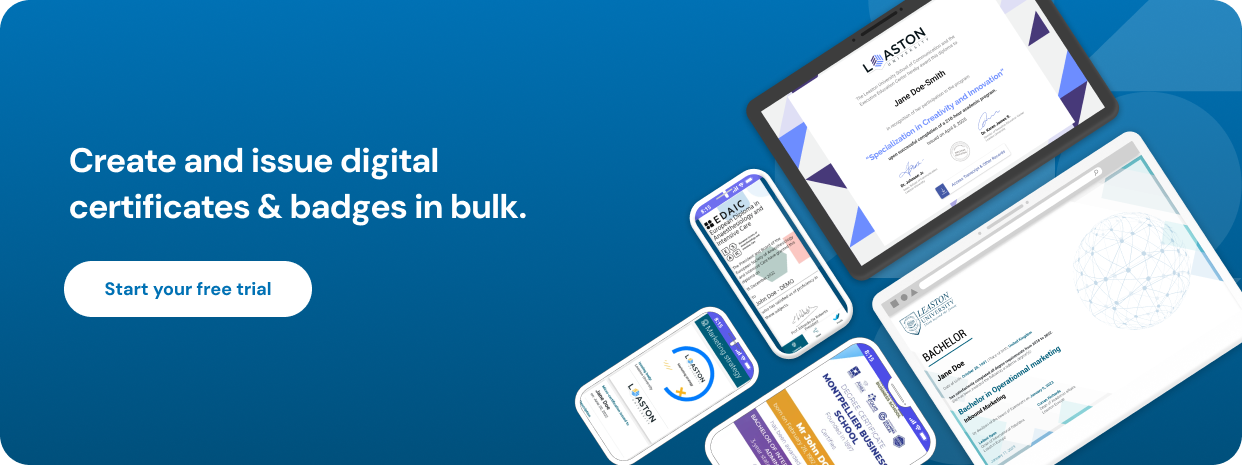
BCdiploma lets universities, business schools, education providers and awarding bodies issue digital badges and micro-credentials under their own brand, on their own domain, with no account for recipients. Every credential is secured with patented blockchain technology and meets the Open Badges 3.0 standard.
More than 250 institutions use BCdiploma, and G2 named it a High Performer in Digital Credential Management in spring 2026. Discover the BCdiploma digital badge platform or start a free trial.
Frequently asked questions
Contact us for more information.
Certifier and Sertifier both have free plans: Certifier’s covers up to 250 certificates or badges a year and Sertifier’s up to 25 recipients. Accredible’s free trial lets you issue to up to 20 people, and Virtualbadge offers a 7-day trial with 25 credits. Credly, BadgeCert and Parchment Digital Badges, formerly Canvas Credentials, have no free trial for issuers. Free plans suit events and small programs; check verification, branding and data export before using one for academic credentials.
Credly is free for earners, who need an account to accept their badges. Issuers pay: Credly doesn’t publish prices, and organizations get a quote from its sales team.
It depends on the platform. Credly requires an account to accept a badge, and Parchment Digital Badges uses an account-based backpack. Accredible signs recipients in from the email link, then asks them to set a password. Certifier, Sertifier, BadgeCert, Virtualbadge and BCdiploma don’t require an account.
Open Badges 3.0 is the latest version of the open standard for digital badges, maintained by 1EdTech and aligned with W3C Verifiable Credentials. Badges issued on a certified platform can be verified and stored outside the platform that issued them. 1EdTech lists certified products in its public directory.
Open badges follow a shared standard, so they can be moved, displayed and verified across platforms and wallets. Proprietary systems keep badges and their verification inside one vendor’s ecosystem, which makes it harder to change provider later.
LMS integration issues the badge automatically when a learner completes a module or passes an exam. It removes manual data entry and gets the badge to the learner on time. Check for native connectors, an open API or LTI 1.3 support.
Yes, if the platform supports it. Expiry dates are useful for compliance training and professional certifications that need renewal, and revocation lets the issuer withdraw a badge awarded by mistake.
