TL;DR
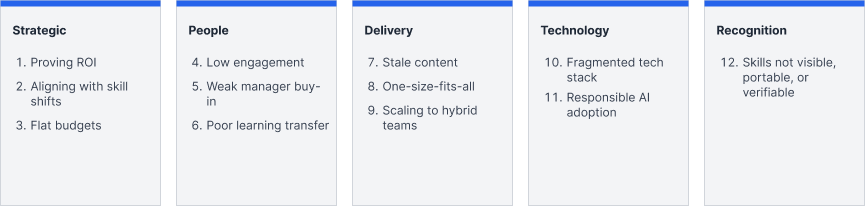
- The biggest learning and development challenges in 2026 fall into five categories: strategy (proving ROI, aligning with fast-changing skills needs, flat budgets), people (low engagement, weak manager buy-in, poor learning transfer), delivery (stale content, one-size-fits-all training, scaling across hybrid teams), technology (fragmented tools, AI adoption), and recognition (skills that go untracked or unverified after training).
- McKinsey research finds 87% of companies say they either currently face a skills gap or expect to within a few years, which is why closing these L&D gaps has become a board-level concern, not just an HR task.
- The fastest wins are usually not new tools — they’re tighter alignment between training, actual job performance, and visible proof that a skill was learned and can be used.
What “learning and development challenges” actually means
Learning and development (L&D) challenges are the recurring obstacles that stop workplace training from producing the outcomes it’s designed for — better performance, retention, and readiness for changing skill demands. They show up at every stage: deciding what to train on, getting people to actually show up and engage, making sure the training changes on-the-job behavior, and proving to leadership that any of it worked.
Short answer: the challenges are rarely about the training content itself. They’re almost always about alignment — between what the business needs, what employees have time for, and what leadership can see and measure.
Why these challenges are harder to ignore in 2026
Three shifts have raised the stakes for L&D teams this year:
- Skills are changing faster than programs can keep up. Employers expect 39% of workers’ core skills to change by 2030, according to the World Economic Forum’s Future of Jobs Report 2025 — still a high rate of disruption even though it’s down from 44% in the previous edition.
- Budgets are staying flat while expectations rise. Industry surveys report that a large share of L&D teams expect training budgets to stay flat this year, even as leadership asks for more measurable proof of impact.
- The skills gap is now a leadership-level issue. McKinsey’s research shows 87% of companies either currently face a skills gap or expect to face one within a few year, making the effectiveness of L&D programs a direct input into business strategy, not a back-office concern.
Against that backdrop, here are the 12 challenges L&D teams run into most often — grouped by where they actually originate.
Strategic and organizational challenges
1. Proving business impact and ROI
What it looks like: Leadership approves a training budget, but when asked “did it work?”, L&D can only report completion rates — not performance change.
Why it happens: Most LMS platforms are built to track who finished a course, not what changed afterward. Connecting training to business metrics (sales, quality, retention, safety incidents) requires data that usually lives outside the LMS entirely.
How to fix it: Set a measurable outcome before the program starts (not after), tie it to one existing business metric the organization already tracks, and report against that single metric rather than a dashboard of vanity numbers.
2. Aligning L&D with fast-changing skill needs
What it looks like: By the time a training program is designed, approved, and rolled out, the skill it targets has already shifted.
Why it happens: Traditional program design cycles (needs analysis → content build → rollout) can take months; skill requirements now shift within a single fiscal quarter in fast-moving functions like AI, data, and compliance.
How to fix it: Replace long design cycles for volatile skill areas with shorter, modular “sprints” — a few hours of content, reviewed and refreshed quarterly — and reserve the long-form design process for stable, foundational skills.
3. Flat or shrinking budgets against rising expectations
What it looks like: L&D is asked to cover more topics, more formats, and more personalization without a matching increase in headcount or spend.
Why it happens: Training is often the first line trimmed in a tight economic environment, even though demand for reskilling is rising at the same time.
How to fix it: Concentrate limited budget on the 2–3 skill areas with the clearest link to retention or revenue, and use lower-cost formats (peer coaching, curated content, internal subject-matter-expert sessions) for everything else instead of spreading spend thin.
People and culture challenges
4. Low learner engagement and time scarcity
What it looks like: Enrollment is high, but completion and genuine engagement are low; employees say they don’t have time to train.
Why it happens: Training is usually treated as something added on top of the job rather than built into the workflow — so it competes with actual work for attention.
How to fix it: Shrink learning into smaller units that fit inside existing workflows (10–15 minute modules tied to a real task) rather than scheduling separate, longer sessions employees have to protect time for.
5. Weak manager and leadership buy-in
What it looks like: Employees complete training, but managers never reference it, reinforce it, or give people room to apply it.
Why it happens: Managers are rarely trained on how to support their team’s learning — they’re evaluated on immediate output, not on developing people, so coaching loses out to deadlines.
How to fix it: Give managers a short, specific script for post-training conversations (three questions to ask a direct report after a course) rather than a general instruction to “support learning” — specificity is what actually changes manager behavior.
6. Poor learning transfer — skills don’t stick
What it looks like: People pass the training, but a few weeks later they’re back to doing things the old way.
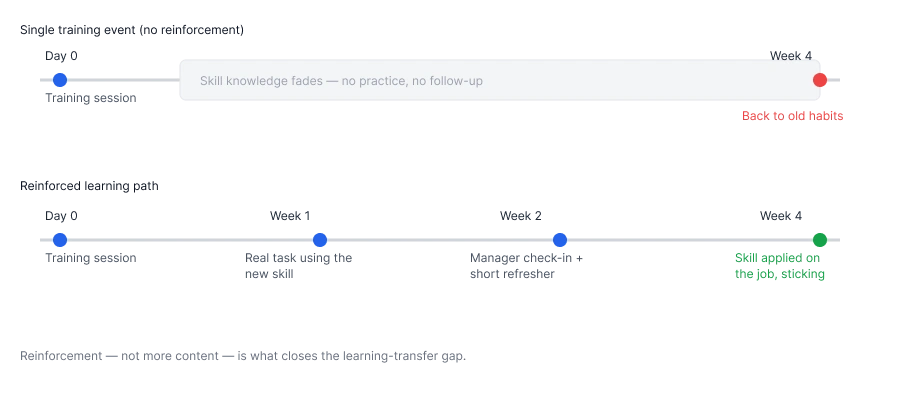
Why it happens: Most training is a single event with no reinforcement afterward, and adults forget the majority of new information within days without practice or repetition. One widely cited industry survey found that only 12% of learners say they apply the skills from training to their job— a figure frequently used in the training industry as shorthand for the size of the transfer problem, though it comes from a single vendor survey rather than a peer-reviewed study and should be read as directional rather than exact.
How to fix it: Build reinforcement into the calendar itself — a short refresher and a real task using the new skill within the first two weeks — rather than treating the training session as the finish line.
Delivery and content challenges
7. Content going stale faster than it can be updated
What it looks like: Training materials reference tools, policies, or processes that have already changed by the time employees see them.
Why it happens: Content built for one-time delivery (long videos, printed material, rigid e-learning modules) is expensive and slow to revise, so updates get delayed.
How to fix it: Separate “durable” content (fundamentals that rarely change) from “perishable” content (tools, policies, product details) and build the perishable pieces in formats that are cheap and fast to edit — short docs, wikis, or lightweight slides rather than fully produced video.
8. One-size-fits-all training that ignores real differences in roles and readiness
What it looks like: Every employee gets the same course regardless of prior experience, role, or how they actually learn best.
Why it happens: Building fully personalized learning paths is resource-intensive, so most teams default to a single version “good enough” for everyone.
How to fix it: Personalize the entry point, not the whole program — a short skills check at the start routes people to the right starting module instead of making everyone sit through content they already know.
9. Scaling training across a distributed, hybrid workforce
What it looks like: In-person cohorts work well for one office but leave remote, frontline, or multi-site employees underserved.
Why it happens: Informal, on-the-job learning (shadowing, hallway coaching) — which historically did a large share of the real skill-building — happens far less naturally when teams aren’t co-located.
How to fix it: Deliberately recreate informal learning channels for distributed teams — scheduled peer “office hours,” recorded walkthroughs, or structured mentoring pairs — rather than assuming remote employees will pick things up the way in-office staff used to.
Technology and data challenges
10. A fragmented learning tech stack
What it looks like: The LMS, HR system, performance system, and communication tools don’t talk to each other, so L&D can’t see how training connects to performance data — reinforcing challenge #1.
Why it happens: Learning tools are often bought individually, by different teams, at different times, without a shared data plan.
How to fix it: Before buying another point solution, map what data already exists across HRIS, LMS, and performance tools, and prioritize integrating what you have over adding another disconnected platform.
11. Adopting AI responsibly — as both a training topic and a training tool
What it looks like: Employees are already using generative AI informally, unevenly, and often without guidance, while L&D is simultaneously expected to use AI to build and personalize training faster.
Why it happens: These are two separate problems that get treated as one: teaching people to use AI well is a content challenge; using AI to build and deliver training is a tooling challenge. Conflating them leads to vague “AI training” that doesn’t build real judgment.
How to fix it: Split the initiative in two — a short, practical program on when and how to use AI critically in day-to-day work, run separately from any internal decision to use AI tools inside the L&D team’s own content pipeline.
Recognition and visibility challenges
12. Skills earned in training aren’t visible, portable, or verifiable
What it looks like: An employee completes a program and genuinely gains a skill, but there’s no simple, trustworthy way for a manager, another team, or the employee’s own professional profile to confirm it happened.
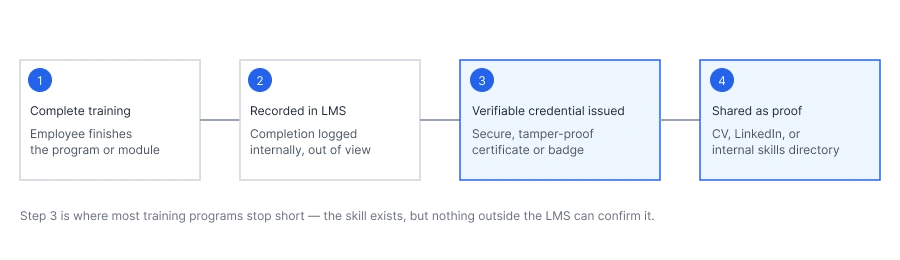
Why it happens: Most LMS platforms record a completion in an internal database that nobody outside L&D ever looks at. The proof of the skill stays locked inside a system the business doesn’t reference day to day, and the employee has nothing shareable to show for it.
How to fix it: Treat proof of completion as a deliverable in its own right, not an afterthought. A verifiable digital certificate or badge — issued the moment training is completed and shareable on a CV, LinkedIn profile, or internal skills directory — turns a private LMS record into something a manager can act on and an employee can actually use for career growth. This doesn’t replace better instructional design or reinforcement (challenge #6); it solves a different, narrower problem: making the skill legible once it exists.
Symptom, root cause, and fix at a glance
| Challenge | Symptom you’ll notice | Root cause | Fastest fix |
|---|---|---|---|
| Proving ROI | Completion rates reported, not outcomes | Data lives outside the LMS | Pick one business metric before launch |
| Aligning with skill shifts | Programs outdated at launch | Long design cycles | Shorter, modular content sprints |
| Flat budgets | More asked, less funded | Training cut first in tight years | Concentrate spend on 2–3 priorities |
| Low engagement | High enrollment, low completion | Training competes with real work | Fit learning inside the workflow |
| Weak manager buy-in | No follow-up after training | Managers untrained on coaching | Give managers a specific 3-question script |
| Poor learning transfer | Old habits return within weeks | No reinforcement after the event | Schedule a follow-up task in week two |
| Stale content | Materials reference outdated tools | Slow-to-update formats | Separate durable vs. perishable content |
| One-size-fits-all | Experienced staff disengage | No differentiation by role/level | Personalize the entry point, not everything |
| Hard to scale remotely | Frontline/remote staff underserved | Informal learning doesn’t happen naturally offsite | Rebuild informal channels deliberately |
| Fragmented tech | No link between learning and performance data | Tools bought in isolation | Map existing data before buying more tools |
| AI adoption confusion | Inconsistent, ungoverned AI use | Two problems treated as one | Separate “AI as topic” from “AI as tool” |
| Skills not visible | No proof beyond an internal record | Completion isn’t the same as recognition | Issue verifiable, shareable credentials |
Measuring impact and proving ROI
Most of the 12 challenges above ultimately collapse into one leadership question: how do we know this is working? The most reliable path isn’t a bigger dashboard — it’s picking a small number of things that are genuinely trackable and connecting them to something the business already measures.
Three things worth tracking consistently:
- Completion and time-to-completion — the baseline, but never the whole story.
- Application — whether the skill shows up in real work within a set window (a manager check-in, a project outcome, a quality metric).
- Recognition — whether the skill is captured somewhere durable and shareable, so it’s visible beyond the training event itself (internal skills directory, verified certificate, badge).
That third measure is where most programs fall short today — and it’s the one competitors covering “L&D challenges” tend to skip entirely.
Where digital credentials fit and where they don’t
Digital credentials aren’t a fix for weak content, disengaged learners, or a lack of manager support — those are instructional design and culture problems, and no badge solves them. What a verifiable digital certificate or badge does solve is narrower: it gives a skill a durable, shareable, checkable record once someone has genuinely earned it, instead of leaving proof buried in an LMS log only L&D ever opens.
For organizations already working through challenge #12 — training that happens but is never visible to the business — BCdiploma’s employee training credentials let L&D issue secure, tamper-proof certificates the moment a program is completed, with digital badges available for more granular, stackable skills recognition. Both are shareable directly to a professional profile, which gives employees a personal reason to finish training, not just an organizational mandate to complete it. This is worth exploring specifically for teams struggling with recognition and visibility — it’s not a substitute for fixing engagement, transfer, or budget problems, which need their own solutions above.
Sources & Further Reading
- McKinsey & Company, Mind the [skills] gap / Five Fifty: The skillful corporation — https://www.mckinsey.com/featured-insights/week-in-charts/mind-the-skills-gap
- World Economic Forum, Future of Jobs Report 2025 — https://www.weforum.org/publications/the-future-of-jobs-report-2025/
- World Economic Forum, Future of Jobs Report 2025: Skills Outlook — https://www.weforum.org/publications/the-future-of-jobs-report-2025/in-full/3-skills-outlook/
- Edstellar, The 20 Most Important Corporate Training Statistics for 2026 (learning-transfer figure, sourced to a 24×7 Learning survey) — https://www.edstellar.com/blog/corporate-training-statistics
- TalentLMS, The 2026 L&D Report: The State of Workplace Learning — https://www.talentlms.com/research/learning-development-report-2026
- BCdiploma, Employee Training digital credentials — https://www.bcdiploma.com/en/Employee-Training
- BCdiploma, Digital Badge Platform — https://www.bcdiploma.com/en/microCertification
Frequently asked questions
Contact us for more information.
The most common are proving training’s business impact, low learner engagement, poor learning transfer (skills not being applied on the job), flat budgets against rising demand, and keeping content current as skills change quickly.
This phrase, common in HR coursework and management textbooks, generally refers to the same underlying obstacles covered above — measurement difficulty, resistance to change, budget constraints, and keeping pace with technology — framed as conceptual categories rather than day-to-day operational problems.
Start by diagnosing which category a problem falls into — strategic, people, delivery, technology, or recognition — since the fix is different for each. A budget problem needs prioritization, not more content; an engagement problem needs workflow-embedded training, not a longer course; a transfer problem needs reinforcement, not a better initial session.
Industry data points to two things competing for the top spot in 2026: proving measurable business impact from training, and keeping pace with how quickly required skills are changing — the World Economic Forum estimates 39% of core skills will change by 2030.
“Building” typically means executing the framework end to end: competencies → requirements → assessment → governance → validity/renewal decisions → credential and delivery infrastructure → pilot → launch → ongoing measurement.
Usually because there’s no reinforcement after the initial session — no follow-up task, manager conversation, or refresher — so the new skill fades before it becomes habit. This is a design problem with the program, not a motivation problem with the employee.