TL;DR: key takeaways
- A degree is awarded by a college or university after a multi-year program. A certificate is awarded by a school or training provider after a shorter, focused program. A certification is awarded by a professional or standards body after you pass an assessment.
- The exam separates a certificate from a certification. A certificate records that you finished learning. A certification records that you met a competence standard, and it usually has to be renewed.
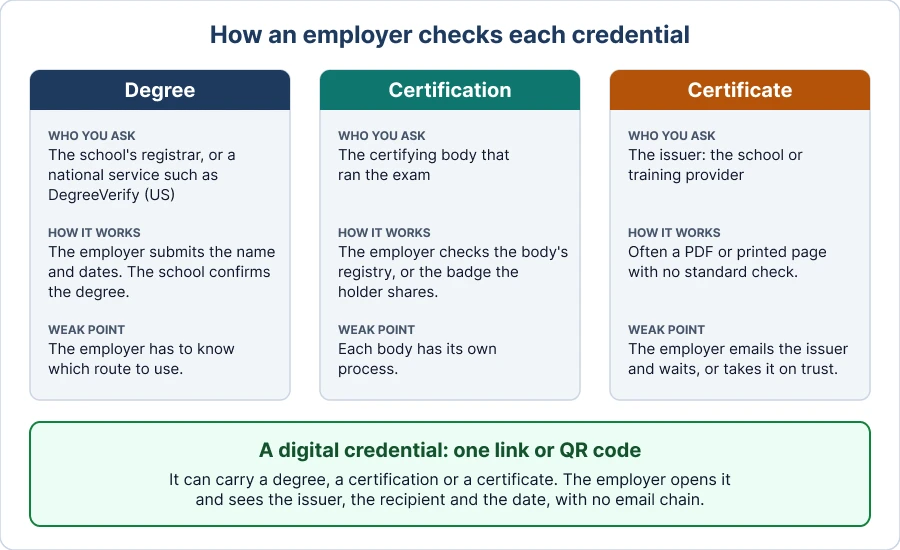
- Each one is checked differently. Degrees go through the school’s registrar or a national service, certifications through the certifying body, and certificates often have no standard check at all.
- A digital credential with a verification link or QR code can carry all three, so an employer can confirm any of them in seconds.
Certificate vs. degree vs. certification: people swap these three words all the time, and picking the wrong one can mean paying for a program that doesn’t lead where you expected. A degree is awarded by a college or university after a multi-year program of study. A certificate is awarded by a school or training provider when you finish a shorter, focused program. A certification is awarded by a professional or standards body when you pass an assessment. This guide covers certificate vs degree and certificate vs certification, compares all three in one table, and explains how employers check each one.
What is a degree?
A degree is an academic qualification awarded by a college or university once you complete a program of study at a set level. In the US the main levels are associate, bachelor’s, master’s and doctoral degrees. An associate degree typically takes two years and a bachelor’s degree four.
Degrees give you a broad grounding in a field rather than training for one job, and many professional roles list a bachelor’s degree as a minimum requirement. A degree doesn’t expire. Because employers check degrees so often, most have a standard route for it, covered in the verification section below.
What is a certificate?
A certificate is a credential from a school or training provider showing that you completed a focused program. These programs usually run from a few weeks to about a year. Some are academic certificate programs offered by colleges (a college certificate), and their credits can sometimes count toward a later degree. Others are a certificate of completion, a document confirming you finished a course or workshop. Our guide explains what a certificate of completion is and how to issue one.
Either way, a certificate records that you took part in the learning and finished it. It doesn’t show, on its own, that an independent body tested what you know. Certificates usually have no expiry date.
Undergraduate and graduate certificates
Academic certificates come at two levels. An undergraduate certificate typically takes 9 to 15 credits, and Penn State World Campus asks only for a high school diploma or GED. A graduate certificate usually requires a bachelor’s degree first; Colorado State University, for example, requires applicants to hold one. That is the short answer to graduate certificate vs degree: a graduate certificate adds focused, graduate-level study without the length of a master’s program, but it doesn’t award a degree. Requirements vary by school and program.
What is a certification?
A certification is a credential from a professional association or other independent body, awarded after you pass an exam or assessment against a published standard. The body that certifies you is usually separate from whoever trained you. For the certification of people, the international reference is ISO/IEC 17024, which sets requirements for the bodies that run these programs.
Most certifications have to be maintained. The Project Management Professional (PMP) credential from the Project Management Institute, for example, requires 60 professional development units in every three-year cycle. Some certifications also require work experience before you can sit the exam. If your organization is thinking about running one, our guide to creating your own certification program explains what that involves.
Certificate vs degree vs certification: comparison chart
This chart compares certification vs degree vs certificate side by side.
| Dimension | Degree | Certificate | Certification |
|---|---|---|---|
| Who issues it | College or university | School, college or training provider | Professional association or independent certifying body |
| How you earn it | Complete a multi-year program of study | Finish a short, focused program | Pass an exam or assessment, sometimes after meeting experience requirements |
| Typical length | About 2 years (associate) to 4 or more (bachelor’s and above) | A few weeks to about a year | Varies: study time plus the exam |
| What it shows | Broad academic knowledge of a field | You completed specific training | You met a defined competence standard |
| Does it expire? | No | Usually not | Often: renewal or continuing education required |
| How it’s verified | School registrar or a national service | Ask the issuer; often a PDF or printed copy | The certifying body’s registry or a shared digital badge |
| Best for | Careers or licenses that require one, and a broad foundation | Learning a skill fast or changing field | Proving job-specific skills to employers in your field |
Certificate vs degree: which one fits your goal?
Neither is better in general. Degrees and certificates suit different goals, and the right choice depends on what the job or license requires, how fast you need the skill, and what you can spend in time and money.
A degree makes sense when the role or license requires one, or when you want a broad foundation for a long career. A certificate makes sense when you need a specific skill quickly, when you’re changing fields, or when you want to test a subject before committing to a multi-year program. The most common version of this choice is an associate degree vs a certificate: an associate degree typically takes two years and covers general education alongside a major, while a certificate is shorter and trains for one skill set.
Pay data is one input. In 2025, full-time workers aged 25 and over with a bachelor’s degree had median weekly earnings of $1,578, compared with $1,135 for an associate degree and $966 for a high school diploma, according to the US Bureau of Labor Statistics. Those are annual estimates that exclude October, when data weren’t collected during the federal government shutdown. They cover degree levels only: the table doesn’t break out certificates, and an average says nothing about what your own pay will be. A quicker check is to read a handful of job postings in your target field and see which credential they ask for.
Certificate vs certification: the exam is the dividing line
The difference comes down to who tested you. A certificate comes out of an educational process: you studied and finished. A certification comes out of an assessment process: someone independent checked you against a standard.
That’s why finishing a certificate program doesn’t make you certified. A college might offer a project management certificate that prepares you for the PMP exam, but you only hold the PMP once the Project Management Institute accepts your application and you pass its exam. Preparing for the exam and passing it are two separate credentials.
Two more differences follow from that. Certificates are usually open to beginners, while certifications can require prior education or experience. And a certificate rarely expires, while a certification usually needs renewal or continuing education to stay valid.
You may also see “certification of completion.” That is another name for a certificate of completion, not a certification in this sense.
How employers verify a degree, a certificate and a certification
A credential is only as useful as the answer to one question: can someone check it? The three work differently.
Degrees have the most established route. In the US, many colleges send employer requests to the National Student Clearinghouse and its DegreeVerify service. The Clearinghouse says nearly all colleges and universities participate and that it can verify over 90% of the requests it receives, 80% of them immediately. Those figures are the Clearinghouse’s own.
A certification is checked with the certifying body, which is the single source of truth. In practice that means its public registry, if it has one, or a badge the holder shares.
Certificates are the weak link. A certificate is often a PDF or a printed page, and there is no standard way to check it. The employer contacts the issuer and waits, or accepts the document on trust.
A digital credential closes that gap. When a certificate, certification or degree is issued with a verification link or QR code, the employer opens the link and sees the issuer, the recipient and the date. Universities, training providers and certification bodies use BCdiploma to issue credentials this way. What makes a digital certificate verifiable explains the mechanism, and the portfolio shows examples issued by BCdiploma clients.
Can you combine a degree, a certificate and a certification?
Yes, and many people do. A certificate can be a stepping stone, because some certificate credits transfer toward a degree. A certification can sit on top of either one, proving a specific skill after a degree or certificate gave you the background. Digital badges and micro-credentials add finer detail by recording single skills or modules that can stack toward a larger credential. See our guides to micro-credentials and digital badge examples.
Diploma vs degree vs certificate: where do diplomas fit?
A diploma is a qualification whose meaning changes by country and by school. In the US it usually means a high school diploma, which is not a college degree. Community colleges and technical schools also award diploma programs, which tend to be more focused than a degree but deeper than a certificate. Elsewhere a diploma can be a higher education award. So “degree or diploma?” has no single answer: check how the issuing school defines it.
People also search for “degree certificate.” In some countries that is the name of the document confirming a degree, which is a different thing from a certificate program. Traditional versus digital diplomas covers how these documents work. A certificate of completion sits at the lightest end of the certificate family: it confirms you finished a course and needs no exam.
Issue verifiable certificates, certifications and diplomas with BCdiploma
BCdiploma helps universities, training organizations and certification bodies issue credentials that anyone can check in one click. Pick a template, upload your recipient list and issue verifiable digital credentials in bulk. Explore our certificate templates, see how it works, or browse the portfolio of examples issued by our clients.
Frequently asked questions
Contact us for more information.
A certificate shows you completed a course of study. A certification shows you passed an assessment against an industry or professional standard. The first comes from a school or training provider, the second from an independent certifying body, and only the certification usually needs renewing.
No. A degree comes from a college or university after a multi-year program and gives a broad academic foundation. A certificate is shorter and focused on specific skills, although some academic certificates can count toward a degree.
Neither is better in general. A degree suits roles and licenses that require one and gives a broad base. A certificate suits a fast, targeted skill or a career change. Check which credential your target job postings ask for.
Certificates usually don’t. Certifications often do, and holders renew them through continuing education or a renewal exam. The certifying body sets the rules.
Often yes, but it depends on the certifying body. Some require only an exam, some require work experience, and some require a degree or specific education. Check the requirements for the specific certification.
Degrees go through the school’s registrar or, in the US, a service such as the National Student Clearinghouse’s DegreeVerify. Certifications go through the certifying body. Certificates go through the issuer, which is fastest when the certificate is a digital credential with a verification link.
A degree is awarded by a college or university after a program at a set level, such as associate or bachelor’s. A diploma’s meaning varies: in the US it usually means a high school diploma or a focused program at a community or technical college, while elsewhere it can be a higher education award.