TL;DR: Key Takeaways
- A certificate of completion confirms someone finished a course, workshop, or training program — it documents participation, not mastery, and doesn’t require passing an exam.
- It’s different from a certification, which is awarded after passing a recognized exam and is generally seen as more rigorous.
- A valid certificate should include the recipient’s name, the exact program title, the completion date, the issuer’s signature or branding, and a way to verify it’s genuine.
- Digital, blockchain-secured certificates of completion can be verified in one click and shared instantly on LinkedIn — unlike a static PDF or paper document.
What is a certificate of completion?
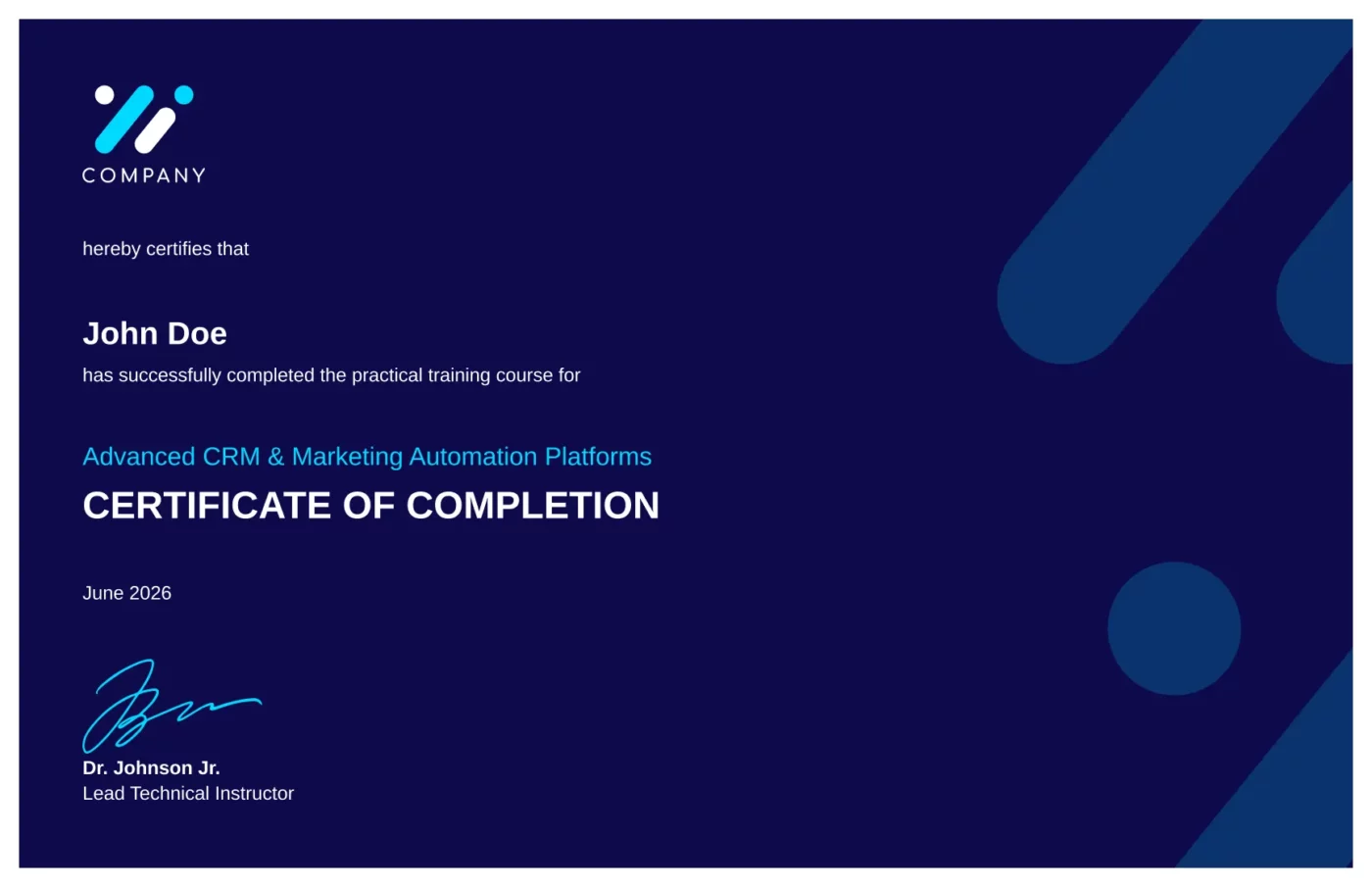
A certificate of completion is a document that confirms someone has finished a course, training program, workshop, or non-credit learning experience. Unlike a professional certification, it doesn’t require passing an exam — it simply documents that the recipient engaged with and completed the material from start to finish.
Organizations issue certificates of completion for a wide range of programs: employee onboarding, compliance training, professional development workshops, online courses, and continuing education. For the learner, it’s proof the training happened. For the issuing organization, it’s a record that can support compliance requirements, track engagement, and — when done well — reinforce the brand every time a recipient shares it.
This isn’t just theoretical — real institutions issue verifiable certificates of completion through BCdiploma today. See live examples in our portfolio of verifiable digital certificates.
Certificate of completion vs. certification vs. attendance: what’s the difference?
These three terms get used interchangeably, but they sit at three different levels of rigor. A certificate of attendance simply confirms someone was present — at a webinar, conference, or workshop — with no requirement to finish material or pass anything. A certificate of completion goes a step further: it confirms the recipient actually finished the course or program, though still without any formal assessment. A certification is the most rigorous of the three — an industry-standard credential earned by passing a recognized exam or demonstrating hands-on competency, typically awarded by an external accrediting body.
| Dimension | Attendance | Completion | Certification |
|---|---|---|---|
| Requirement | Show up to the event/session | Finish the course or program | Pass a recognized exam or assessment |
| What it proves | Presence only | Participation and engagement | Verified knowledge or skill |
| Issued by | The event organizer | The training provider or employer | Typically an external accrediting body |
| Rigor | Lowest — no completion required | Medium — no formal testing | Highest — standardized evaluation |
| Best for | Conferences, webinars, one-off sessions | Onboarding, workshops, internal training | Regulated professions, industry-recognized skills |
For training and continuing-education programs that want the more rigorous end of this spectrum, the ANSI/IACET 1-2018 Standard for Continuing Education and Training is the recognized U.S. framework accrediting bodies use to evaluate CE/T program quality — a useful reference point even for organizations issuing certificates of completion rather than formal CEUs.
If assessment-based rigor is what you actually need rather than a simple completion record, see our step-by-step guide to creating your own certification program. If you’re documenting event presence rather than program completion, our attendance and participation certificate templates are the better fit.
What does a certificate of completion include?
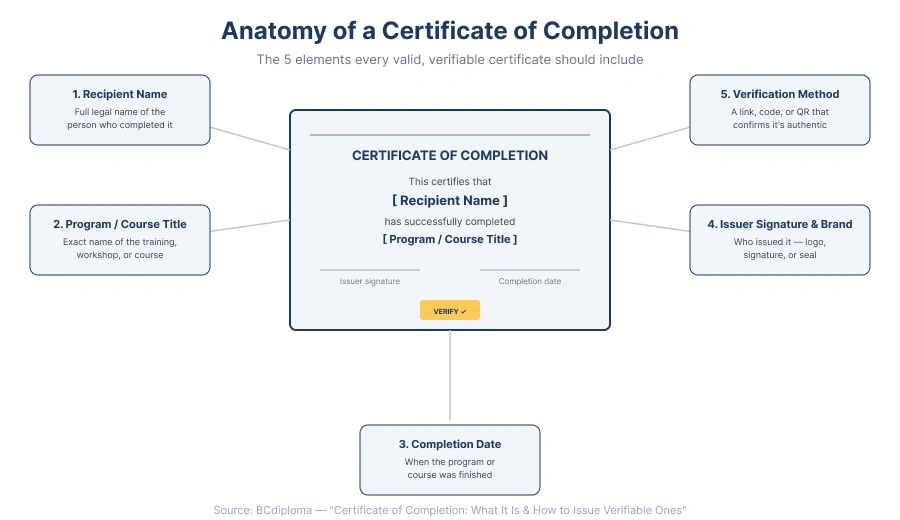
A certificate of completion doesn’t need to be complicated, but a handful of elements separate a credible one from a document nobody can trust or verify:
- Recipient name — the full name of the person who completed the program
- Program or course title — the exact name of what was completed
- Completion date — when the program was finished
- Issuer signature or branding — who is standing behind the credential
- A verification method — a link, code, or QR that lets anyone confirm it’s genuine
Want to see what one actually looks like rather than just reading a list? Browse our free, customizable certificate of completion templates — real sample designs you can preview and issue instantly.
Why issue verifiable, digital certificates of completion?
A static PDF or printed certificate is easy to forge, hard to verify, and impossible to update once issued. A blockchain-secured digital certificate solves all three problems: it’s tamper-proof, it can be verified by anyone in one click without contacting the issuer, and it’s built to be shared — recipients can post it directly to LinkedIn or embed it in a portfolio the moment they receive it.
This is the same verification model used across BCdiploma’s platform for digital certificates, credentials, and diplomas more broadly — a certificate of completion is simply one of the most common credential types organizations issue with it.
How to create and issue a certificate of completion
1. Define what “completion” means
Decide upfront whether that means attendance, a set number of modules finished, or a minimum time spent — the criteria you’ll actually check before issuing.
2. Choose or design a template
Pick a design that reflects your brand — see our free, ready-to-issue templates below — rather than building one from scratch.
3. Issue in bulk
Upload your list of recipients and issue to the entire cohort at once, rather than creating certificates one by one.
4. Deliver a verifiable digital certificate
Recipients get a credential they can check, share, and add to their professional profile instantly — not a static file that just sits in an inbox.
The fastest way to start: pick a design from our certificate of completion template library, customize it with your branding, and issue it to your entire cohort in one upload.
Create certificates of completion with BCdiploma
BCdiploma lets you issue verifiable, blockchain-secured certificates of completion at scale — pick a template, upload your recipient list, and issue professional credentials your learners can share and anyone can verify. Explore our certificate of completion templates, or see how organizations are already using BCdiploma in our customer success stories.
Frequently asked questions
Contact us for more information.
A certificate of completion is a document confirming someone finished a course, training program, or workshop. It proves participation and engagement, not mastery — no exam is required.
Yes — “certification of completion” and “certificate of completion” are generally used to mean the same thing: a document proving someone finished a program. This is different from a “certification,” which requires passing a recognized exam.
No. A certificate of completion only requires finishing the program — attending the sessions, completing the modules, or meeting whatever completion criteria the issuer sets. Formal certifications are the ones that require passing a test.
Generally, no — unless it’s tied to a compliance requirement with its own renewal cycle (like an annual safety training). Most certificates of completion for courses and workshops don’t have an expiration date.
It can, if it’s issued as a digital, blockchain-secured credential rather than a static PDF. Anyone with the verification link can confirm it’s genuine in one click, without needing to contact the issuer directly.