TL;DR
- Yes, you can create your own certification program — nothing stops an organization or individual with genuine expertise from designing one. But building a certification and building a credible one are different problems: credibility depends on your competency framework, assessment quality, and governance, not on the word “certified” itself.
- The core steps are: define the purpose and audience, build a competency framework, set eligibility requirements, design a valid assessment, set passing criteria, establish governance, decide on validity/renewal, and design how the credential itself will be issued and verified.
- Accreditation (e.g., under ISO/IEC 17024 or NCCA standards) is optional but signals third-party-verified quality — most organization-run certifications operate without it, which is fine as long as you don’t imply a recognition you don’t have.
- Digital credentials (verifiable, shareable, tamper-evident digital versions of the certification) aren’t required to launch, but they make the program easier to trust, verify, and manage once it scales.
What is a certification program?
A certification program is a structured process through which an organization evaluates whether a candidate meets a defined set of competency requirements, and formally recognizes that achievement with a credential. The defining feature is assessment against a standard — not just attendance, not just course completion.
A few related terms get used loosely, so it’s worth separating them cleanly from the start:
- Certificate of completion — evidence that someone finished a course, workshop, or training. It says “this person showed up and did the work.” It does not, by itself, claim they can perform a skill competently.
- Professional certification — a designation showing that a candidate met predefined eligibility and/or competency requirements, typically verified through an assessment (exam, practical demonstration, portfolio review, etc.).
- Accreditation — recognition that an organization, program, or certification process meets external, independently verified standards. Accreditation applies to the certifying body or scheme, not directly to the individual candidate.
- Digital credential — a digital representation of an achievement, certification, or qualification that can be verified and shared electronically. It’s a delivery and verification mechanism, not a substitute for program quality.
The practical point: calling something a “certification” doesn’t automatically make it one in the rigorous sense. What makes it a real certification is the presence of a genuine competency standard and a genuine assessment against that standard.
Can anyone create a certification program?
Short answer: yes, in the sense that no general law prevents an organization or individual with genuine subject-matter expertise from designing a certification and issuing credentials for it. Multiple industry guides confirm this directly — one widely circulated piece on the topic states outright that anyone can create their own certification program, provided they bring real, industry-relevant expertise to it.
But that “yes” needs three important qualifications, because they’re exactly what separates a credible certification from a decorative one:
1. Creating a certification does not automatically make it accredited. Accreditation is a separate, voluntary process in which an independent body reviews your certification scheme against a published standard. In the U.S., the most widely referenced standard for non-regulatory, voluntary certification programs is the NCCA Standards for the Accreditation of Certification Programs, maintained by the Institute for Credentialing Excellence (ICE); internationally, ISO/IEC 17024 (“Conformity assessment — General requirements for bodies operating certification of persons”) plays the equivalent role. Both exist specifically because “I created a certification” and “an independent body verified my certification meets a quality standard” are different claims. Accreditation is optional — most internal, corporate, and association-run certifications operate without it — but if you say or imply your program is “accredited,” you need the actual accreditation to back that up.
2. Creating a certification does not automatically make it legally regulated or required. In some professions (law, medicine, several skilled trades, financial advising in certain jurisdictions), practicing without a government-issued license is illegal — and a private certification cannot substitute for that license. In most other fields, certification is voluntary, market-driven recognition, not a legal gate. Which category you’re in depends entirely on your profession and jurisdiction, so this is worth checking against your specific field and country/state before you position your certification as a requirement to practice.
3. Creating a certification does not automatically make it professionally recognized or valuable to employers. Recognition is earned — through rigor, consistency, and adoption over time — not declared. A certification with a weak or absent competency framework, or an assessment that doesn’t actually test competence, may be legally fine to issue but will carry little weight with employers or peers. This is the gap most DIY certification programs fall into: they’re legitimate in the sense of “allowed,” but not yet credible in the sense of “trusted.”
The practical takeaway: you can start. What determines whether the certification means anything is everything covered in the rest of this article — the competency framework, the assessment, and the governance around it.
Certification vs. Certificate vs. Digital Credential
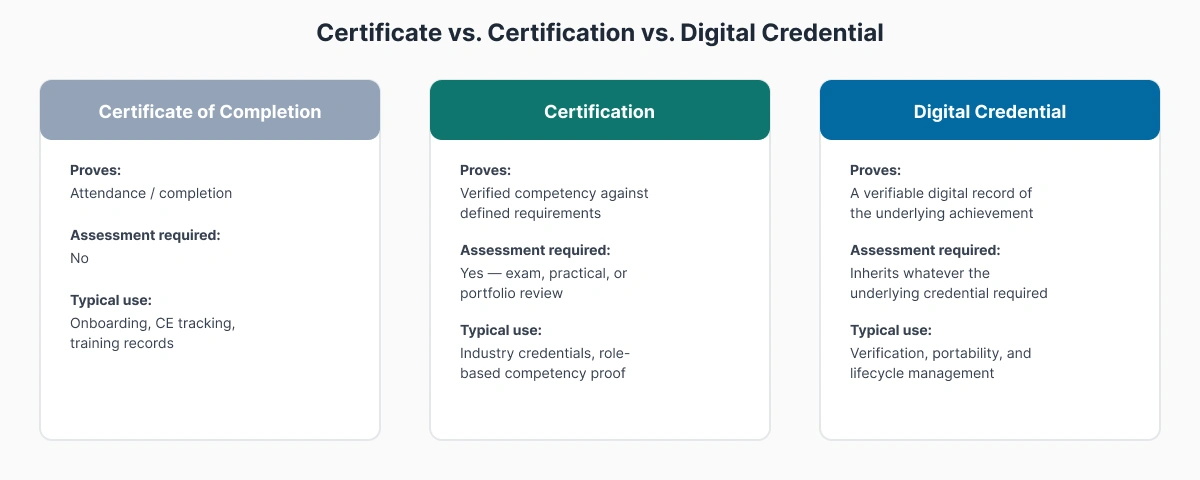
| Concept | What it proves | Assessment required? | Typical use |
|---|---|---|---|
| Certificate of completion | The person attended or completed a course/training | No — completion only | Onboarding, internal training records, CE tracking |
| Professional certification | The person met defined competency requirements | Yes — exam, practical demonstration, portfolio, or similar | Industry credentials, role-based competency proof, partner/employee certification programs |
| Accreditation (of the certifying body, not the individual) | The certification scheme itself meets an external quality standard (e.g., ISO/IEC 17024, NCCA) | N/A — applies to the certifying organization’s process, not a candidate | Signals third-party-verified program quality; often pursued once a certification has scaled |
| Digital credential | A verifiable, shareable digital record of any of the above (certificate, certification, or accredited credential) | Inherits whatever the underlying credential required | Verification, portability, and lifecycle management of the achievement, regardless of type |
The key distinction to hold onto: certificate = proof of participation. Certification = proof of competence, verified by assessment. Accreditation = proof that the certification process itself meets an external standard. Digital credential = the format and verification layer that can carry any of the three.
Why create your own certification program? (and when not yo)
Organizations build their own certification programs for several recurring reasons:
- Setting an industry or professional standard where none exists yet, or where existing options don’t reflect current practice.
- Employee or partner certification — verifying that internal staff, resellers, or implementation partners meet a defined competency bar before they represent the organization.
- Product or platform expertise — SaaS and technology companies certifying users or consultants on their specific tools.
- Continuing education and professional development — associations maintaining member competency over time.
- Customer education and community-building — turning trained, certified users into advocates.
- Skills recognition for non-traditional learners — validating competencies gained outside formal degree programs.
When it’s not the right solution: if what you actually need is simply proof that people attended training (a certificate of completion is enough and far cheaper to build), if the competency you want to certify can’t yet be reliably assessed, or if an established, recognized certification already exists in your field and building a competing one would only fragment recognition without adding real differentiation. In those cases, partnering with or building toward an existing standard is usually a better use of resources than building a parallel one from scratch.
What it costs. There’s no single number, because scope varies enormously — a single-exam internal certification and a multi-region accredited program aren’t comparable builds. As a rough industry-estimated range: basic assessment/testing tools typically run $1,000–$20,000 a year, while a full certification management system (candidate registration, exam delivery, credential issuance, renewal tracking) typically runs $10,000–$100,000+ a year depending on scale, according to industry cost estimates compiled by certification-technology providers. Treat these as starting reference points, not quotes — get a real estimate based on candidate volume and assessment complexity before budgeting.
How to create your own certification program: an 8-stage framework
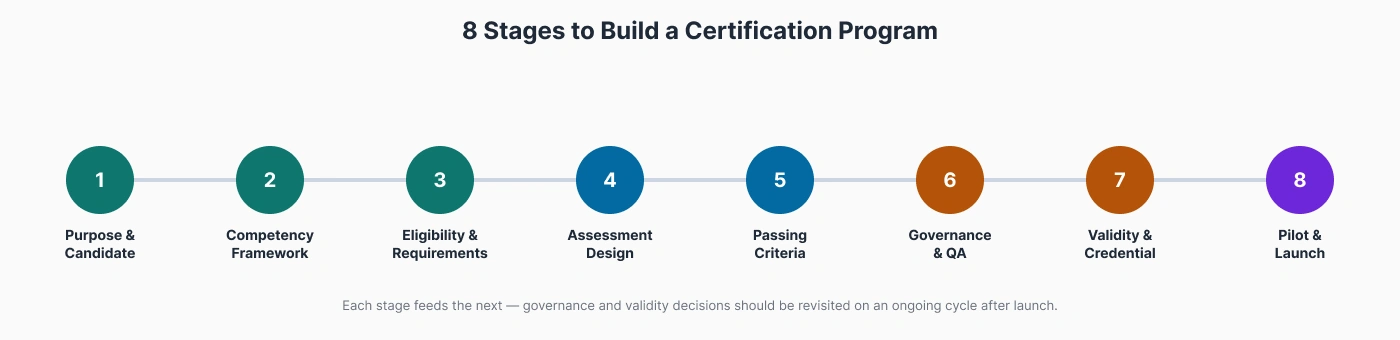
Stage 1 — Define the purpose and the target candidate
Start by answering two questions in writing, because everything downstream depends on the answers: What problem does this certification solve, and for whom?
Purpose should be specific enough to guide every later decision: “recognize baseline competency in X for Y role” is usable; “show we’re serious about training” is not. Define the target candidate alongside it — their starting experience level, whether prerequisites apply, and what they’ll be able to do differently once certified that they couldn’t credibly claim before.
Stage 2 — Build the competency framework
This is the foundation the entire certification rests on. A competency framework defines, concretely:
- What candidates should know (knowledge)
- What candidates should be able to do (skills, demonstrated through action)
- What behaviors or standards of conduct they’re expected to uphold, where relevant (e.g., codes of ethics for professional certifications)
Competencies should be written as observable, assessable statements — “can configure X to meet Y requirement,” not “understands X.” If a competency can’t be observed or tested, it can’t be certified against; it can only be taught.
Stage 3 — Set eligibility and certification requirements
Decide what a candidate must bring or complete before they can attempt certification. Common requirement types include prior training completion, verified professional experience, minimum education level, practical demonstration, and agreement to a code of conduct.
One distinction is worth stating plainly because it trips up most new programs: completing training and being certified are not the same thing. Training builds toward competence; certification verifies it. A program that certifies everyone who finishes the course, without an independent assessment step, is really issuing certificates of completion labeled as certifications.
Stage 4 — Design the Assessment
This is where certification quality is won or lost. Match the assessment method to what you’re actually trying to verify:
- Multiple-choice / knowledge exams — efficient for verifying factual and conceptual knowledge; weak at verifying applied skill on their own.
- Case studies and scenario-based questions — better for judgment and applied reasoning.
- Practical assessments, simulations, or performance demonstrations — necessary when the competency is a physical or technical skill that can’t be verified through questions alone.
- Portfolio assessment — appropriate when competence is best demonstrated through a body of real work over time.
- Oral examination — useful for roles requiring real-time reasoning or communication, though harder to standardize across assessors.
Whatever method you choose, two properties determine whether the assessment is actually doing its job:
- Validity — does the assessment actually measure the competencies you defined in Stage 2, and nothing else? An exam full of trivia unrelated to the real-world competency is not valid, no matter how well-written the questions are.
- Reliability — would the same candidate get a consistent result if assessed again, or by a different assessor? Inconsistent scoring, ambiguous questions, or ungraded subjectivity all reduce reliability.
Beyond validity and reliability, build in basic assessment security and fairness from the start: item banking to prevent question leakage/memorization, proctoring or integrity checks appropriate to the stakes of the certification, and accommodations for candidates with disabilities. Do not assume a multiple-choice test is automatically sufficient for every competency — for higher-stakes or highly technical certifications, a single knowledge exam is rarely enough on its own.
Stage 5 — Define Passing Criteria
Set, and document, what counts as success: minimum score, required performance on specific competency areas (not just an overall average), and how borderline cases are handled. Passing criteria should be defensible — ideally set through a structured process (e.g., a panel of subject-matter experts reviewing item-level difficulty) rather than an arbitrary round number.
Stage 6 — Establish Governance and Quality Assurance
This is the stage most DIY certification programs skip, and it’s the one that most determines whether a program stays credible over time. At minimum, define:
- Ownership and governance structure — who has final authority over the competency framework and assessment content, and how decisions get made (a single founder, a governing committee, an advisory board of practitioners).
- Conflict-of-interest handling — especially important if the same organization both trains candidates and certifies them; document how independence is maintained.
- Version control — a documented process for updating the competency framework and assessment content as the underlying field evolves.
- Appeals and complaints process — a clear, published path for candidates to contest results or raise concerns.
- Periodic review — a scheduled cadence (annually, or every 2–3 years) to revisit whether the competency framework still reflects current practice, often informed by a job/practice analysis involving working professionals in the field.
None of this requires formal accreditation to implement — but it’s exactly what accreditation standards like NCCA’s and ISO/IEC 17024 audit for, so building it in from the start also keeps the door open if you decide to pursue accreditation later.
Stage 7 — Decide on Validity, Renewal, and How the Credential Will Be Issued
Two decisions belong together here because they get finalized at the same point in the build:
Validity and recertification approach. There is no single correct answer — it depends on how quickly the underlying competency changes:
- Lifetime/non-expiring certification — appropriate when the underlying knowledge or skill is stable over long periods. Simpler to administer, but risks certifying people on outdated competencies if the field moves quickly.
- Fixed validity period with recertification — candidates must retest or otherwise re-demonstrate competence after a set period (commonly 1–5 years). Keeps the certification current but adds ongoing administrative and candidate cost.
- Continuing education (CE) requirements — instead of full retesting, candidates maintain certification by logging ongoing learning activity. A middle path, common in healthcare and other fast-moving fields.
Do not default to “certifications should expire” as a universal rule — match the approach to how fast your field’s competencies actually change, and be explicit about which model you’re using and why. For reference, among established certification bodies that do use fixed validity periods, two, three, or five years is the most common range, with three years being especially frequent across large professional certification programs (PMI’s PMP, most Cisco certifications, ASQ’s Six Sigma and quality credentials, and ISO management-system certifications all use a three-year cycle) — useful as a starting benchmark, not a rule.
Credential design. Decide what the credential itself needs to communicate, at minimum: credential name, recipient, issuing organization, issue date, expiration date (if any), the requirements met, the competencies certified, a verification mechanism, and a unique credential ID. If evidence of the work behind the credential (a project, a score breakdown) adds value, decide whether and how to attach it.
This is also the point to decide how credentials will be issued, verified, and managed — manually (PDF + spreadsheet, which doesn’t scale and is easy to falsify), through a general-purpose certificate generator (fine for low-stakes certificates of completion), or through a dedicated digital credentialing platform built for verifiable, tamper-evident certification records (more relevant once a program needs to scale, prevent fraud, or make verification effortless for employers). More on this in the dedicated section below.
Stage 8 — Pilot, Launch, and Continuously Improve
Pilot first. Run the assessment with a small group before a full public launch, and track: completion rate, pass/fail rate, item-level performance (which questions are too easy, too hard, or ambiguous), candidate feedback, and operational friction (registration, scheduling, technical issues). Use pilot data to adjust the assessment and process before it’s public — mistakes are far cheaper to fix here than after launch.
Launch with clear positioning (what the certification proves and who it’s for), transparent eligibility and registration, defined pricing if applicable, a scheduling/delivery mechanism for the assessment, and a communication plan so the target audience actually finds out it exists.
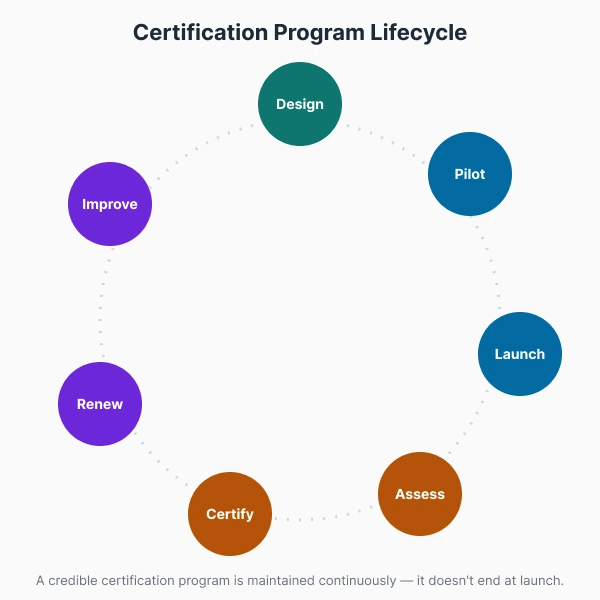
Measure and improve on an ongoing basis, not just at launch. Track registrations, completion and pass rates, item-level assessment performance over time, candidate satisfaction, renewal/recertification rates, and — where you can get visibility into it — employer or industry adoption. Treat the certification as a living program: competency frameworks and assessments should be revisited on the governance cadence set in Stage 6, not left untouched indefinitely.
Practical example: Digital Learning Program Manager Certification (fictional, illustrative only)
All figures and specifics below are hypothetical, provided only to show how the framework applies in practice.
- Purpose: Recognize professionals who can design, run, and measure results for corporate digital learning programs.
- Target audience: L&D professionals with 2+ years of experience managing at least one digital training initiative.
- Prerequisites: Completion of a foundational learning-design course (internal or external) or equivalent documented experience.
- Competency framework (sample): designing a learning needs analysis; building a competency-based curriculum; selecting and configuring delivery technology; designing and interpreting assessment data; reporting program ROI to stakeholders.
- Learning pathway: Self-paced modules mapped 1:1 to each competency, plus one applied capstone project.
- Assessment: A scored capstone project (a full learning program design submitted for review) plus a 60-question scenario-based exam covering the knowledge components. Capstone graded by two independent reviewers against a published rubric to support reliability.
- Passing criteria: Minimum 75% on the knowledge exam and a “meets standard” rating from both capstone reviewers on every rubric dimension.
- Credential: “Certified Digital Learning Program Manager (CDLPM)” — issued as a digital credential showing issue date, competencies certified, and a verification link.
- Validity: 3 years.
- Renewal: 20 hours of documented continuing education in learning technology or instructional design, submitted before expiration, or a retake of the knowledge exam.
- Sample KPIs tracked post-launch: pilot pass rate, capstone inter-rater agreement (reliability check), year-1 renewal rate, employer recognition (tracked via candidate self-report).
Certification program design table
| Element | Key question | Example (from the fictional CDLPM above) |
|---|---|---|
| Purpose | Why does the certification exist? | Recognize competency in managing digital learning programs |
| Audience | Who is it for? | L&D professionals with 2+ years relevant experience |
| Competencies | What must candidates demonstrate? | Needs analysis, curriculum design, delivery tech, assessment, ROI reporting |
| Eligibility | Who can apply? | Foundational course completion or equivalent experience |
| Assessment | How is competence evaluated? | Scenario exam + independently graded capstone project |
| Passing criteria | What counts as success? | 75%+ exam score and “meets standard” on all rubric dimensions |
| Validity | How long is it valid? | 3 years |
| Renewal | How is it maintained? | 20 hours CE or exam retake |
| Credential | How is achievement represented? | Digital credential with verification link |
| Governance | Who maintains quality? | Advisory panel reviews framework and exam items annually |
From Certification Design to Digital Credentials
Once the purpose, competencies, assessment, and governance are in place, one practical question remains: how will you actually issue, represent, verify, and manage the credential over time?
For a small, low-stakes program, a manually created PDF certificate may be enough at first. But as a certification program grows, three problems tend to show up:
- Verification gets harder. Employers or partners need a fast, reliable way to confirm a credential is genuine — over half of employers using skills-based hiring cite verifying skill claims as their main obstacle, according to a 2026 analysis by National University of current hiring-practice research. A credential that can’t be verified quickly loses much of its value the moment it leaves your website.
- Fraud and tampering risk increases. Static PDFs and image-based certificates are easy to alter or fabricate — and this isn’t a hypothetical risk: in a February 2025 survey by ResumeLab, roughly 7 in 10 workers admitted to lying somewhere on a resume, and 11% specifically admitted to misrepresenting their education credentials. A certification program’s credential is only as trustworthy as the ease with which a third party can confirm it’s genuine.
- Management becomes manual. Tracking expiration dates, renewal status, and reissuance across hundreds or thousands of candidates in a spreadsheet doesn’t scale.
This is where a dedicated digital credentialing platform like BCdiploma becomes relevant — not as a requirement to run a certification program, but as infrastructure for the issuance-and-verification layer once a program needs it. BCdiploma issues branded, white-labeled digital certificates secured with blockchain-based technology, giving recipients lifelong, instantly verifiable access to their credential without depending on the issuing organization’s servers staying online indefinitely. For certification bodies managing renewal cycles, the platform supports bulk issuance, tracks recipient engagement (opens, shares), and integrates with existing systems through an API — useful once a program moves from a handful of candidates to an ongoing, recurring certification and recertification cycle.
The point isn’t that you need BCdiploma, or any particular platform, to launch a credible certification program. The point is that credential issuance and verification are part of the program’s infrastructure, not an afterthought — and it’s worth deciding deliberately, at Stage 7, rather than defaulting to whatever’s fastest to set up.
Sources & further reading
- ISO/IEC 17024:2026 — Conformity assessment: General requirements for bodies operating certification of persons. International Organization for Standardization. https://www.iso.org/standard/17024
- ANSI National Accreditation Board (ANAB) — overview of ISO/IEC 17024 for personnel certification. https://anab.ansi.org/standard/isoiec17024/
- Institute for Credentialing Excellence / National Commission for Certifying Agencies (NCCA) — Standards for the Accreditation of Certification Programs. https://www.credentialingexcellence.org/Accreditation/Earn-Accreditation/NCCA
- Credential Engine — Counting Credentials 2025 report. https://credentialengine.org/all-resources/2025-counting-credentials/
- National University — 67 Hiring Statistics for 2026 (skills-based hiring and certification verification data). https://www.nu.edu/blog/67-hiring-statistics/
- Cisive — Detect Fraudulent Credentials to Protect Your Business (ResumeLab survey data on credential misrepresentation). https://blog.cisive.com/fraudulent-credentials-examples-and-how-to-avoid-them
- CLIMB — What Is Recertification? Requirements, Process, and Penalties (typical recertification cycle lengths). https://climbtheladder.com/what-is-recertification-requirements-process-and-penalties/
- BCdiploma — digital credentialing platform overview. https://www.bcdiploma.com/en
Frequently asked questions
Contact us for more information.
Yes, in the sense that no general rule prevents an organization or individual with genuine subject-matter expertise from designing one. What determines whether it’s credible — not just legally permissible — is the competency framework, the quality of the assessment, and the governance behind it. In regulated professions, a private certification also cannot substitute for a government-issued license.
Define the purpose and target candidate, build a competency framework, set eligibility requirements, design a valid and reliable assessment, set passing criteria, establish governance and quality assurance, decide on validity/renewal and credential design, then pilot before a full launch. See the 8-stage framework above for the full detail on each step.
Start by writing down, specifically, the problem the certification solves and who it’s for — this shapes every later decision. From there, follow the same core sequence: competency framework, requirements, assessment design, governance, then pilot and launch.
Design centers on two things: a competency framework that states, in observable and testable terms, what candidates must know and be able to do; and an assessment method matched to those competencies (exam, practical demonstration, portfolio, or a combination) that is both valid (measures the right thing) and reliable (produces consistent results).
“Building” typically means executing the framework end to end: competencies → requirements → assessment → governance → validity/renewal decisions → credential and delivery infrastructure → pilot → launch → ongoing measurement.
If what you’re offering is proof of course completion rather than verified competency, you don’t need a full assessment framework — define the completion criteria, then issue a certificate of completion. If you want candidates to be able to claim demonstrated competence, you need the fuller certification process described above, not just a certificate.
Credibility comes from a well-defined, testable competency framework; an assessment that is both valid and reliable; transparent eligibility and passing criteria; and documented governance — including an appeals process and periodic review of the competency framework and assessment content. None of this requires formal accreditation, though following the same principles accreditation standards audit for makes a program stronger either way.