TL;DR
A training needs assessment (TNA) is a structured process for finding out whether employees need training, what they specifically need, and where the gap between current and required skills is big enough to justify a training investment. It works by comparing required performance (from business goals, job roles, and individual capability) against actual performance, then tracing any gap back to its root cause before deciding on training. A full TNA runs at three levels — organizational, task/job, and individual — and typically takes 2 to 6 weeks depending on scope. Not every performance problem is a training problem: process, tooling, workload, and management issues can look identical to a skills gap from the outside, which is why root-cause analysis has to come before any training decision, not after.
Prefer to skip ahead? The free Training Needs Assessment Template is available near the end of this guide.
What is a training needs assessment?
Short answer: A training needs assessment is a systematic process used to identify gaps between the skills and knowledge employees currently have and the skills and knowledge they need to meet business, job, or performance objectives.
The term is sometimes used interchangeably with “training needs analysis,” and in everyday HR conversation that’s harmless. Used precisely, though, assessment is the broader activity — gathering and interpreting data about performance and capability — while analysis is the more analytical step within it: breaking that data down to isolate specific gaps, causes, and priorities. Both sit inside the same discipline, sometimes labeled Training Needs Assessment and Analysis (TNAA).
A training needs assessment typically answers four questions:
1. Is there a gap between required and actual performance?
2. Is that gap caused by a lack of knowledge or skill — or by something else (tools, process, incentives, workload)?
3. If it is a skills gap, how large is it, and how much does it matter to the business?
4. What kind of intervention would close it, and in what order should needs be addressed?
Why is training needs assessment important?
Skipping straight to “let’s run a training” without first assessing the need is one of the most common — and most expensive — mistakes in L&D. A TNA matters for four connected reasons.
It protects a shrinking training budget. According to the Association for Talent Development’s State of the Industry research, average formal training hours per employee fell from 17.4 in 2023 to 13.7 in 2024, even as direct learning spend held in the 1,050–1,280 per-employee range. When fewer hours and a flat-to-declining budget have to cover more ground, an untargeted training program is a luxury few L&D teams can still afford.
It closes a gap that is genuinely widening. The World Economic Forum’s Future of Jobs Report 2025 — based on a survey of over 1,000 employers across 55 economies — found that 39% of workers’ core skills are expected to change by 2030, and that 59 out of every 100 workers will need reskilling or upskilling in that period, with roughly 11 of those unlikely to receive it under current investment levels. A TNA is the mechanism that turns that macro trend into a specific, budgeted, prioritized plan for one organization.
It keeps training aligned with business goals, rather than with whichever course catalog, vendor pitch, or trending topic happens to be easiest to buy.
It creates a defensible, auditable rationale for where training budget goes — useful internally for L&D credibility, and useful externally if training investment needs to be justified to finance or leadership.
Training needs assessment vs. training needs analysis
| Dimension | Training Needs Assessment | Training Needs Analysis |
|---|---|---|
| Scope | The full process: planning, data collection, interpretation, decision | A component within the process: breaking down data to isolate specific gaps and causes |
| Primary question | “Do we have a need, and where?” | “What exactly is the gap, and why does it exist?” |
| Typical output | A prioritized list of needs and a recommendation on whether/how to act | A detailed diagnosis of a specific gap (competency, cause, severity) |
| When it happens | Start to end of the process | Mainly in the middle — after data collection, before the training plan |
| Common synonym use | Often used as the umbrella term in HR practice | Sometimes used interchangeably with “assessment” in casual usage |
In practice, most organizations don’t need to police this distinction rigidly — but understanding it helps when reading academic or SHRM-aligned sources, which tend to use the terms more precisely.
The 3 levels of training needs assessment
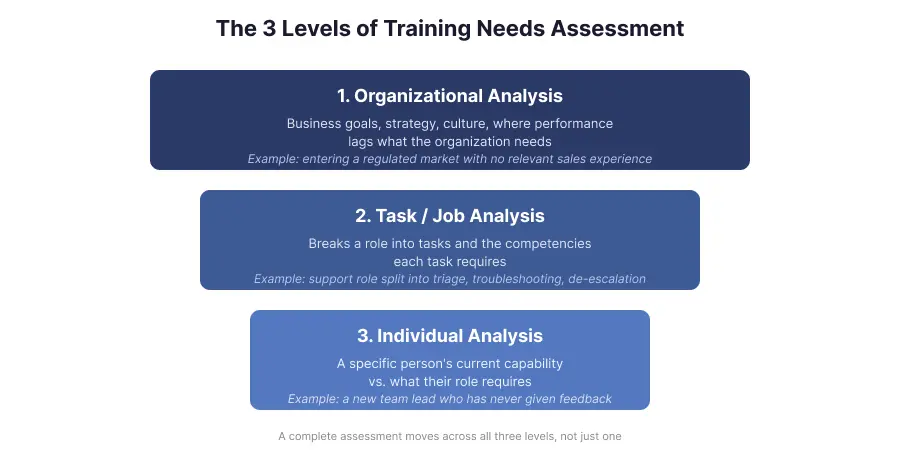
A properly scoped TNA looks at three levels simultaneously. Skipping one is the most common reason a training program solves the wrong problem.
1. Organizational analysis. Looks at the business as a whole: strategic goals, culture, structure, and where performance is falling short of what the organization needs to compete. Example: a company entering a new market realizes none of its sales team has experience selling in a regulated industry.
2. Task / job analysis. Breaks a specific role down into its component tasks and the competencies each task requires. Example: a customer support role is broken into ticket triage, technical troubleshooting, and de-escalation — each requiring a different skill set.
3. Individual analysis. Looks at a specific person’s current capability against what their role — or a role they’re moving into — requires. Example: a newly promoted team lead has strong technical skills but has never given performance feedback.
A complete TNA moves between all three: organizational analysis sets the direction, task analysis defines the target, and individual analysis measures the actual gap.
How to conduct a training needs assessment
The exact number of steps varies by source, but the reliable pattern collapses into six stages. Each can be broken into sub-steps depending on scope.
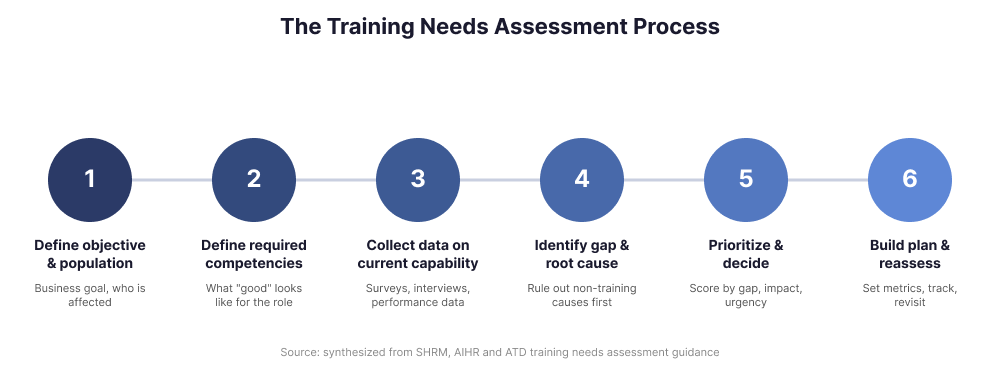
1. Define the business objective and target population. Start with why the assessment is happening — a KPI miss, a strategic shift, a new system rollout — and who it affects.
2. Define the required competencies. For the relevant roles, list what “good” looks like: knowledge, skills, and behaviors tied to the objective in step 1.
3. Collect data on current capability. Combine multiple sources — performance data, manager input, self-assessment, observation — rather than relying on a single one (see Methods below).
4. Identify the gap and its root cause. Compare required vs. current capability, then ask why the gap exists before assuming training is the fix (see “Training problem or performance problem?” below).
5. Prioritize and decide on the intervention. Not every gap justifies training, and not every training-worthy gap can be addressed at once. Score and rank (see Prioritization below).
6. Build the plan, define success metrics, and reassess. Translate prioritized needs into a training plan with owners, timelines, and — critically — a way to measure whether the gap actually closed.
Training problem or performance problem?
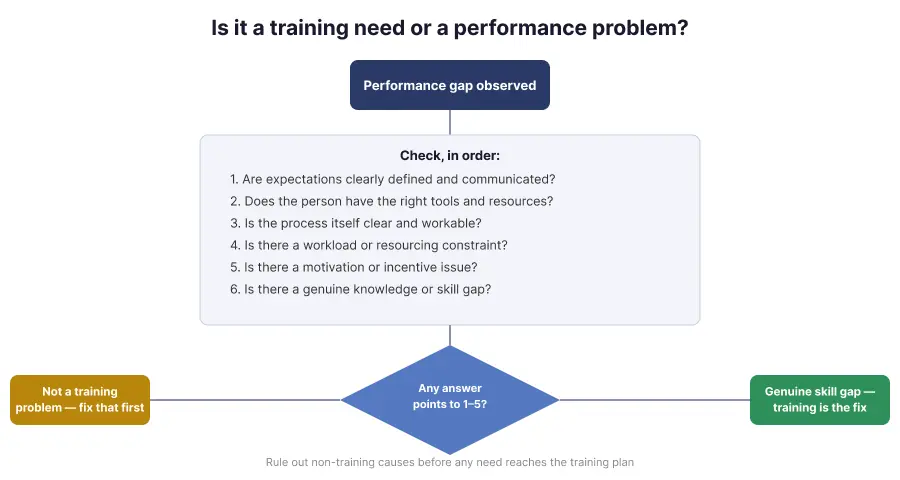
Before committing any need to a training plan, it’s worth explicitly ruling out non-training causes. A short diagnostic works well:
– Is the expected performance clearly defined and communicated?
– Does the person have the tools and resources needed to perform?
– Is the process itself clear and workable?
– Is there a workload or resourcing constraint?
– Is there a motivation, incentive, or recognition issue?
– Would coaching, clearer documentation, or a process fix solve this without formal training?
– Is there a genuine, verifiable gap in knowledge or skill?
Only when the answer to that last question is a clear “yes” — and the others point away from tools, process, or motivation — does a need belong on the training plan. This distinction is central enough that it’s built as a mandatory first step in the accompanying template, not an optional check.
Training needs assessment methods
No single method gives a complete picture. Combining two or three, depending on scope and budget, is standard practice.
| Method | Best for | Advantages | Limitations | Example |
|---|---|---|---|---|
| Surveys | Broad, low-cost data across many employees | Scalable, anonymous, easy to analyze | Self-reported, can miss unconscious gaps | Company-wide skills self-assessment before a systems migration |
| Interviews | Nuanced, role-specific insight | Rich detail, follow-up questions possible | Time-intensive, small sample | One-on-ones with team leads after a product launch |
| Focus groups | Shared or team-level gaps | Surfaces group dynamics and shared blockers | Groupthink risk, needs skilled facilitation | Cross-functional group after a process change |
| Observation | Task-level, on-the-job accuracy | Objective, catches what people don’t self-report | Resource-intensive, observer effect | Job shadowing on a manufacturing line |
| Performance data | Quantifiable, business-tied gaps | Objective, already exists in most organizations | Doesn’t explain why performance is low | Declining first-call resolution rate in support |
| Skills assessments / tests | Verifiable current competency level | Standardized, comparable across people | Doesn’t always reflect real-world application | Coding assessment before an internal mobility move |
| Manager assessments | Contextual, day-to-day visibility | Captures behavior surveys miss | Subject to manager bias | Manager ratings ahead of an annual TNA cycle |
| Self-assessments | Employee perspective and stated confidence | Cheap, fast, involves the employee | Prone to over/under-confidence | Pre-course self-rating against a competency framework |
| Customer feedback | Frontline, customer-facing gaps | Ties training directly to customer impact | Indirect, may reflect non-training issues | Recurring complaint themes in support tickets |
| Business KPIs | Organization-level prioritization | Directly tied to strategy and budget conversations | Lagging indicator, multi-causal | Missed sales targets in a specific region |
Training needs assessment questions
For employees: What part of your role do you feel least confident in? What tools or information do you wish you had but don’t? What would help you do this task faster or better?
For managers: Where does your team’s performance fall short of target, and why do you think that is? Which skills will your team need in the next 6–12 months that they don’t have today? Is there a task your team consistently struggles with regardless of who’s doing it?
For HR / L&D: What business goals require capabilities we don’t currently have at scale? Which roles have the highest turnover or ramp-up time, and does that point to a skills or a process issue? What did the last training investment actually change, and how do we know?
For business leaders: What capability gap, if closed, would move a top business metric? Where is the organization relying on a small number of people for a critical skill?
Training needs analysis sample
Illustrative example — not real company data.
| Competency | Current level (1–5) | Target level (1–5) | Gap | Business impact | Urgency | Priority |
|---|---|---|---|---|---|---|
| Consultative selling in regulated industries | 2 | 4 | 2 | High | High | 1 |
| Data visualization in reporting tool | 3 | 4 | 1 | Medium | Medium | 3 |
| De-escalation in customer support | 2 | 4 | 2 | High | Medium | 2 |
| Advanced spreadsheet formulas | 3 | 3.5 | 0.5 | Low | Low | 4 |
How to prioritize training needs
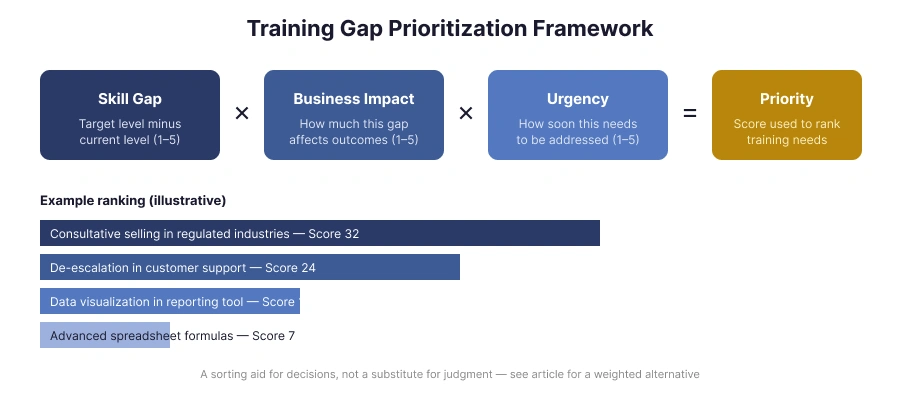
A simple, transparent starting formula:
Priority Score = Skill Gap × Business Impact × Urgency (each factor rated 1–5)
It’s easy to explain to stakeholders and easy to build into a spreadsheet, and it produces a defensible ranking without requiring statistical expertise. Its main weakness: multiplication is unforgiving. A “1” in any single factor drags the whole score down, even when the other two factors are high, and it can quietly reward generous self-ratings. If that trade-off doesn’t sit well with how your organization scores things, a weighted additive alternative works too: (Gap × 0.4) + (Impact × 0.4) + (Urgency × 0.2). It’s gentler, and lets you decide how much weight urgency should carry relative to gap size. You’ll find both versions built in, side by side, in the free template below.
Whatever formula you use, treat the score as a sorting aid for a conversation, not an automatic decision — a small gap on a mission-critical competency can outrank a large gap on something peripheral, and no formula fully captures that kind of judgment call.
Training needs assessment template
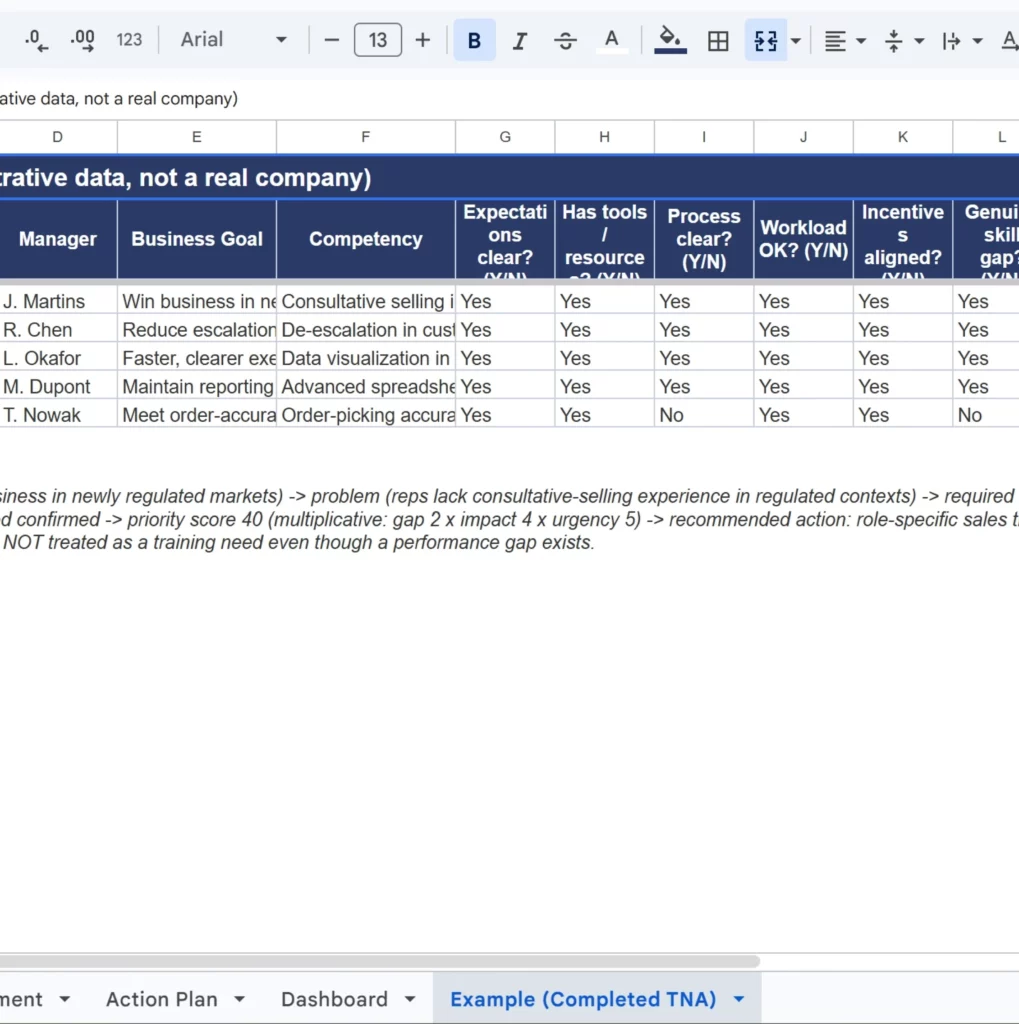
A training needs assessment template turns the process above into something an L&D or HR professional can actually fill in, rather than a set of ideas to remember. The free Training Needs Assessment Template built alongside this article is a multi-tab Google Sheet that:
- Starts with a training-vs-performance-problem diagnostic, before any skill is scored
- Records current vs. target level, gap, business impact, and urgency in one place
- Calculates a priority score automatically (with both formula options above)
- Produces a simple, at-a-glance dashboard
- Turns the top-priority needs into an action plan with owners, dates, and success metrics
- Includes a fully worked, pre-filled example so a first-time user can see the whole path from problem to plan
(See “Lead Magnet Strategy” and “Final Google Sheet Structure” below for full detail and download-flow copy.)
FREE TEMPLATE
Get the Training Needs Assessment Template
Identify skill gaps, rule out non-training problems, prioritize what matters, and turn your findings into an action plan
Common training needs assessment mistakes
- Choosing the training before assessing the need — starting with a course catalog instead of a diagnosis.
- Treating every performance problem as a training problem, when the cause is process, tooling, or incentives.
- Only asking employees, and skipping managers or business data — or the reverse.
- Relying solely on self-assessment, which tends to be optimistic for well-known skills and pessimistic for unfamiliar ones.
- Skipping root-cause analysis and jumping straight from “gap observed” to “training scheduled.”
- Not prioritizing, so every need gets equal — and usually insufficient — budget and attention.
- Defining no success metric, making it impossible to know afterward whether the training worked.
- Never reassessing, so skills gaps that reopen (or never really closed) go unnoticed until they cause a visible problem again.
From training needs assessment to verifiable skills
A training needs assessment identifies a gap and, often, leads to a training intervention. But closing a skills gap is not the end of the cycle — it’s the middle of one: identify → assess → train → certify → track → reassess.
Once a competency has genuinely been developed, organizations increasingly need a way to make that outcome tangible: to document it, recognize it formally, and let the employee carry proof of it — whether that’s for internal mobility, a client-facing certification, a regulatory requirement, or simply to make the training investment visible and shareable. This is where digital credentials become relevant, not as a replacement for the TNA process, but as its natural continuation for the needs that do lead to a certifiable outcome.
BCdiploma helps organizations issue secure, verifiable digital credentials and certificates for the skills, courses, and certifications employees complete — turning a completed training need into a permanent, shareable, verifiable record, rather than a line in a spreadsheet that’s forgotten once the course ends. Not every training need should end this way; but for the ones that do — a compliance certification, a completed upskilling program, an internal competency milestone — it’s worth having a system for skills recognition that keeps pace with how much organizations are now investing in identifying those needs in the first place.
Frequently asked questions
Contact us for more information.
A structured process for identifying gaps between the skills employees have and the skills they need, in order to decide whether, where, and how to invest in training.
It targets a shrinking training budget at the gaps that matter most, keeps training aligned with business goals, and creates a defensible rationale for L&D investment — rather than training based on assumption or trend.
Organizational analysis (business-wide), task/job analysis (role-specific), and individual analysis (person-specific). A complete assessment considers all three.
Define the objective and population, define required competencies, collect data on current capability, identify the gap and its root cause, prioritize, and build a plan with success metrics — then reassess.
Assessment is the full end-to-end process; analysis is the more focused diagnostic step within it that isolates specific gaps and their causes. In everyday use, the two terms are often used interchangeably.
A clear objective, defined competencies, multiple data sources, root-cause analysis (to rule out non-training causes), a prioritization method, and a plan with measurable success criteria.
A ready-to-use tool — often a spreadsheet — that structures the assessment process: recording current vs. target skill levels, calculating gaps and priority, and turning results into an action plan.
By combining methods — surveys, interviews, observation, performance data, skills assessments — rather than relying on a single source, and comparing findings against defined role and business requirements.