From 2027, Europeans will carry a European Digital Identity Wallet (EUDI Wallet) on their phone, provided or recognised by their country. It will hold their identity card, their driving licence and, one day, their diplomas. BCdiploma and Talao are announcing a technology partnership so that digital credentials and diplomas issued through BCdiploma can go into it, in the formats set by EU law, without institutions having to reissue anything. A first pilot is under way with a major French university.
In brief
- The eIDAS 2 regulation requires every member state to offer at least one digital identity wallet by the end of 2026; most will be late, and the real timeline is 2027-2028.
- The technical formats have been set since 11 August 2026: SD-JWT VC and mdoc, with the OpenID4VCI and OpenID4VP protocols. The content of a diploma is not.
- Diplomas in the wallet are not an obligation, but a use the regulation provides for (Annex VI, educational qualifications), and your graduates may ask you for it as soon as their wallet is available.
- With BCdiploma, there is no double issuance: your digital credentials remain the source, and they gain a second output in the wallet format.
- A pilot run with Talao at a major French university starts in December 2026; we will publish the results.
The European Digital Identity Wallet (eIDAS 2) in three points
Regulation (EU) 2024/1183, known as eIDAS 2, requires every member state to offer its citizens at least one digital identity wallet: a mobile app in which people store their identity and “attestations” (driving licence, student card, diploma, membership, and so on), and in which they choose what they show, to whom, and in how much detail. It is not a single product but a common framework that each country implements in its own way, with mutual recognition. In France, France Identité is set to become the national wallet; in Germany, it will be d-you; in Italy, IT-Wallet.
The reference date is the end of December 2026 for each member state to make a first wallet available. Most countries will miss it: in autumn 2026, the press estimated that 24 out of 27 member states would not make it, no wallet had been certified and the certification scheme had not yet been adopted. Germany, for example, has set the launch of d-you for 2 January 2027. The real timeline for European digital identity is 2027 and 2028.
The formats, on the other hand, are set. Since 11 August 2026, Implementing Regulation (EU) 2026/1731 has required the SD-JWT VC (IETF) and mdoc (ISO/IEC 18013-5) formats and the OpenID4VCI (to issue an attestation) and OpenID4VP (to present it) protocols. These texts define the envelope, not the content of the diploma. “Getting a diploma ready for the wallet” means putting it in that envelope.
What the wallet changes for a diploma, and what it does not
What changes
A graduate will be able to present their degree from their wallet to a recruiter, a host university or a public authority, revealing only what is asked for: proving they graduated without showing their grade, for example. The verifier, once registered as a relying party in its country, will get the answer in seconds, in the same tool it will use anyway to check an identity.
The diploma can also be linked to an identity verified by the state. This offers an answer to a long-standing problem: a former graduate who no longer has a university email address or an institutional account still has their national identity.
What does not change
Nothing requires an institution to put its diplomas in a wallet, or an employer to accept them in that form. The obligation that is often quoted only covers identifying the person, and only at their request: for online public services that require electronic identification and, by the end of 2027, for certain private-sector organisations, including those in education, where strong authentication is already required. A university may therefore have to accept the wallet to identify its students, not for its diplomas.
Graduates who will not have a wallet, and there will be many of them for years, must keep receiving their credentials. Finally, a digital diploma is only worth as much as the institution that seals it: in the wallet as on paper, it is the institution that takes responsibility.
Attestation, qualified attestation, seal: three concepts not to confuse
A diploma in a wallet is an electronic attestation of attributes: verifiable data about a person. Depending on who issues it, it has one of these three statuses.
| Status | Who issues it | What it is worth |
|---|---|---|
| Electronic attestation of attributes (EAA) | The institution, under its own electronic seal, advanced or qualified | Recognised like any electronically sealed document: evidential value if the author is identified and integrity is guaranteed (Article 1366 of the French Civil Code; Articles 35 and 45b of the eIDAS Regulation); presumption of integrity and origin in all 27 member states with a qualified seal. |
| Qualified attestation (QEAA) | A qualified trust service provider, listed on an official trusted list, which seals the data on the institution’s instructions | The same legal value as a paper document in all 27 member states. |
| Attestation from a public body (PuB-EAA) | A public body responsible for an authentic source, designated by the state: for example a national register, or a public university designated for its own diplomas | The same value as a qualified attestation, without going through a provider. |
In eIDAS terms, an institution does not sign its diplomas: it seals them. This is called an electronic seal, advanced or qualified. A signature commits a person; a seal commits an institution. A qualified seal guarantees the origin and integrity of an attestation everywhere in Europe; it does not make it a qualified attestation. BCdiploma and Talao can support the implementation of all three statuses; in each case, it is the institution that obtains the corresponding sealing method: an electronic seal, a mandated qualified provider, or designation by the state with a qualified seal.
Where does Europe stand on diplomas?
Educational qualifications are explicitly listed in the eIDAS 2 regulation, among the attributes that member states must make verifiable against their authentic sources, whether a national register or the institutions themselves. But there is no official European reference model for the diploma in the wallet: the large European pilot dedicated to education (DC4EU) ended in 2025 without its education rulebook being adopted at European level. Only a handful of countries have announced diplomas in their wallet, often because they already have a national register that issues them.
For now, diplomas are being decided country by country. It is therefore better to prepare now, without waiting for a European diploma standard. Outside the EU, the UK is not covered by eIDAS 2: its own GOV.UK Wallet, which has held the digital HM Armed Forces Veteran Card since October 2025, follows a separate UK framework.
Three countries, three situations (November 2026)
| Country | Wallet | Diplomas |
|---|---|---|
| France | France Identité, 5 million users on 1 October 2026; currently holds the identity card, the driving licence and the vehicle registration certificate | Diplomas have not been announced as a use case yet, but in its test version, France Identité Partenaires already accepts attestations issued by third parties, the category diplomas will fall into. |
| Germany | d-you, launch announced for 2 January 2027 | Digital Abitur certificate in d-you from 2027 (end of secondary school). |
| Spain | Draft royal decree on the wallet ecosystem put to public consultation in autumn 2026 | Nothing announced at national level. |
The BCdiploma principle: one source, two outputs
Institutions that use BCdiploma, more than 250 on four continents, already issue verifiable digital credentials. Each credential exists in several forms that work today: a permanent verification page, a PDF, a LinkedIn share and an Open Badge 3.0 (BCdiploma has been 1EdTech Open Badges 3.0 certified since March 2026). That chain does not change.
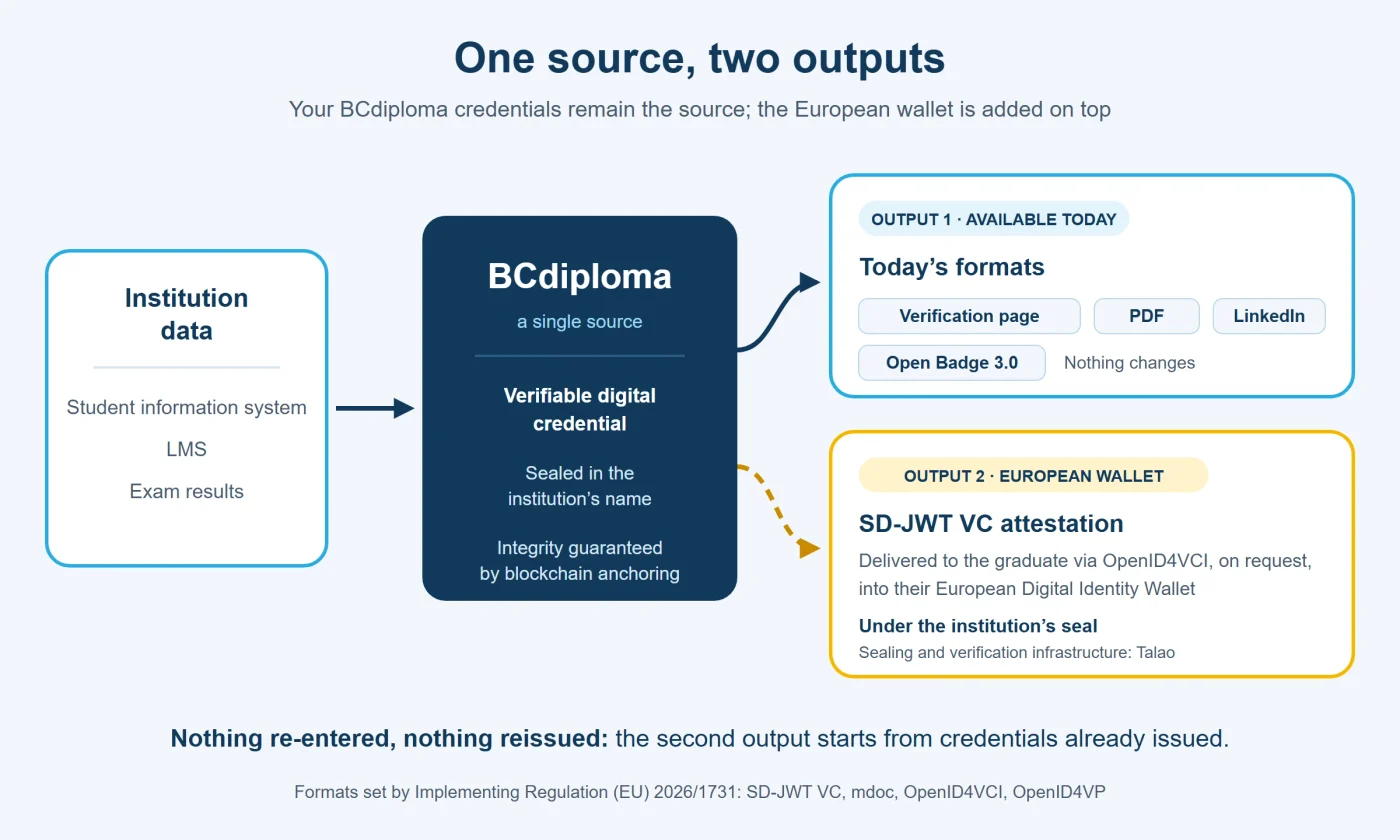
What we are adding is a second output. From the digital credentials already issued, a simple request from the graduate triggers issuance in the wallet format: an SD-JWT VC attestation, delivered to the graduate through the OpenID4VCI protocol, sealed in the institution’s name, and designed to be read by wallets that comply with the European framework.
Nothing is re-entered, and the institution reissues nothing: a credential issued in 2020 can be claimed in a wallet in 2027 by its holder, after their identity has been verified from their wallet. The diploma itself is still awarded under the national rules in force, and therefore under your current procedures; the attestation in the wallet does not change that.
What this asks of an institution: almost nothing technical, and a few governance decisions.
- The seal level: advanced when your verifiers know you, qualified for international mobility.
- The attributes that can be shown separately (degree, date, grade, specialisation).
- The revocation policy: who can withdraw an attestation, and how the verifier sees it.
These are institutional choices, not IT projects: we work through them with you.
BCdiploma and Talao: who does what
Talao is a French publisher of digital identity wallets that also provides an issuance and verification infrastructure in the European wallet formats. Its APIs and products are aligned with the reference architecture of the European wallet. Talao publishes its software as open source, takes part in the European APTITUDE pilot and was selected in 2026 by a Spanish public operator to integrate a European wallet.
BCdiploma runs the business chain: data, document templates, issuance and delivery management, life cycle, and conversion to the European formats. The institution seals, under its own name: it is the institution the verifier sees. Talao provides the technical infrastructure for sealing and for verification by API, in line with the protocols of the European framework.
A first pilot with a major French university
A first pilot run by BCdiploma and Talao is under way with a major French university during the 2026-2027 academic year.
- Phase 1, from December 2026 to January 2027: volunteer master’s students install a test wallet aligned with European standards, receive in it their official bachelor’s degree (licence) certificate already issued through BCdiploma, and check that it is valid. Everything happens in a test environment, under a test certificate, with no government-issued identity data: the aim is to validate the principle, the format and the user experience.
- Phase 2, in 2027: issuance under the university’s seal, with the holder’s identity checked from the wallet, to give the institution what it needs to decide on going live.
Further reading
- Regulation (EU) 2024/1183 (eIDAS 2), EUR-Lex.
- Implementing Regulation (EU) 2026/1731 (formats and protocols), EUR-Lex.
- Architecture and Reference Framework (ARF) v3.0.0, 21 July 2026.
- European Commission, EU Digital Identity Wallet.
- ENISA, consultation on the wallet certification scheme, April 2026.
- Europass, European Digital Credentials for Learning.
Frequently asked questions
Contact us for more information.
No. Credentials issued with BCdiploma remain the source; the wallet-format version is produced from the same data, when the holder requests it.
Not for your diplomas. The obligation concerns accepting the wallet to identify a person, at their request: for online public services as soon as wallets are available, and by the end of 2027 for certain private-sector organisations, including those in education. A university may therefore have to accept it to identify its students; this obligation covers neither accepting nor issuing diplomas.
The institution, with its electronic seal. BCdiploma and Talao run the technical chain on the institution’s behalf and do not appear as issuers.
Not always. An advanced seal is enough in many cases; a qualified seal becomes useful for international mobility, because it provides a public trust anchor recognised in all 27 member states. In both cases, the attestation remains the institution’s: a qualified seal does not make it a qualified attestation. The choice is made with you.
They keep being served exactly as they are today: verification page, PDF, LinkedIn, Open Badge.
No: it relies on standardised formats and electronic seals, and requires no particular infrastructure from the issuer. Blockchain anchoring of your BCdiploma credentials continues to guarantee their integrity and long-term verification; the wallet output is added on top without requiring anything more.
These are four separate ecosystems. Europass (European Digital Credentials for Learning) serves mobility and learning pathways in Europe; EBSI is the European blockchain services infrastructure, with diploma pilots; Open Badges 3.0 (1EdTech) cover badges and micro-credentials. They mainly rely on Verifiable Credentials (W3C). The European Digital Identity Wallet (EUDI Wallet), for its part, requires the SD-JWT VC and mdoc formats, and none of the three has, to date, an announced official bridge to it. “Europass compatible” therefore does not mean “wallet compatible”, and vice versa. BCdiploma already issues certified Open Badges 3.0 and has demonstrated its ability to issue EBSI-compatible credentials; the “European wallet” output is added, it replaces nothing.
After the pilot, and depending on your country’s wallet timeline. We will publish the pilot results and a country-by-country update.

