Digital badges are verified online credentials that document specific skills and achievements with embedded, checkable data. Unlike paper certificates, they can be confirmed in seconds, shared across professional networks, and linked directly to evidence of the work behind them.
The benefits of digital badges extend well beyond simple recognition. They give learners a portable, detailed record of their capabilities. They give employers fast, trustworthy proof of a candidate’s skills. And they give organizations a measurable tool for tracking program impact and expanding their brand reach.
This guide breaks down the benefits of digital badging for each stakeholder — and explains why forward-thinking institutions are making the shift now.
To understand the full landscape of digital credentials, explore our complete guide to digital badges.
What Are Digital Badges and How Do They Work?
A digital badge looks like a simple icon. Its real value lives in the data underneath it.
When someone earns a badge from your program, they receive a secure digital file containing structured, machine-readable information that tells the full story of the achievement. That data is what separates a meaningful credential from a decorative image.
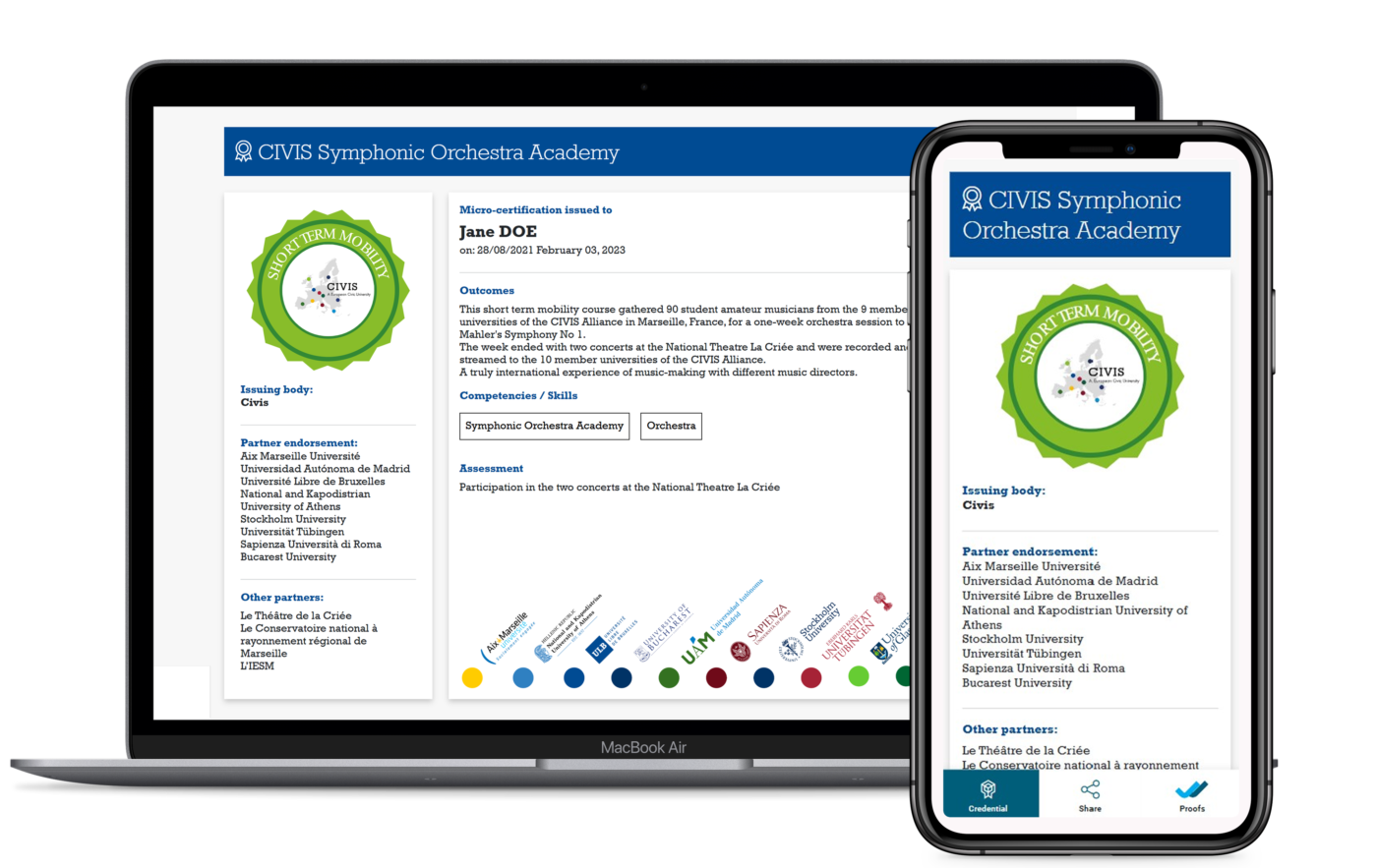
The anatomy of a modern digital badge:
- Issuer information — identifies the organization that awarded the badge and ties the credential to that institution’s reputation
- Earner details — confirms exactly who earned it and when
- Credential criteria — states precisely what the earner had to demonstrate or complete
- Supporting evidence — can include a link to a project, assessment result, or portfolio piece
- Timestamp and expiry date — shows when the badge was issued and, where relevant, when it expires — critical for time-sensitive certifications
This structured data layer is what makes a digital badge far more informative than a static PDF or paper certificate.
The Blockchain Advantage — Why Verification Matters
Many platforms can generate badges. Fewer can guarantee that those badges remain trustworthy over time.
A blockchain-enabled badging platform stores credential data on a shared, tamper-proof record. Once your organization issues a blockchain-secured digital badge, the underlying data cannot be altered. Any employer or institution can confirm the credential in seconds — without contacting the issuer, creating an account, or relying on manual processes.
For organizations operating in high-stakes environments — professional certifications, healthcare compliance, financial services — this level of built-in proof of integrity is not a luxury. It is a requirement.
Key Benefits of Digital Badges for Organizations
For education providers, training companies, and corporate learning teams, a digital badging program delivers measurable returns across brand visibility, data intelligence, and operational efficiency.
Benefit 1 — Extended Brand Reach Through Learner Sharing
When someone earns a digital badge, sharing it takes one click. Learners post their new credential on LinkedIn, embed it in email signatures, or add it to digital portfolios — and every share puts your organization’s name in front of a new professional audience.
This organic visibility works continuously, long after the credential is issued. Your learners become active advocates for your programs without any additional marketing spend. Over time, a consistent stream of shared badges builds measurable brand authority in your sector.

Benefit 2 — Actionable Analytics for Program Development
Modern digital badging platforms generate detailed engagement data that goes far beyond simple issuance counts. You can track which credentials are shared most frequently, which skills attract the highest learner engagement, and which pathways lead to the strongest career outcomes.
These insights make credentialing a strategic tool — not just an administrative process. They help you refine curriculum, demonstrate return on investment to stakeholders, and align your program offering with real-world employer demand.
Benefit 3 — Reduced Administrative Overhead
Automated badge issuance — triggered directly by LMS completions or API integrations — eliminates the manual steps that slow down traditional certificate workflows. Instead of generating, formatting, and distributing certificates by hand, your team sets the criteria once and lets the system handle delivery at any scale.
Benefits of Digital Badges for Employees and Learners
The strongest badging programs are built around learner outcomes first. When your credentials genuinely serve the people who earn them, engagement, completion rates, and program reputation all improve.
Digital Badge for Employees — Making Every Achievement Visible
One of the most practical benefits of digital badges for employees is visibility. Traditional training completions often disappear into internal HR records, invisible to anyone outside the organization. A digital badge changes that.
Digital badges for employees create a shareable, verifiable record of each skill developed — from onboarding modules and compliance training to advanced leadership programs. Employees can display these credentials on LinkedIn, include them in job applications, and use them to make a case for promotions or new responsibilities.
This visibility serves both the employee and the organization. Employees feel genuinely recognized for their development. Organizations build a culture where learning is visibly valued and rewarded.
Key benefits of digital badges for students, learners or employees include:
- Instant online confirmation — verifiable by any employer or institution without contacting the issuer
- Granular skill documentation — the ability to showcase specific, in-demand competencies beyond what a résumé captures
- Career mobility — a clear, portable advantage in competitive job markets
- A lifelong personal record — achievements remain accessible and shareable indefinitely, independent of any single employer or platform
Building a Verifiable Online Portfolio
A single digital badge documents one achievement. A structured collection of badges tells a far richer professional story.
As learners accumulate credentials across different programs, skills, and institutions, they build a dynamic, checkable portfolio — one that shows depth of expertise, breadth of experience, and a demonstrated commitment to continuous development. This portfolio format is particularly powerful on LinkedIn, where verified credentials are visible to hiring managers and professional networks simultaneously.
Compared with a static list of qualifications on a CV, a verified badge portfolio signals real-world capability in a way that is immediately trustworthy and easy to assess.
Benefits of Digital Badges for Employers
Digital badging for employers solves two of the most persistent challenges in talent acquisition and workforce development: the speed and reliability of skills verification.
Faster, More Reliable Screening
When hiring managers review a large volume of applications, time is the primary constraint. A verified digital badge cuts through that pressure immediately. Rather than contacting previous employers or waiting for manual certificate checks, a recruiter can confirm a candidate’s credential in seconds — with full confidence in the result.
That speed reduces hiring risk. It shortens time-to-decision. And it gives talent teams a reliable, standardized signal across candidates from different institutions and backgrounds.
Internal Talent Intelligence
Digital badging for employers does not stop at hiring. Internally, a structured badging program gives HR and L&D teams a real-time map of organizational capability.
When employees earn badges for completing training, mastering new tools, or reaching defined performance milestones, those credentials accumulate into a searchable record of team skills. That record informs succession planning, identifies skill gaps before they become business problems, and supports a culture of continuous improvement that employees can see and feel.

Benefits of Micro-Credentials and Digital Badges Working Together
The benefits of micro-credentials and digital badges are strongest when the two systems are designed to work in parallel — the micro-credential defines the assessed competency, and the digital badge makes it visible, portable, and shareable.
In practice, this means:
- A learner completes a focused, outcome-based micro-credential program
- Upon passing a rigorous assessment, they receive a digital badge as the verified visual record of that achievement
- The badge carries the full metadata of the micro-credential — issuer, criteria, evidence, and validity period
- The credential can be stacked with others over time, building toward a broader qualification or a more comprehensive skills profile
This combination gives institutions a powerful way to recognize granular skill development without waiting for learners to complete full degree programs. It gives learners a progressive, motivating path through their development. And it gives employers a precise, verified signal of role-specific readiness.
Benefits of Digital Badges and Certificates for Career Growth
For professionals navigating competitive job markets, the benefits of digital badges and certificates for career growth are both immediate and long-term.
In the short term, a verified credential signals current competency to a hiring manager who has neither the time nor the resources to manually verify every qualification in a candidate pool.
In the medium term, a portfolio of stacked credentials demonstrates commitment to continuous development — a quality that hiring managers, promotion committees, and professional networks increasingly value over static, point-in-time qualifications.
In the long term, the portability of digital badges means that every achievement remains part of a professional’s permanent, verifiable record — accessible from any device, shareable on any platform, and independent of any single employer’s internal HR system.
For professionals making career pivots, re-entering the workforce, or seeking recognition for skills developed outside formal education, digital badges provide a credible, employer-recognized alternative to traditional credentials.
Real-World Examples of Digital Badge Benefits
The flexibility of a modern badging platform means its benefits can be realized across many learning and training environments. By looking at some digital badge examples, you will see how different sectors stand to benefit.
Higher Education
The benefit of digital badges in education is how they help recognize accomplishments beyond formal transcripts or certificates. They help students get recognition for a variety of other accomplishments and engagement, such as research, public speaking, or co-curricular programs.
Corporate Training and Professional Development
Companies that issue digital badges with a quality digital badge maker see immediate benefits in engagement. Badges awarded to employees for completing training or achieving a new internal certification make professional development more rewarding, and help them showcase these new accomplishments on their LinkedIn profiles.
Professional Associations and Certification Bodies
For organizations issuing industry certifications, the security benefits of these modern credentials are a major draw. They offer a secure, shareable and fraud-proof alternative to traditional certificates, protecting the integrity of the issuer and its credentialing program.
BCdiploma — A Digital Badging Platform Built for Impact
By adopting a blockchain-enabled digital badging platform like BCdiploma, your organization moves beyond modernizing its certificate process. It invests in the long-term credibility of every credential it issues.
BCdiploma combines blockchain-secured verification, Open Badges 3.0 compliance, native LMS integration, and a full white-label design studio — giving institutions the infrastructure to issue credentials that learners want to share, employers can trust, and programs can build their reputation on.
Frequently asked questions
Contact us for more information.
Digital badges are verified online credentials embedded with structured data about a person’s skills or achievements. Unlike paper certificates, they can be confirmed instantly, shared on platforms like LinkedIn, and linked to direct evidence of the work. That combination of speed, detail, and portability makes them significantly more useful than static documents.
A well-designed badge holds rich metadata: issuer details, earner information, the specific criteria required to earn it, supporting evidence, and a timestamp or expiry date. This data provides context and trust — confirming who issued it, who earned it, what was required, and whether it remains current.
A blockchain-enabled platform stores credential data on a shared record that cannot be altered after issuance. This means verification is instant, online, and requires no contact with the issuing organization — eliminating manual checks and removing the possibility of credential fraud.
Organizations gain expanded brand reach as earners share credentials across professional networks, plus detailed analytics on learner engagement, in-demand skills, and program effectiveness. Together, these turn credentialing from an administrative task into a strategic growth tool.
For employees, digital badges make every skill visible, support career progression through documented achievements, and build a portable, verifiable professional portfolio — particularly valuable on LinkedIn. For employers, digital badging accelerates candidate screening, reduces hiring risk, and provides ongoing intelligence about internal skill development and workforce readiness.