TL;DR: Key takeaways
- Digital badges for students are verifiable online credentials that show a specific skill, task, or result — richer than a transcript line, and checkable by anyone in one click.
- Each badge includes metadata: issuer, earning criteria, proof of work, and issue date.
- Students use them to showcase granular skills (like a single Python or design project), boost their online presence on LinkedIn and in portfolios, and stay motivated through a clear skill-building path.
- Schools benefit from higher engagement and skill tracking; employers get faster, checkable proof of specific abilities instead of a degree alone.
Digital badges for students are online credentials that show a skill, a task, or a result. They are easy to share and easy to check. They are more than a picture, because they also include data about the issuer, the rules, and the proof of the work.
In a fast-moving school world, digital badges for college students can show code, design, leadership, and other skills. They also help students stand out when they apply for jobs, internships, or grad school.
Schools can create digital badges for students in a few steps. When creating digital badges for students, the key is to keep each badge tied to one clear skill and one clear proof. Awarding digital badges and micro-credentials for student achievements gives schools a simple way to track growth.
Table 1: Steps to implement a badging program
| Step | Action required | Outcome |
|---|---|---|
| 1. Planning | Define the skill and assessment criteria. | Clear learning objectives. |
| 2. Design | Create visual assets aligned with brand guidelines. | A professional, recognizable badge. |
| 3. Issuing | Use a secure platform to “mint” and send the badge. | The earner receives the credential. |
| 4. Verification | Maintain cryptographic proof of the badge. | Employers can verify the badge forever. |
What are digital badges for students?
At their core, digital badges are simple visual signs of what you have done. But they are much more than a pretty image.
Each badge includes metadata. This data lists the issuer, the rules for earning it, the proof of work, and the issue date. This makes every badge unique and traceable. These aren’t just for club activities. Digital badges in education are now part of how schools recognize success.
A school can issue a badge for a stats project. It can also award one for a strong science fair. A badge can show formal learning and real-world skill. The Open Badges standard lets badges move across tools and platforms, so your skills stay easy to share.
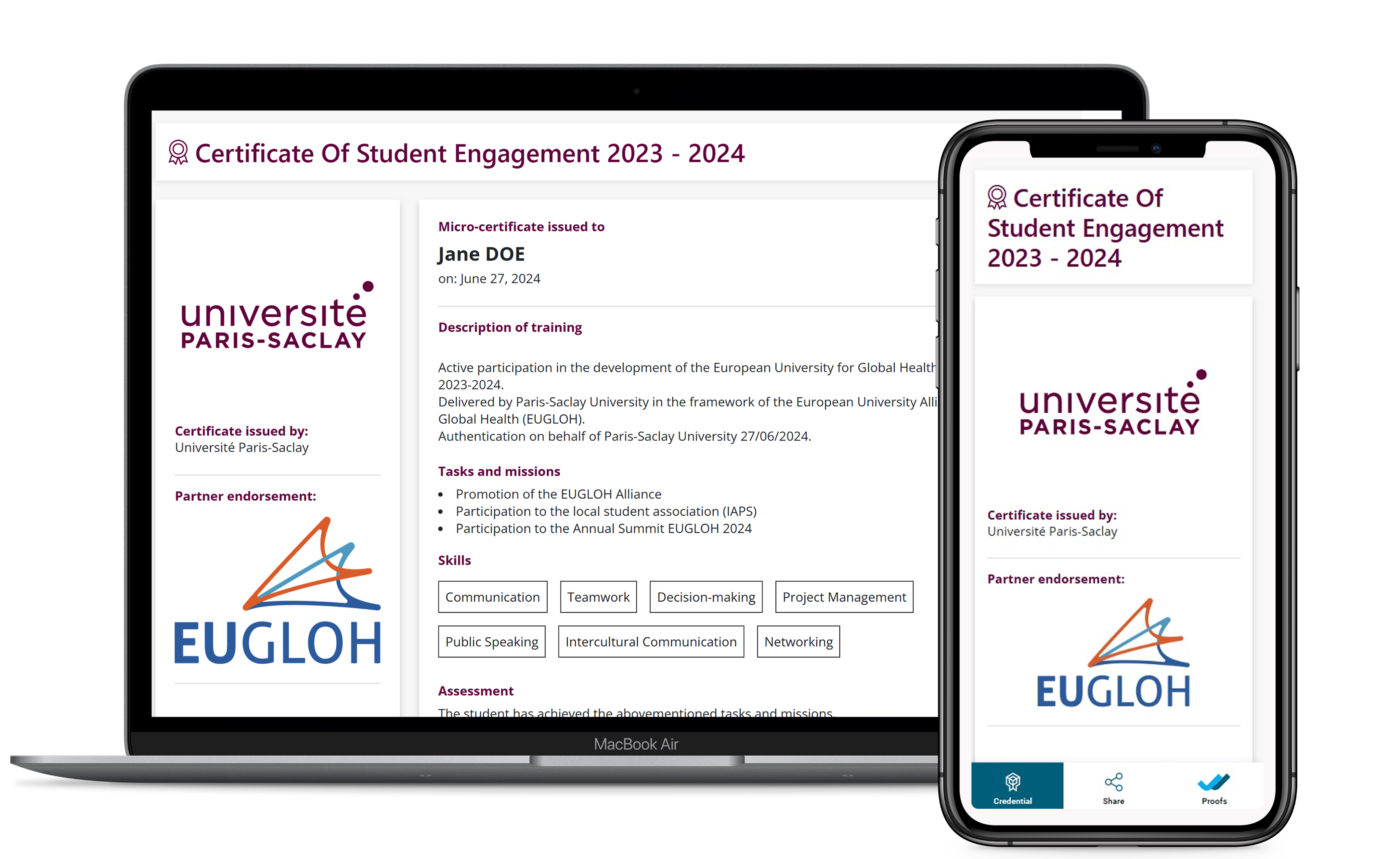
For example, Université Paris-Saclay issues a digital badge to students participating in the European University Alliance for Global Health (EUGLOH) — recognizing international collaboration alongside academic coursework, not just a single class project.
Table 2: Timeline of digital badges and Open Badges frameworks
| Year | Milestone |
|---|---|
| 2011 | The Mozilla Foundation, backed by the MacArthur Foundation, launches Open Badges 1.0 as an open, free technical standard for issuing digital achievements. |
| 2012 | Mozilla releases the Public Beta of the Open Badge Infrastructure, making the technology publicly available; the Badge the UK campaign grows to 120+ issuing organizations. |
| 2013 | U.S. President Bill Clinton commits, via the Clinton Global Initiative, to expanding Open Badges access to 2 million students and workers — a target exceeded within a year. |
| 2016 | Open Badges 2.0 is published as the first widely adopted version, adding endorsements, internationalization, and full JSON-LD support. |
| 2017 | Stewardship of the Open Badges specification formally transfers from Mozilla to IMS Global Learning Consortium. |
| 2018 | Over 24.1 million Open Badges have been issued to date, according to figures reported by the standards body. |
| 2022 | IMS Global rebrands as 1EdTech Consortium, continuing to lead the standard’s evolution. |
| Today | Open Badges 3.0 integrates with W3C Verifiable Credentials and blockchain anchoring, aligning with the European Learning Model for cross-border recognition. |
What’s inside a digital badge?
So, what is inside one of these digital credentials?
- The issuer: Who awarded the badge? A school, a company, or an online learning platform.
- The earner: That’s you, the student.
- The rules: What did you need to do to earn it? For example, pass a test, finish a project, or show a skill.
- The proof: A link to the work you did, like a project file, a talk, or code.
- The issue date: When you got the badge.
Table 3: Traditional certificates vs. digital badges
| Feature | Traditional paper certificate | Digital badge |
|---|---|---|
| Format | Physical paper or static PDF | Dynamic, data-rich digital file |
| Verification | Requires contacting the university | Instant one-click online verification |
| Detail Level | Broad (e.g. degree title) | Granular (e.g. specific coding skill) |
| Portability | Difficult to share widely | Easy social sharing and embedding |
| Security | Susceptible to forgery and alteration | Unforgeable and tamper-proof |
This verifiable structure is what gives a digital badge its power. It’s concrete proof of your knowledge and abilities. To dive deeper into how badges are issued, verified, and used, check out our complete guide to digital badges.
How digital badges help students build their careers?
For students, the benefits are clear. Digital badges for students give a better view of what you know than a transcript alone.
Showcase granular skills
A college degree is a major win. But it may not show the exact skills you picked up along the way. Did you learn Python in a data science class? Did you build a design project in a marketing course? A badge can show each of these distinct skills.
This is why many schools use micro-credentials. These are small, focused awards for one skill. Examples of digital badges for students are a Python badge, a design badge, a data analysis badge, and a team leadership badge. Students can collect these over time and build a strong profile.
Boost your online presence and career prospects
Once you earn a badge, you can share it. Add it to LinkedIn with one click. Put it in your portfolio, email signature, or website.
This makes your skills visible to recruiters, mentors, and peers. When a hiring manager clicks a badge, they can see the rules and the proof behind it. That is far stronger than a line on a resume. It helps you stand out in a crowded job market.
Stay motivated and follow a path
The process of earning badges can be a strong motivator. It turns learning into a game with clear steps.
Instead of one final exam, students work toward a series of small wins. This breaks big topics into simple goals. It also gives students a clear path to follow. If you want to become a project manager, you can look for badges in agile work, risk control, and team leadership. Digital badges guide your learning path and help you build the skills you need.
The win-win: benefits for schools and hiring teams
While the benefits of digital badges for students are many, the ecosystem of digital badges thrives because it offers immense value to educational organizations and the professional world as well.
Why educational institutions love digital badges
For schools, colleges, and training groups, badges are a simple way to raise interest and improve programs.
- More engagement: Badges make success visible and rewarding. This helps with class work and club work.
- Skill tracking: Schools can use badges to track progress and check learning goals.
- Work links: Awarding digital badges and micro-credentials for student achievements shows a clear link between class work and career skills.
- Brand reach: When students share badges online, they also share the name of the school.
Table 4: Adoption of micro-credentials among higher education leaders
| Metric | Figure | Source |
|---|---|---|
| Higher ed leaders who believe micro-credentials strengthen students’ career outcomes | 94% | Coursera Micro-Credentials Impact Report, 2024 |
| Institutions currently offering micro-credentials | 51% | Coursera Micro-Credentials Impact Report, 2024 |
| Of those, institutions that also grant academic credit for micro-credentials | 53% | Coursera Micro-Credentials Impact Report, 2024 |
| Non-adopting institutions planning to launch micro-credentials within 5 years | 68% | Coursera Micro-Credentials Impact Report, 2024 |
| Institutions reporting embraced credentialing initiatives (2025) | 53% | UPCEA / Modern Campus, 2026 |
| Same figure in 2021, for comparison | 54% | UPCEA / Modern Campus, 2026 |
Institutions can use digital badge maker services or a comprehensive platform to create digital badges that align with their unique learning goals and academic standards. From initial proposals to final design, the process allows for a custom and meaningful credentialing system.
How companies benefit from digital badges
Companies want more than a degree. They want defined, checkable skills.
A portfolio of digital badges lets a hiring manager see what a person can do. It also makes it easier to check the skill behind the badge. This is useful for tech jobs where tools, code, or software skills matter.
Digital badges for employees also support internal training. Companies can use them to upskill staff, reward progress, and build a culture of ongoing learning.
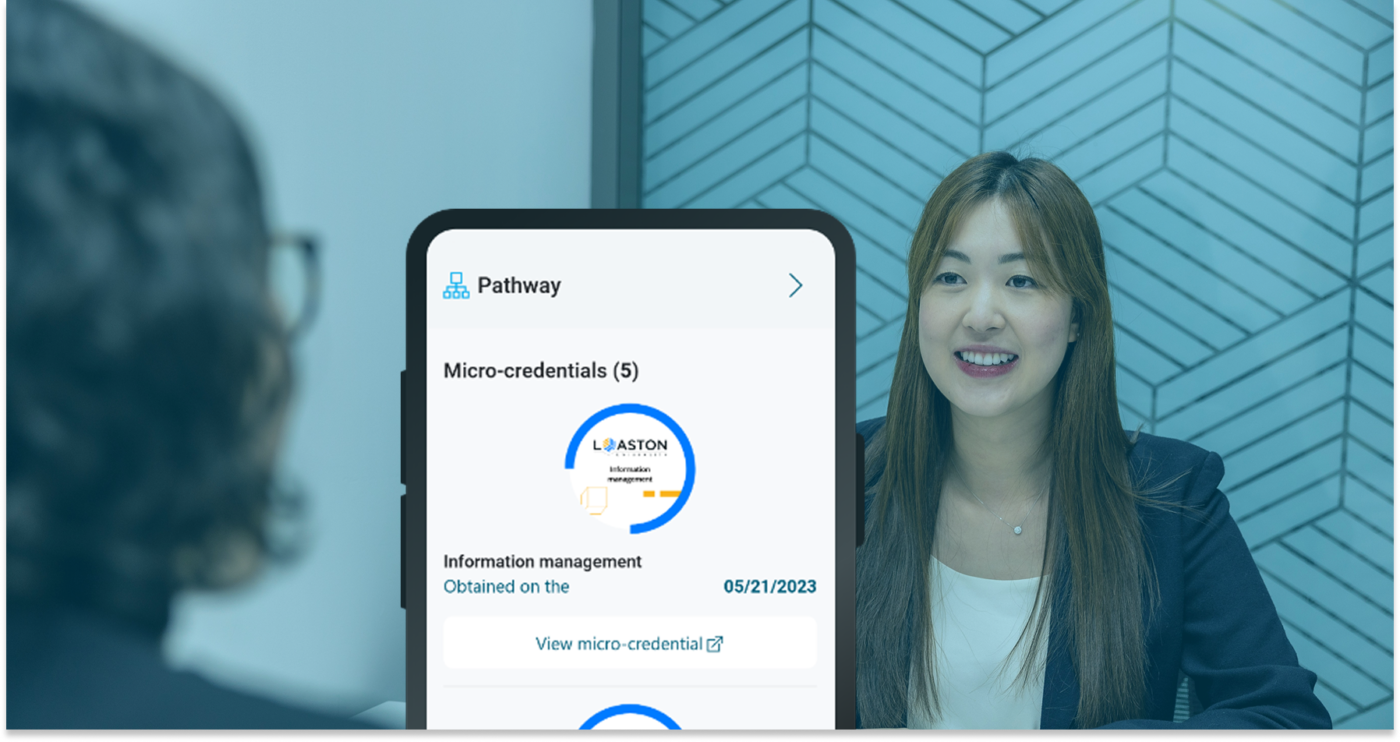
Digital badges for employees are also used for internal professional development. Companies can create their own badging programs to upskill their workforce, recognize achievements, and promote a culture of continuous learning. This approach helps create a clear framework for professional advancement within an organization. There are many digital badge examples of companies using them to foster talent. You can even find free platforms to experiment with the process.
The future is verifiable, portable, and secure
The value of a digital credential comes from trust. Anyone can make a PNG icon. A real badge must be secure and easy to check. This is where blockchain technology helps.
By tying digital badges to a blockchain, they become hard to tamper with. The record sits on a shared, encrypted ledger. It cannot be changed or faked. This gives students, schools, and companies a strong level of trust. The best digital badge examples from top universities and new companies use this same base of trust.
It means the badge you earn is yours for life. Anyone can check it at any time, from anywhere. Choosing a blockchain-based badging solution such as BCdiploma helps protect the integrity of your credentials and keep them shareable for years. It turns a simple badge into a safe, lifelong record of your skills.
Frequently asked questions
Contact us for more information.
Digital badges are online credentials with rich data. They show who issued them, what you had to do, proof of your work, and the issue date. That makes them more useful than a static paper record.
Badges can cover class work and club work. They can show a science project, coding skill, leadership, or a micro-credential for one skill.
They are easy to share on LinkedIn, in a portfolio, or on a website. Recruiters can open the badge and see the proof, which builds trust and helps you stand out.
Schools use badges to boost engagement, track skills, and link learning to work. Employers use them to spot clear skills fast. Blockchain makes the record hard to fake, so the badge stays valid over time. Choosing a blockchain-based badging solution such as BCdiploma helps protect the integrity, portability, and longevity of your credentials.
Digital badging in higher education is the structured process by which universities define competencies, design badge assets, and issue them through secure, Open Badges-compliant platforms — turning specific academic and co-curricular achievements into portable, verifiable credentials that live independently of the student’s transcript.
Institutions typically start with pilot programs in a single department or executive education track, then scale using LMS integrations and automated issuing platforms once assessment criteria and design standards are established.