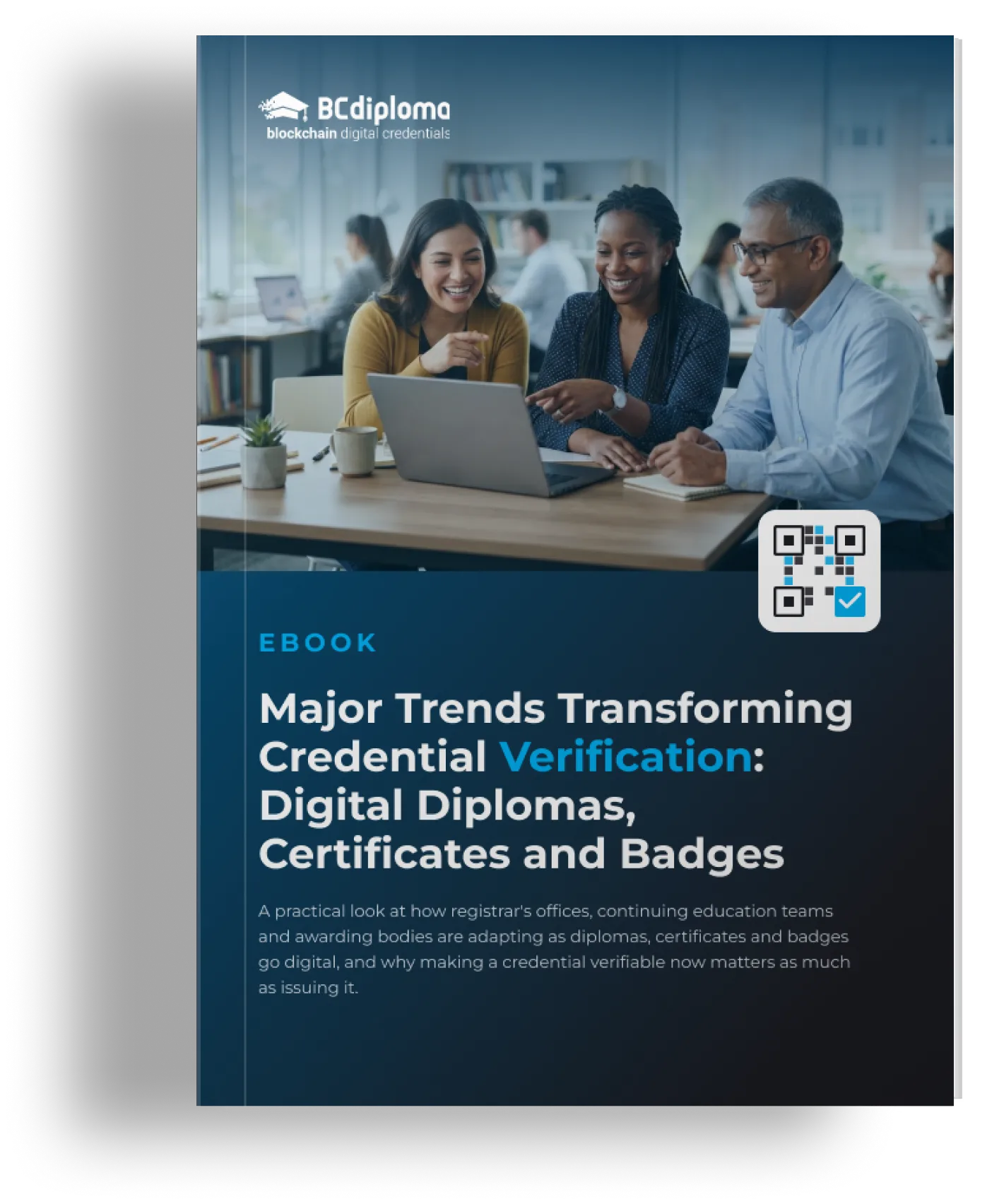
FREE EBOOK
Major Trends Transforming Credential Verification: Digital Diplomas, Certificates and Badges
Rising verification requests, AI-assisted fraud, credentials that keep evolving after they're issued: a sourced ebook for universities, business schools, education providers and awarding bodies.
- Understand what's changing
Two gaps and three sourced trends, from fraud to evolving credentials, so you know what's coming for your organization.
- Take action
Three case studies, a four-step roadmap and a six-question self-assessment.
Why credential verification is now an issuer's problem
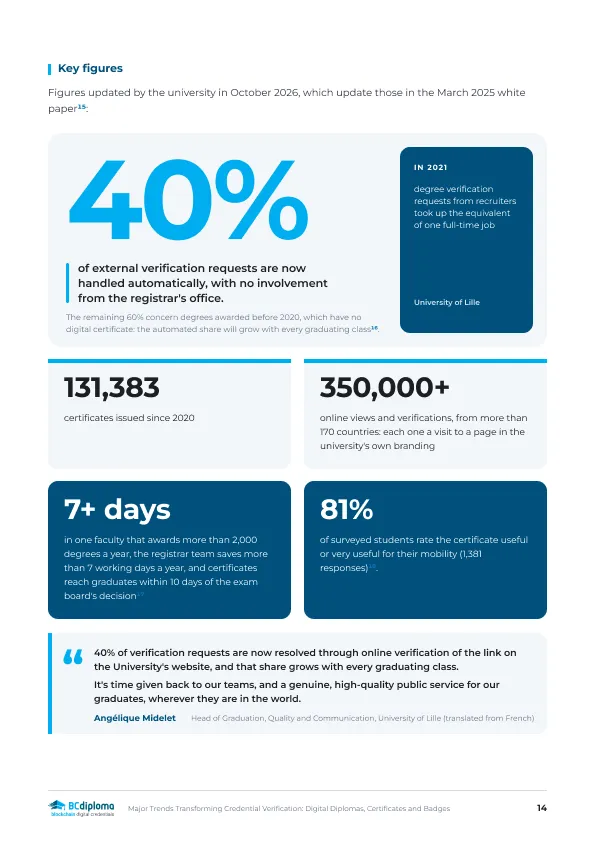
Credential verification is the process of confirming that a diploma, certificate or badge was issued by the organization named on it and is still valid. A digital diploma is not automatically verifiable. A PDF can be edited in a few clicks, and AI tools make fakes easier to produce: Gartner predicts that by 2028, one in four candidate profiles worldwide could be fake. When a recruiter has doubts, they contact the issuer. At the University of Lille, those requests once took up the equivalent of a full-time job. A verifiable credential changes that: anyone can check its authenticity and current status from a link or a QR code, without contacting the issuer. Since its certificates became verifiable online, the University of Lille handles 40% of external verification requests automatically.
ABOUT THE EBOOK What you'll find inside
A short, sourced ebook to decide where to start, without replacing your tools.
between "digital" and "verifiable"
from fraud to evolving credentials
University of Lille, ETS Global (TOEIC®), eCampusOntario
to see where your organization stands
Key figures
40% of external verification requests handled automatically at the University of Lille (University of Lille, October 2026)
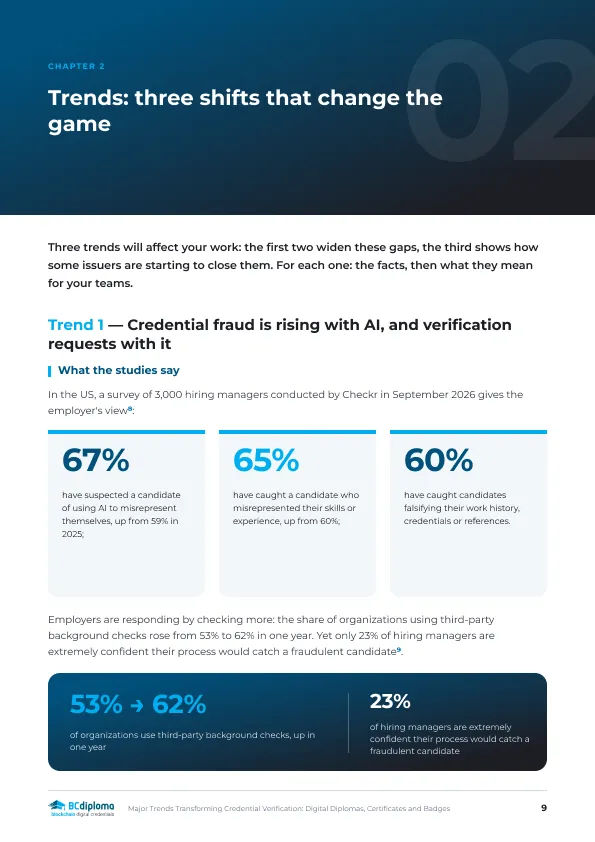
60% of US hiring managers have caught candidates falsifying work history, credentials or references (Checkr, 2026)
×3.7 expected growth of the alternative credentials market by 2034 (Fortune Business Insights, 2026)
500,000+ verifiable digital TOEIC® score certificates issued in 2025 (ETS Global, 2025)
The 3 trends at a glance
1. Credential fraud is rising with AI
Employers see more fraudulent applications and are checking more. Every check lands on the issuer: the university, education provider or awarding body.
2. Alternative credentials are gaining ground
Micro-credentials, professional certificates and digital badges are multiplying. When a recruiter doesn't know the issuer, only verifying the credential itself makes it possible to trust it. Our ebook Major Trends Transforming Skills Recognition covers them in depth.
3. From frozen credentials to evolving credentials
A credential can now grow after it is issued, as long as every addition is dated, tied to the issuer and verifiable. A frozen PDF can't do that.
Issuers who got ahead of these trends





1EdTech · Open Badges 3.0BCdiploma has been 1EdTech Open Badges 3.0 certified since February 2026.
DOWNLOAD THE EBOOK
Get your free copy
Loading…
Frequently asked questions
A diploma is verifiable when anyone can check its authenticity on their own, without contacting the institution. It is shared as a link or a QR code, its proof is tied to the issuer's official domain, and its status (valid, suspended, revoked) is shown in real time. The ebook covers these four properties and a four-step roadmap.
Digital credential verification means checking, from a link or a QR code, that a diploma, certificate or badge was really issued by the organization named on it and that it is still valid. It lets anyone verify digital credentials without contacting the issuer, because the proof is tied to the issuer's official domain. This is what the industry calls verifiable credentials.
They open the link or scan the QR code: the page shows the issuer and the credential's current status. They can also paste the link into the public Credential verification page to see the proofs recorded on the blockchain. For credentials from other issuers, see our guide on how to verify the authenticity of an online certificate.
When a credential is issued, an unreadable fingerprint of it (a hash) is recorded on a blockchain. Anyone who opens the credential's link or scans its QR code sees the issuer and its current status, and the check compares the credential with that record, so an altered copy no longer matches. With BCdiploma's patented technology, credentials stay verifiable and permanently accessible without third-party dependencies. The University of Lille has issued more than 130,000 digital degree certificates this way.
No. A PDF or a scan is still an editable file, and nothing in the file says whether it's still valid. Only a verification link tied to the issuer shows that it is authentic and up to date. See how traditional and digital diplomas compare.
It's a credential that grows after it is issued: each skill validated later is added to it, dated and verifiable. The French school aivancity launched one for its graduates in 2026, and 47% of eligible graduates signed up in the first round.
No. Verification is added at the moment of issuance: you keep your student information system, your LMS or your certification tool, connected through ready-made connectors, Zapier or an API.
Teams that issue credentials: registrar's offices at universities and business schools, continuing education units and education providers, and awarding bodies.
Can anyone verify your credentials today?
Find out in six questions with the ebook's self-assessment, then talk it through with an expert if you'd like.