TL;DR:
Micro credentials in higher education are short, competency-based qualifications issued by universities and training providers to verify specific skills. Universities use them to support lifelong learning, improve graduate employability, and respond faster to labour market needs. Often issued as secure digital badges, they provide verifiable proof of skills that learners can share with employers. As demand for flexible education grows, micro-credentialing is becoming a strategic priority for higher education institutions worldwide.
The higher education sector is undergoing a major transformation driven by changing workforce needs, lifelong learning expectations, and the growing demand for verified skills. For decades, universities relied on degrees as the primary way to certify knowledge and prepare students for employment. Today, that model is evolving. Employers increasingly expect candidates to demonstrate practical, up-to-date skills that can adapt to rapidly changing technologies and business needs.
This shift explains the rapid growth of micro credentials in higher education. Rather than replacing traditional degrees, these shorter, competency-based qualifications complement them by recognising specific knowledge and skills that can be acquired throughout a learner’s career.
From artificial intelligence and cybersecurity to leadership, sustainability and healthcare, universities are creating flexible learning opportunities that help students and professionals continuously develop new competencies. Combined with digital badges and secure verification technologies, micro credentials are becoming a trusted way to connect education with employment.
What are micro-credentials in higher education?
A micro credential in higher education is a short, competency-based qualification issued by a university, college or accredited training provider to certify that a learner has successfully demonstrated a specific skill or learning outcome.
Unlike a traditional degree, which covers a broad curriculum over several years, a micro credential focuses on one clearly defined competency. In other words, micro credentials in higher education measure what learners can demonstrate, not simply how long they have studied. Learners can usually complete it within a few hours, days or weeks depending on the programme.
Micro credentials are designed to be:
- Flexible: learners can study around professional and personal commitments.
- Skills-focused: they target specific competencies rather than broad academic fields.
- Employer-relevant: they are often aligned with current workforce needs.
- Stackable: multiple micro-credentials can be combined to build broader learning pathways.
- Digitally verifiable: achievements can be securely shared through digital badges.
Many institutions now issue them as digital badges, allowing learners to share verified achievements on LinkedIn, CVs and digital portfolios.
Rather than measuring the amount of time spent in a classroom, micro credentials demonstrate what a learner is actually capable of doing.
Micro-credentials meaning in education
The micro credentials meaning in education goes beyond simply earning a smaller qualification.
Micro-credentials represent a shift from measuring education through time spent learning to measuring demonstrated capabilities.
Traditional qualifications often combine multiple learning outcomes into one final diploma. Micro-credentials break these outcomes into smaller, measurable achievements that can be recognised individually.
For example, a university student studying business could earn separate micro-credentials in:
- digital marketing strategy;
- data analysis;
- project management;
- artificial intelligence literacy;
- leadership skills.
Each achievement provides evidence of a specific competency that can be communicated to employers.
The value of micro-credentials in education for learners, universities and employers
| Stakeholder | How micro-credentials create value |
|---|---|
| Learners | Micro-credentials help students and professionals demonstrate specific skills, improve employability, build personalised learning pathways and showcase achievements through digital badges and online portfolios. |
| Universities | Micro-credentials allow higher education institutions to create flexible learning models, reach lifelong learners, strengthen industry partnerships and develop new educational pathways beyond traditional degrees. |
| Employers | Micro-credentials provide clearer evidence of candidate capabilities, helping organisations identify verified skills and make more informed hiring decisions. |
This shift explains why micro credentials in education have become one of the fastest-growing trends in lifelong learning. By focusing on demonstrated competencies rather than time spent studying, micro-credentials create a more flexible connection between education, skills and employment.
Why are micro-credentials transforming higher education?
Several major forces explain why micro credentialing in higher education has accelerated over the last few years.
The labour market changes faster than university programmes
Technological innovation continues to reshape nearly every profession. Artificial intelligence, automation, cybersecurity and data analytics are evolving so quickly that traditional degree programmes cannot always update their curricula at the same pace.
Employers therefore increasingly recruit based on demonstrated competencies rather than academic titles alone.
Micro credentials help bridge this gap by allowing universities to certify emerging skills much faster than a complete programme redesign.
Lifelong learning is becoming the norm
Education no longer ends at graduation. Professionals now expect to update their knowledge several times throughout their careers. Rather than returning to university for another multi-year degree, many prefer shorter learning experiences focused on one practical objective. Micro credentials make continuous learning accessible by allowing professionals to acquire new competencies without interrupting their careers.
This flexibility explains why governments, universities and employers are investing heavily in lifelong learning.
Why employers increasingly value micro-credentials
Employers are increasingly moving towards skills-based hiring. While university degrees remain valuable, recruiters want clearer evidence that candidates can apply their knowledge in real-world situations. A micro credential provides this proof by validating a specific competency through a structured learning and assessment process.
The data behind the rise of micro-credentials in education is unambiguous. Recent industry data supports this trend. A massive 96% of employers agree that micro-credentials strengthen a candidate’s job application. Furthermore, 90% are willing to offer higher starting salaries to those holding relevant badges. The message is clear: competency counts. If you can prove you possess the skills, the job is yours.
How can institutions adapt to the rise of micro-credentials?
Higher education and other institutions must adapt to a new reality: learners are no longer only 18-year-old students entering a traditional four-year degree.
Today’s learners include professionals, career changers and lifelong learners who need flexible learning opportunities that fit around their personal and professional commitments.
This transformation represents both a challenge and an opportunity. Universities face increasing demographic pressure, including declining numbers of traditional college-aged students. Relying exclusively on traditional degree programmes may limit their ability to attract future generations of learners.
By implementing micro credentialing in higher education, institutions can create more flexible and accessible learning pathways while responding to changing workforce needs.
Micro credentials allow universities and institutions to:
- Attract new audiences: reach adult learners, professionals and career changers beyond traditional degree students.
- Create new revenue opportunities: develop short, targeted programmes that complement existing degrees and reach learners who cannot commit to a full degree.
- Strengthen industry connections: build programmes aligned with employer expectations and regional workforce needs.
- Increase learner engagement: use stackable credentials and smaller learning milestones to motivate students throughout their educational journey.
- Extend institutional visibility: enable learners to share digital badges online, increasing awareness of the university and its programmes.
For higher education institutions, micro credentials are therefore not simply an additional type of certificate. They represent a strategic approach to lifelong learning, helping universities remain competitive while supporting learners at every stage of their careers.
The value of digital badges and micro-credentials in higher education
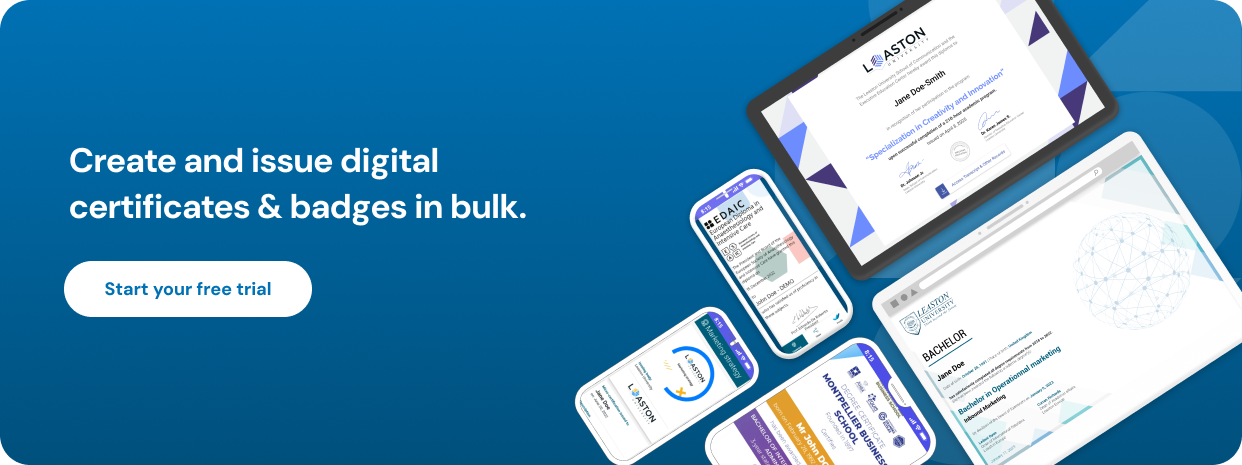
Micro credentials become even more powerful when combined with digital badges. Digital badges are the visual and verifiable representation of a micro-credential. They contain metadata that proves who issued the credential, what skill was achieved, and how it was earned.
A micro credential proves that a learner has achieved a specific competency. A digital badge provides a secure, shareable representation of that achievement.
Together, digital badges and micro-credentials in higher education create a transparent way to communicate skills between learners, universities and employers.
Unlike traditional certificates, digital badges can include:
- issuer information;
- learning outcomes;
- assessment criteria;
- evidence of achievement;
- verification data.
This makes credentials easier to share, verify and understand.
The market explosion and future projections
The growth in the global market for micro-credentials is staggering and sustained. Analysts project the digital badges market will continue to grow at a Compound Annual Growth Rate (CAGR) of over 17% through 2032, indicating that this is a long-term shift, rather than a temporary trend.
The following table summarizes some key statistics and projections for the sector:
| Metric | Statistic | Source |
|---|---|---|
| Market value | Projected to reach $117 Billion by 2026 (combined with online degrees) | HolonIQ |
| Employer trust | 96% of employers value micro-credentials on resumes | Coursera Impact Report |
| Hiring trends | 65% of employers prioritize skills-based hiring over degrees | NACE Data |
| Salary impact | 90% of employers offer higher pay for micro-credential holders | Coursera Impact Report |
These numbers prove one thing, that the business of education is booming for those who adapt. Micro-credential platforms are the infrastructure powering this boom, allowing organizations to issue, manage and verify certificates with pace and ease.
What do successful programs look like?
You might be wondering what these courses look like in practice. Micro credentials examples vary widely across industries. However, as AI becomes a common tool used across society, focus is shifting to both technical mastery of it and uniquely human skills:
- AI & Tech: Generative AI Fluency, Prompt Engineering, Python for Data Science, and Cybersecurity Defense.
- Human Skills: Critical Thinking, Cross-Functional Collaboration, Negotiation, and Emotional Intelligence.
- Business: Agile Project Management, Digital Marketing Strategy, and Remote Team Leadership.
- Healthcare: Telehealth Protocols, Patient Data Privacy, and Mental Health First Aid.
Each of these examples targets a specific competency. They allow a professional to upskill without putting their careers on pause. They help organizations fill specific gaps and current demands in their workforce.
How will blockchain transform credentialing?
Trust is the currency of the digital age. How do you know a digital certificate is real? This is where blockchain technology steps up.
Is fraud a real threat to digital learning?
Yes, most digital files can be copied or faked, whether it’s by Photoshop, Canva, or generative AI. However, a blockchain-based credentials provide a highly secure and tamper-evident way to verify achievements. Not only that, it is immutable and enduring. When a school issues a badge on the blockchain, it creates a permanent record.
Why do learners prefer blockchain credentials?
Learners want ownership. They want a certificate they can keep forever. They do not want to rely on a university’s server staying online. Blockchain gives the student full control. They can share their verifiable credential with any employer or job-seeker network, anywhere in the world, at any time. It is the ultimate promise of portability.

Summary: critical insights for the future of skills
We have covered the explosive growth of the micro-credential market and its impact on the global workforce. From the changing demands of employers to new opportunities for educators, the shift is clear:
- Micro-credentials better bridge the gap between education and employment.
- Employers are willing to pay a premium for verified, specific skills, including in AI and human-centric roles in particular.
- Blockchain technology ensures trust and portability for these digital certificates.
- Schools must adapt their offerings to include flexible, short-term learning options in order to survive the demographic cliff.
- The market is projected to continue its rapid growth in the coming years.
The ultimate solution for your credentials
Ready to issue secure, tamper-proof credentials? BCdiploma provides turnkey, blockchain-based solutions for education and training institutions, ensuring every digital badge is instantly verifiable. And it delivers lifelong, employability-boosting assets for learners.
Our white-label solution will integrate seamlessly with your own systems, keeping your brand front and center while you provide the gold standard in digital credentialing.
Frequently asked questions
Contact us for more information.
The biggest trends include: AI fluency as a baseline skill, A resurgence of human skills, like critical thinking and empathy, that AI cannot replace, The move from experimental pilot programs to structured, institution-wide implementation of digital badges
Micro-credentials in higher education are short, competency-based certifications issued by universities, colleges, or training providers to formally verify a specific skill or area of expertise. They can be earned in days to weeks, are often stackable toward broader qualifications, and are issued as verifiable digital badges that learners can share instantly with employers.
A certification is often a broad, industry-standard exam (like a CPA for accountants, CFA for financial analysts, or PMP, for project managers). A microcredential is typically more specific, focusing on an individual skill or competency, or a set of granular skills. However, the lines are definitely blurring as microcredentials become more and more recognized and widely used.
Not entirely. While degrees provide a broad foundation, micro-credentials offer specialized, just-in-time learning. That is, specific learning that satisfies specific, immediate demands. Micro-credentials are, in fact, complementary to university degrees, and many institutions now offer stackable credentials that stack up to or provide credits for a full degree.
Yes. In the current hiring landscape, the vast majority of employers see them as a strong signal of continuous learning and of specific skills acquisition, preferring them particularly for technical and technological roles where skills undergo rapid change.
The value of digital badges and micro-credentials in higher education is three-dimensional: for learners, they provide a portable, verifiable proof of specific skills that complements their degree; for institutions, they open new revenue streams and attract non-traditional students; for employers, they provide fast, reliable, cryptographically confirmed evidence of role-specific competencies.