
If you’ve ever felt like your resume undersells what you can actually do, or that you’re one step behind in meetings full of technical jargon, you’re not alone. Technical proficiency is one of the most in-demand — and most misunderstood — qualities employers look for today. The good news: it’s not a fixed trait. It’s a skill set you can deliberately strengthen, often faster than you’d think.
TL;DR
– Technical proficiency = technical knowledge + applied skill + consistent execution. It’s the functional baseline that becomes technical expertise with time.
– No official taxonomy defines it, but 5 skills come up consistently: analytical skills, data analysis skills, network management, project management skills, and technical knowledge.
– You can accelerate it with 5 practices: learn by doing, focus on one skill gap at a time, reverse-engineer expert workflows, teach what you learn, and use tight feedback loops.
– On your resume, list specific tools and quantified results — not vague claims like “proficient in various technical tools.”
– Since resumes are self-reported, verified digital credentials (e.g. via BCdiploma) are becoming the standard way recruiters confirm technical skills are real.
What Is Technical Proficiency?
Technical proficiency refers to your ability to apply specific tools, systems, methods, or technical knowledge effectively to complete tasks and solve problems within a given field. It’s less about memorizing facts and more about doing — using what you know to produce reliable, accurate results.
Technical Proficiency Meaning and Definition
By definition, technical proficiency combines three things:
| Component | What it means |
|---|---|
| Technical knowledge | Understanding how systems, tools, or processes work |
| Applied skill | The ability to use that knowledge in real situations |
| Consistency | Performing tasks accurately and efficiently, not just occasionally |
So what does technical proficiency mean in practice? Someone who is technically proficient can pick up a new tool, understand a technical brief, troubleshoot a problem, and deliver a working result — without needing constant guidance.
Technical Proficiency vs. Technical Expertise
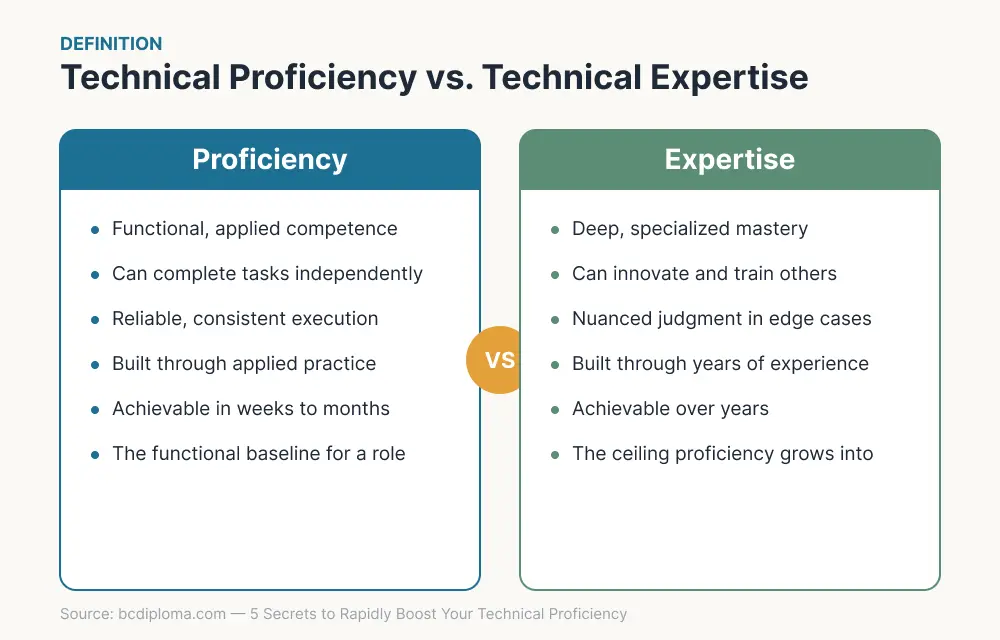
It’s worth distinguishing proficiency from technical expertise, which implies a deeper, often specialized mastery built over years. Proficiency is the functional baseline; expertise is what proficiency becomes with enough time and depth.
| Dimension | Technical Proficiency | Technical Expertise |
|---|---|---|
| Depth | Functional, applied competence | Deep, specialized mastery |
| Independence | Completes tasks without supervision | Can innovate and train others |
| Judgment | Reliable, consistent execution | Nuanced judgment in edge cases |
| Timeline | Weeks to months | Years |
| Role | The baseline for a job | The ceiling proficiency grows into |
The Core Components of a Strong Technical Skillset
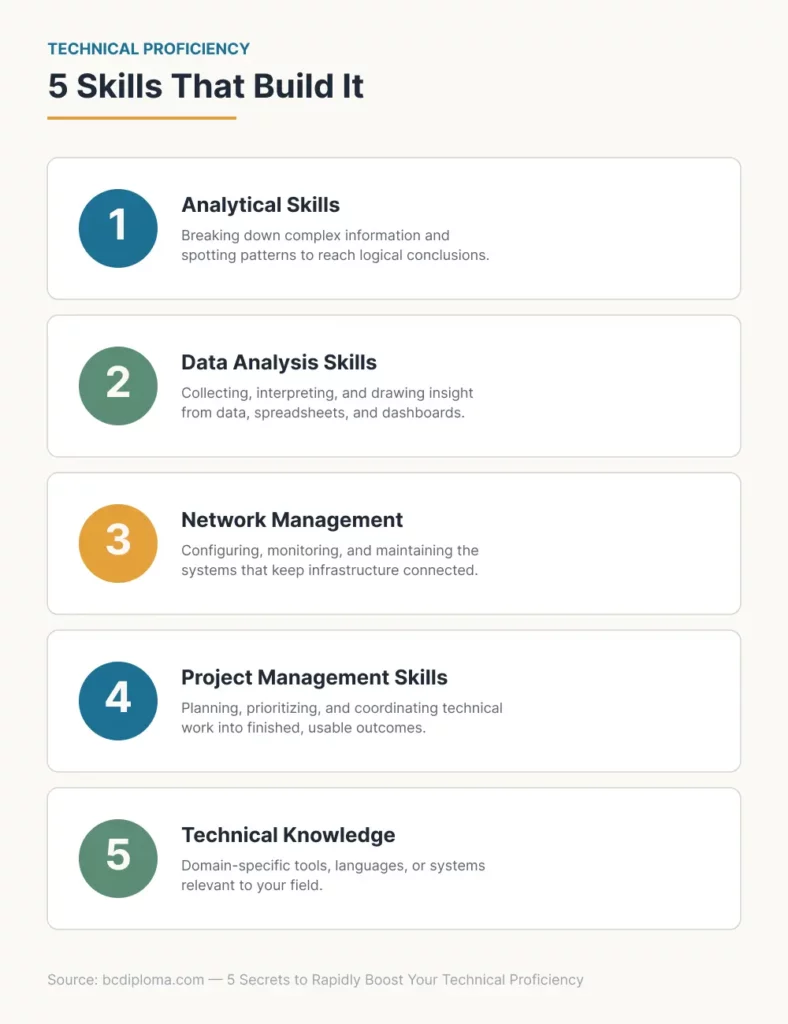
Technical proficiency isn’t one single skill — it’s an umbrella covering several interconnected competencies. There’s no single official taxonomy that defines it, but these five come up consistently across job descriptions, resume guides, and skills frameworks like LinkedIn’s:
| Skill | What it covers | Why it matters |
|---|---|---|
| Analytical skills | Breaking down complex information, spotting patterns | Diagnose problems instead of guessing |
| Data analysis skills | Collecting, interpreting, and drawing insight from data | Data literacy is now cross-industry |
| Network management | Configuring, monitoring, maintaining systems | Core to IT and infrastructure roles |
| Project management skills | Planning, prioritizing, coordinating technical work | Turns knowledge into delivered outcomes |
| Technical knowledge | Domain-specific tools, languages, systems | The foundation everything else builds on |
5 Secrets to Rapidly Boost Your Technical Proficiency
You can’t fake years of experience, but you can accelerate how quickly you become genuinely competent. Here’s how.
Secret 1: Learn by Doing, Not by Watching
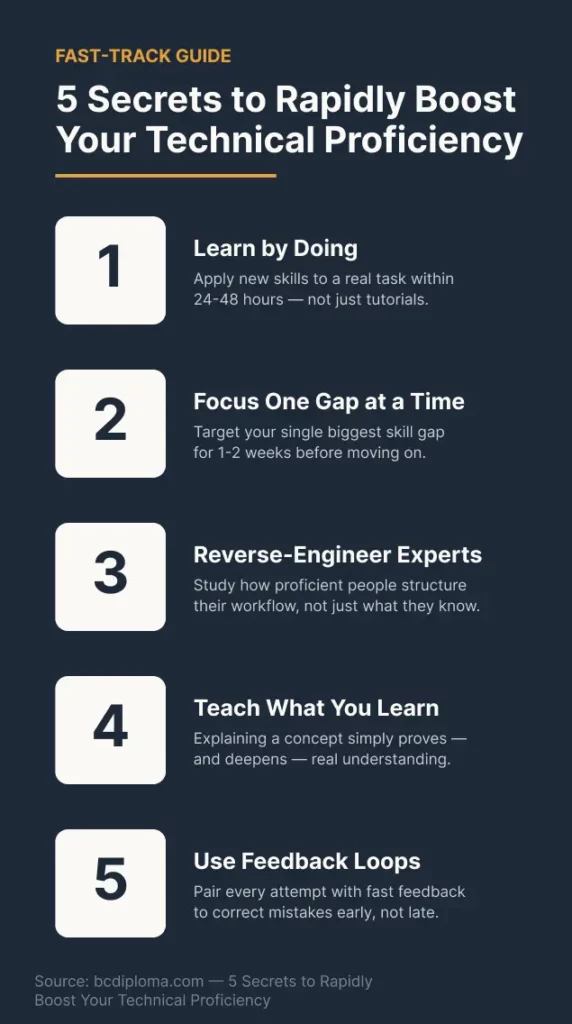
Passive learning (tutorials, videos, courses) builds familiarity, not proficiency. The fastest way to become technically proficient is to apply a new tool or skill to a real task within 24–48 hours of learning it. Pick a small, low-stakes project and use the new skill immediately — repetition under real conditions builds muscle memory far faster than theory alone.
Secret 2: Focus on One Skill Gap at a Time
Trying to upgrade five skills simultaneously spreads your attention too thin. Identify the single skill gap that’s currently limiting you most — often data analysis or a specific software tool — and focus deliberate practice there for one to two weeks before moving to the next.
Secret 3: Reverse-Engineer Expert Workflows
Find someone technically proficient in your field and study how they work, not just what they know. Watch how they structure a project, troubleshoot an error, or manage a network configuration. Modeling an expert’s process shortcuts a lot of trial and error.
Secret 4: Practice Explaining What You Learn
Teaching — even informally, to a colleague or in your own notes — forces you to organize technical knowledge into clear, logical steps. If you can explain a concept simply, you actually understand it. This is one of the fastest ways to convert surface-level knowledge into real proficiency.
Secret 5: Use Feedback Loops, Not Just Practice
Practice alone can reinforce bad habits. Pair every new skill attempt with fast feedback — a code review, a manager’s input, a tool’s built-in error log, or peer feedback. Tight feedback loops correct mistakes early, which is far faster than practicing blind for weeks.
How to Showcase Technical Proficiency on Your Resume
Building the skill is half the job — communicating it clearly is the other half. A technical proficiency resume section should be specific, not vague.
Avoid: “Proficient in various technical tools”
Instead, try:
– List concrete tools, platforms, and methods (e.g., “Advanced Excel, SQL, Google Analytics, Agile project management”)
– Quantify results where possible (“Reduced reporting time by 30% using automated data analysis workflows”)
– Group skills by category
| Category | Technical proficiency skills examples |
|---|---|
| Data & Analytics | Excel, SQL, Tableau, Google Analytics |
| Network & Systems | Network administration, cloud infrastructure, troubleshooting |
| Project Management | Asana, Jira, MS Project, Agile/Scrum |
| Programming | Python, JavaScript, scripting languages |
| Business Software | CRM (Salesforce, HubSpot), ERP systems |
Recruiters scan resumes quickly — specific, verifiable skills stand out far more than generic claims of being “technically proficient.”
Proving It’s Real: Verified Credentials Matter
There’s a catch with any resume, no matter how well it’s written: it’s self-reported. Recruiters have no easy way to confirm that the certifications, diplomas, or technical training you list are genuine — and inflated or fabricated credentials remain a widespread problem in hiring.
This is where verified digital credentials come in. BCdiploma, a company specializing in blockchain-based digital credentialing since 2017, lets institutions issue diplomas, certificates, and skill badges that are tamper-proof and instantly verifiable — no phone calls to a registrar required. Each credential comes with a unique link that anyone, including a recruiter, can check in real time against the blockchain record, confirming it hasn’t been altered or fabricated.
For anyone building technical proficiency skills through certifications, bootcamps, or professional training, this matters twofold:
– For learners: a verified credential is a permanent, portable proof of the skills you’ve built — one you fully own and can share with a single link, for life.
– For employers: it removes the guesswork from evaluating a candidate’s technical background, cutting down on credential fraud during hiring.
As technical skills become more central to hiring decisions, the ability to prove proficiency — not just claim it — is becoming as important as the skill itself.
Final Thoughts
Technical proficiency isn’t a fixed talent — it’s built through deliberate, applied practice. By focusing on real-world application, targeting one skill gap at a time, learning from experts, teaching what you learn, and using fast feedback loops, you can noticeably sharpen your technical skillset in a matter of weeks, not years. Pair that growth with a resume — and verified credentials — that clearly showcase specific, measurable skills, and you’ll stand out as genuinely, and provably, technically proficient.
Frequently asked questions
Contact us for more information.
It’s the demonstrated ability to apply technical knowledge and tools effectively and consistently to complete tasks within a specific field.
It typically means a candidate or employee can use the required tools, systems, or methods for their role independently and reliably, without extensive supervision.
Not quite. Proficiency is functional competence — you can do the job well. Expertise implies a deeper, more specialized mastery, usually built over a longer period.