
TL;DR: Key takeaways
• The invisible problem: Managing and issuing diplomas/certificates is often perceived as a minor administrative detail, yet it hides massive operational costs (manual Excel exports, constant reliance on IT teams for template updates, error management, and duplicate requests).
• The limitations of LMS platforms: Learning Management Systems are not built to deliver secure certifications at scale. They merely generate frozen PDFs, creating blind spots during audits or recruiter verifications.
• The urgency in 2026: Expectations have shifted. Learners now demand instant, shareable digital credentials, while recruiters and accreditation bodies require immediate, tamper-proof verification.
• The solution: Automating the process through solutions like BCdiploma, which integrate with existing systems (LMS, SIS) to eliminate manual tasks. The result: institutions like CEMS or Montpellier Business School reducing the time spent on credential management by up to 98%.
For higher education institutions and training providers alike, managing credentials is one of the most time-consuming and least visible operational challenges. Here’s what it’s actually costing you.
Nobody budgets for diploma management. That’s the problem.
Ask any director of academic affairs or training program manager what their biggest operational pain points are. You’ll hear about enrollment, accreditation, learning outcomes, staff shortages. Rarely will anyone mention diploma and certificate issuance.
And yet, when you actually map the process from graduation results to final delivery in a learner’s hands, the hours add up fast. IT teams are called in for every template update. Administrative staff spend days cross-referencing spreadsheets before each graduation. Emails go unanswered. Duplicates are requested weeks later. Errors slip through.
The cost of all this is real. It’s just invisible, until it isn’t.
The statu quo: what “managing credentials” actually looks like in 2026
Whether you run a university with 10,000 students per year or a training organization delivering certifications across dozens of cohorts, the underlying process often looks surprisingly similar.
It starts with a data export from your Student Information System, your LMS, or more often than not, a spreadsheet that someone has been maintaining since 2019. That data gets cleaned, formatted, and handed off. Then comes the design step: someone IT, an administrative assistant, an external provider updates the diploma template. Then individual files are generated, checked, and sent. One by one, or in batches that inevitably contain errors.
For higher education institutions, this cycle repeats once or twice a year at scale, right when teams are already stretched by end-of-year processes. For training organizations, it repeats with every cohort, every program, every session.
The result: credential issuance is one of the most time-consuming tasks in the organization, and one of the least strategic.
The LMS problem nobody talks about
For training organizations specifically, there’s an additional layer of friction that rarely makes it into vendor conversations: the LMS.
Learning Management Systems are built to deliver learning. They do this well. But they were not designed to issue verifiable, traceable, fraud-proof credentials at scale. The certificate export function most LMS platforms offer is, at best, a PDF generator. At worst, it’s a template frozen in time, requiring an IT intervention every time a logo changes, an accreditation is updated, or a new program is launched.
This isn’t a bug. It’s a design limitation and one that costs real time every single cycle.
The workaround most organizations have built: a patchwork of exports, manual formatting, third-party tools, and email sends that nobody has ever properly audited for time or error rate. It works until it doesn’t. Until a learner receives a certificate with the wrong date. Until a recruiter tries to verify a credential and can’t. Until an audit asks for documentation of issuance for 3,000 certificates across four years.
What the hidden costs actually look like
The direct costs of credential issuance; printing, postage, physical storage are easy to see and already falling as institutions go digital. The indirect costs are much harder to quantify, which is exactly why they persist.
- IT mobilization. Every time a diploma template needs to be updated; new logo, new accreditation mention, new program name, someone from IT has to be involved. In most higher education institutions, this is not an exception. It’s the norm. IT teams are called upon for every curriculum change, every graduating class, every accreditation update. These are hours that don’t show up in any credential-management budget line, because they’re absorbed into general IT operations.
- Administrative overhead per cohort. For training providers running multiple cohorts per year, the administrative cost of certificate issuance compounds quickly. Excel exports, manual layouts, individual sending, error management, duplicate requests, each step requires human attention. Multiply that by 20, 50, or 100 cohorts per year and the numbers become significant.
- Error management and duplicates. Lost certificates, incorrect data, undelivered emails, each incident creates a support loop that absorbs time from administrative teams who have higher-priority work to do. In institutions that have measured this properly, duplicate and correction requests alone can represent a substantial portion of total issuance time.
- The audit exposure. Perhaps the most underestimated cost: the inability to rapidly produce verifiable proof of issuance when required. Whether for accreditation audits, employer verification requests, or regulatory compliance, organizations that rely on manual or semi-manual processes face a documentation challenge that only becomes visible and expensive when it’s too late.
CEMS measured this. After switching to a fully digital credential system, they saved 15 person-days per year just on issuance administration. Montpellier Business School reduced the time their teams spent on certificates by 98%. These aren’t marginal gains. They’re the result of replacing a process that was never designed for scale with one that was.
Why this is becoming urgent, not just inefficient
Until recently, the cost of credential issuance was a nuisance. Today, it’s becoming a strategic liability for two reasons.
- First, learner expectations have shifted. A learner who completes a program in 2026 expects to receive their credential quickly, digitally, and in a format they can immediately share with employers and their network. A PDF attachment sent three weeks after graduation if it arrives at all is not that. It’s the last impression your institution makes on every graduate. It should not be an afterthought.
- Second, credential verification is now a real expectation. Recruiters, HR teams, and increasingly funding bodies and accreditation agencies expect credentials to be verifiable instantly, without contacting your institution. A credential that can’t be verified online is, for practical purposes, a credential that doesn’t fully exist in the current professional ecosystem. Organizations that don’t account for this are already behind.
What moving forward actually looks like
The good news: the gap between the statu quo and a modern credential issuance infrastructure is smaller than most organizations expect in terms of both implementation time and budget.
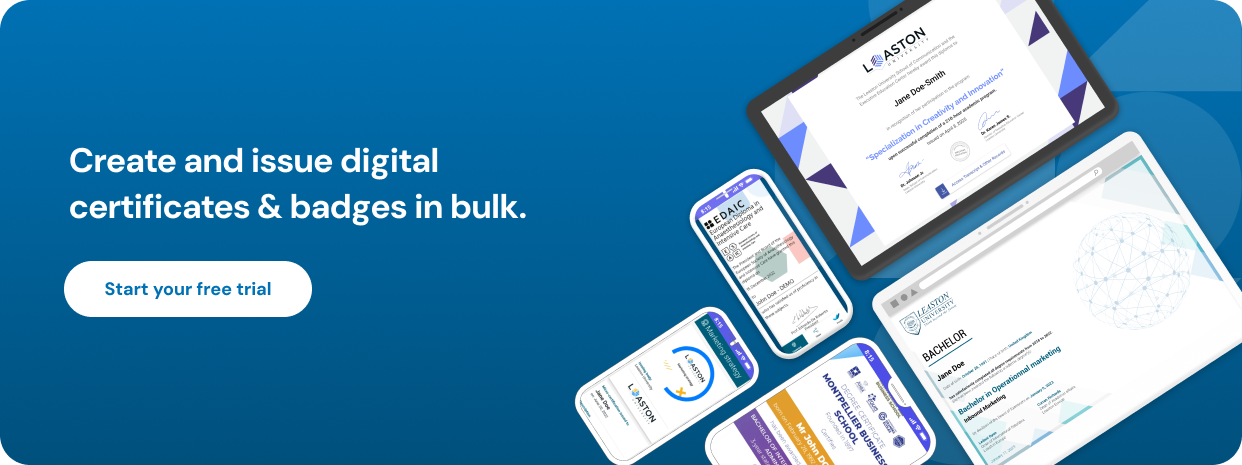
The right credential issuance solution integrates directly with your existing systems: SIS, LMS, ERP via API, eliminating the manual export-and-format cycle entirely. When a graduation is confirmed, credentials are generated and sent automatically. Each credential is unique, tamper-proof, and verifiable by any employer with a single click. Templates are managed without IT involvement. Duplicates are handled by the learner directly.
The result isn’t just time saved. It’s a process that finally matches what your institution or organization is actually trying to achieve: recognizing achievement in a way that’s meaningful, visible, and lasting.
The institutions that moved early are already ahead
The maturity gap in credential issuance is wider than it might appear from the outside. Some institutions have been running fully automated, verifiable credential systems for several years. Others are still on Excel.
The difference isn’t size, budget, or technical sophistication. It’s whether credential issuance has ever made it onto the strategic agenda or whether it’s been treated as an administrative detail too minor to warrant serious attention.
In 2026, that distinction matters. Learners share their credentials publicly. Recruiters verify them. Accreditation bodies increasingly expect them. And the institutions that made the move early are spending their administrative capacity on things that actually move the needle not on certificate logistics.
Why should an organization choose the BCdiploma solution?
BCdiploma helps higher education institutions and training organizations automate credential issuance, eliminate manual processes, and issue verifiable digital diplomas and certificates at scale. Institutions using BCdiploma have reduced credential management time and costs by up to 90%.
Want to see what this looks like for your organization? Schedule a meeting with our team.