TL;DR: Key takeaways
• The rules of institutional reputation have changed and most higher education institutions haven’t caught up yet.
• Since 2024, QS ranks graduate employability as a dedicated, weighted criterion. Employers have moved to skills-based hiring at scale. And prospective students no longer start their research on your website; they go to LinkedIn to see where your graduates work.
• The institutions pulling ahead share one move: they issue verifiable digital credentials that graduates share publicly, link back to the program, and stay visible on LinkedIn indefinitely. 60% of graduates share their credential the moment they receive it turning every graduating class into an organic recruitment campaign for the next one.
Graduate outcomes are now a ranking criterion. Student recruitment now happens on LinkedIn before it happens on your website. And according to Workday’s 2025 research, 96% of companies have now adopted skills-based hiring. For higher education institutions, the diploma is no longer just a final administrative step, it’s a strategic lever. Here’s how leading institutions are using it.
The rules of the game have changed and the rankings reflect it
For decades, university rankings rewarded research output, academic reputation, and faculty ratios. Graduate employability was a narrative, not a metric.
That changed in 2024. QS implemented a methodological overhaul, introducing Employment Outcomes as a dedicated indicator making QS the only major ranking to explicitly emphasize both employability and sustainability in its core methodology. Combined with the existing Employer Reputation indicator which already carries a 15% weighting in the flagship QS World University Rankings, graduate employability now represents a significant and measurable share of how your institution is evaluated on the global stage.
The implications are direct: institutions that cannot document and demonstrate what happens to their graduates after graduation are no longer just missing a narrative. They’re missing points.
And QS isn’t alone. The Financial Times MBA rankings have long weighted employment outcomes as a primary pillar. THE’s rankings incorporate graduate employability through their Industry Income and Citations indicators. The signal across all major ranking systems is consistent: what your graduates become matters as much as what your faculty publishes.
Skills-based hiring is not a trend, it’s the new baseline
The shift in how employers recruit graduates is equally structural. Globally, according to TestGorilla’s 2025 State of Skills-Based Hiring report, 85% of companies are now using skills-based hiring in 2025, up from 81% in 2024 and 73% in 2023 and 67% of employers are using resumes less than before, marking a measurable move away from traditional credential-first screening.
What this means for your graduates and your institution is significant. A degree on a CV tells a recruiter that a candidate completed a program. It says nothing about which skills were acquired, at what level, or how they can be verified.
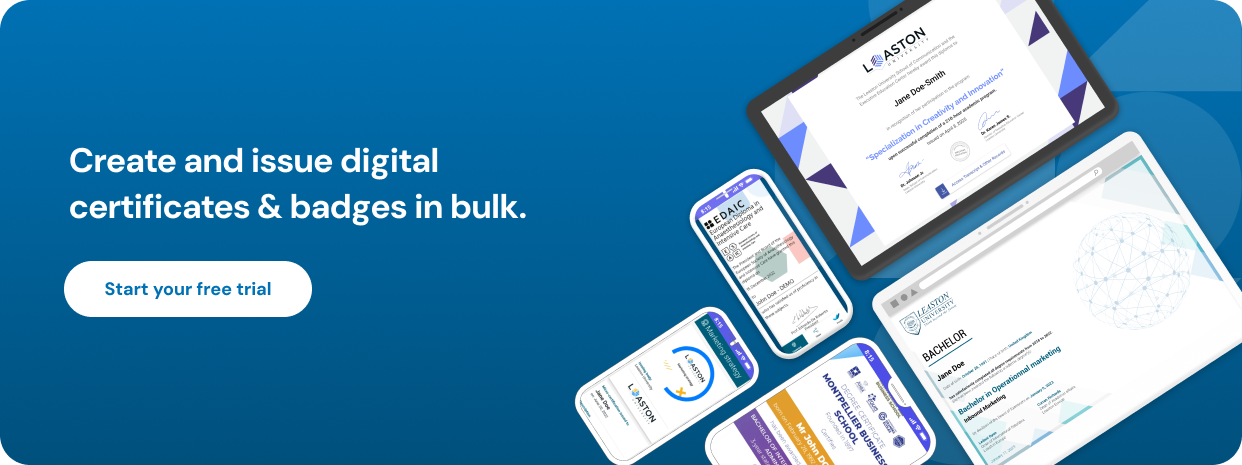
A Digital Credential answers exactly that question. It is not a reformatted diploma, it is a structured, tamper-proof document that details acquired competencies, links back to your institution’s program page, and can be verified instantly by any recruiter, anywhere, without contacting your admissions office.
The difference, from a recruiter’s perspective: one ends up in a folder. The other is visible, clickable, and shareable on LinkedIn where the hiring conversation increasingly begins.
Where your graduates go, so does your reputation
Here is the mechanism most institutions have not yet fully internalized: every graduate who shares their credential on LinkedIn is doing active marketing for your institution to an audience of recruiters, future students, and their parents.
LinkedIn’s “Licenses & Certifications” section highlights credentials directly on graduate profiles, reinforcing their credibility and visibility to the professional network. When a graduate posts their credential, it reaches their connections which typically include classmates, colleagues, and hiring managers. It contains a direct link to your program page. It carries your institution’s name and branding. And it circulates without any additional budget or effort on your part.
60% of graduates who receive a verifiable digital credential share it publicly on LinkedIn. Multiply that by a graduating class of 500, 1,000, or 5,000 students and the organic reach generated by a single graduation cycle is substantial.
This is the mechanism that turns your alumni network from a passive list into an active visibility asset. The institutions that understand this are not running more advertising. They are issuing better credentials and letting each cohort work for the next one.
Visibility as a recruitment tool: what leading institutions are doing differently
The most forward-thinking institutions in Europe have stopped thinking about the diploma as the end of the student journey. They think of it as the beginning of the alumni relationship and as the most powerful proof point they can put in front of prospective students.
Consider what a prospective student actually does before choosing an institution in 2026. They do not start with the brochure. They search LinkedIn for graduates of the programs they’re considering. They look at where those graduates work, what titles they hold, and how quickly they got there. They look for signals of real-world value not institutional claims.
A graduate who has shared a verifiable credential from your institution, linking directly to the program, with their competencies listed and employer-verified, is the most credible marketing asset you have. No copywriter can produce what a real graduate’s career trajectory communicates.
The institutions winning the enrollment battle are not necessarily spending more on marketing. They are making their graduates more visible and that visibility is compounding year on year.
The white-label credential: your brand, not the platform’s
One detail that matters significantly for brand-conscious institutions: not all digital credentials are equal in how they represent your institution.
BCdiploma’s digital diplomas are 100% white-label. Each credential is hosted on your domain, under your brand, and links directly to your program pages not to BCdiploma’s platform. This means the SEO value of each shared credential accrues to your institution. The backlinks point to your site. The brand that appears when a recruiter clicks is yours.
This is not a minor technical distinction. It is the difference between a credential that builds your institution’s digital authority and one that builds a third party’s.
From passive alumni to active ambassadors
Alumni engagement has long been an institutional priority for fundraising, for mentoring programs, for industry connections. Digital credentials create a new dimension of alumni engagement that requires no active management: every shared credential is a public endorsement, issued at the moment of pride, and visible indefinitely.
For institutions that invest in structured alumni networks, verifiable credentials provide a natural integration point. Graduates who share their credentials are more likely to remain connected to their institution’s community, more likely to mentor current students, and more likely to recommend the institution to their own networks.
The credential becomes the first touchpoint in a long-term alumni relationship rather than a piece of paper that ends up in a drawer.
What this looks like in practice
Institutions using BCdiploma’s verifiable credentials have documented outcomes across three areas:
- Visibility: With an average sharing rate of 60% on LinkedIn and professional networks, each graduating class generates thousands of organic brand impressions directly in front of recruiters and prospective students without any additional media spend.
- Ranking exposure: Institutions that document and can demonstrate graduate employment outcomes are better positioned to submit reliable data for QS Employment Outcomes and Employer Reputation indicators; two criteria that now represent a meaningful share of the overall score.
- Administrative efficiency: The credential issuance process is fully automated and integrated with existing SIS and LMS systems, eliminating manual generation and distribution, freeing your teams to focus on outcomes, not logistics.
The window for early-mover advantage is still open but narrowing
The gap between institutions that have activated their graduates as a marketing and reputation asset and those that haven’t is growing. The former are building compounding visibility: each cohort adds to the public record of graduate outcomes, strengthening the institution’s profile with recruiters and prospective students alike.
The latter are still issuing paper diplomas, or digital files that live in email inboxes and never reach LinkedIn, never generate a backlink, and never contribute to employer reputation surveys.
The ranking methodology shift has already happened. The skills-based hiring shift has already happened. The behavioral shift in how prospective students research institutions has already happened.
The question is not whether to adapt. It is whether to adapt now or spend the next two years watching the gap widen.
Why should an organization choose the BCdiploma solution?
BCdiploma helps higher education institutions and training organizations automate credential issuance, eliminate manual processes, and issue verifiable digital diplomas and certificates at scale. Institutions using BCdiploma have reduced credential management time and costs by up to 90%.
Want to see what this looks like for your organization? Schedule a meeting with our team.