
TL;DR: Key takeaways
• Micro-credentials are mini-qualifications that formally certify a specific skill or competency through short, focused training and rigorous assessment.
• They provide a flexible, fast, and cost-effective alternative to traditional, multi-year university degree programs.
• The three main types are academic, professional/industry, and technical micro-credentials.
• Organizations use digital badges containing rich metadata to make these short-form credentials portable, stackable, and instantly verifiable.
• Higher education leaders, training providers, and corporate HR teams lean heavily on them to bridge today’s pressing skills gaps and support lifelong learning.
What are micro-credentials?
Micro-credentials are small-scale, targeted certifications that formally verify an individual has mastered a specific skill, competency, or discrete body of knowledge. Unlike a traditional multi-year diploma, a micro-credential focuses narrowly on a single technical or professional capability, providing a high-density, high-speed path to proof of expertise.
These modern awards represent a major structural shift in global education and professional training. Instead of evaluating a student based on time spent in a lecture hall (the traditional credit-hour model), micro-credentials evaluate explicit real-world performance. Delivered through a compressed educational experience and concluded by a formal, verifiable assessment, they allow individuals to acquire and showcase job-relevant expertise without pausing their professional lives.
Micro-credentials are one specific category within the broader world of credentials — for a full look at how credentials are defined, evaluated, and verified more generally, see our guide to understanding credentials.
What are the key characteristics of micro-credentials?
The key characteristics of micro-credentials are: competency-based design, flexible duration, narrow focus, rigorous assessment, and a digital-first nature.
To understand why this educational format has scaled so rapidly across higher education and corporate upskilling ecosystems, it is helpful to define these core pillars:
- Competency-based outcomes: The qualification is awarded exclusively when a learner proves they can successfully execute a specific task or demonstrate a precise aptitude, independent of how long it took them to study the material.
- Flexible and short duration: While a standard degree spans two to five years, micro-credentials are compressed into learning sprints that can take anywhere from a few days to a few months.
- Targeted learning pathways: They do not attempt to cover an entire academic discipline. Instead, they target an isolated skill gap—such as a specific programming language, an advanced medical procedure, or a modern regulatory compliance framework.
- Cryptographic verification: In 2026, premium micro-credentials are issued as tamper-proof digital tokens, moving far beyond unverified paper certificates or easily forged PDF documents.
Table 1: Micro-credentials vs. Degrees, Certificates, and Digital Badges
The modern credentialing ecosystem contains several distinct terms that are frequently confused. Table 1 outlines how micro-credentials structurally differ from traditional degrees, broader certificate programs, and simple digital badges — a comparison particularly useful when evaluating micro-credentials vs certificates for a specific learning goal.
Note: A digital badge acts as the visual container or “wrapper” for the achievement, whereas the digital micro-credential itself is the actual, assessed competence it signifies.
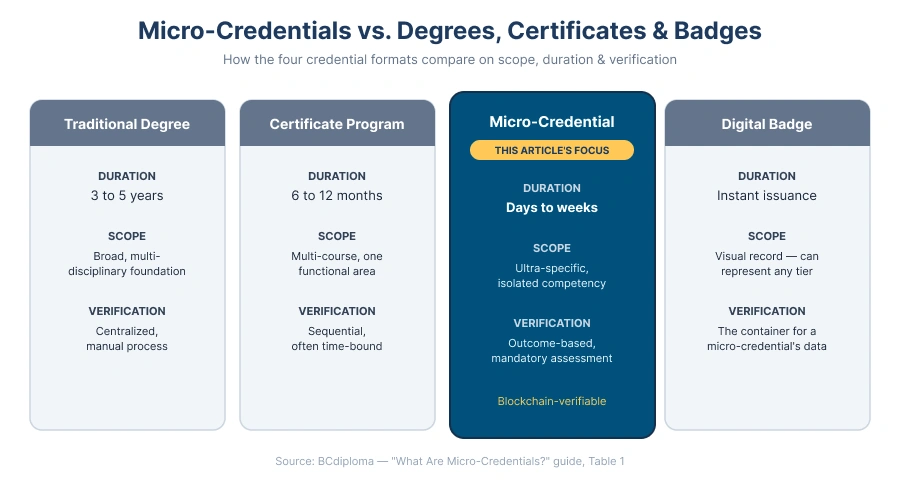
| Educational Instrument | Structural Scope | Average Duration | Core Focus & Verification |
|---|---|---|---|
| Traditional Degree | Broad, multi-disciplinary academic foundation. | 3 to 5 years | Comprehensive field theory; heavily centralized and manual verification. |
| Certificate Program | Multi-course curriculum covering a functional business or academic area. | 6 to 12 months | Sequential programmatic training; often practical but time-bound. |
| Micro-credential | Ultra-specific, isolated professional competency. | Days to weeks | Demonstrated outcome-based mastery backed by a mandatory practical assessment. |
| Digital Badge | The digital, visual representation of any online achievement. | Instant issuance | Can represent simple participation or high-level mastery; acts as the visual record for micro-credential metadata. |
What are the main types of micro-credentials?
To alignt with global workforce needs, micro-credentials generally fall into three distinct categories. Understanding these types helps organizations and learners select the right framework for their specific objectives. Below are the types of micro-credentials most commonly offered across sectors.
Academic Micro-credentials
Issued primarily by universities and colleges, these credentials focus on discrete academic topics or foundational theories. Their adoption continues to accelerate as micro-credentials reshape higher education, lifelong learning, and stackable qualification pathways. They are often “stackable,” meaning learners can accumulate multiple academic micro-credentials over time and combine them to count towards a full undergraduate or postgraduate degree.
Considering adopting micro-credentials at your institution? See our in-depth look at how higher education is putting them to work, from enrollment strategy to credit-transfer design, in our guide: Micro-credentials in higher education: why they are transforming education.
Professional and Industry Micro-credentials
Created in partnership with or directly by industry bodies and corporate enterprises, these qualifications validate specialized, real-world workplace skills. As one of the most established use cases of micro-credentials for professional development, they help employees upskill, reskill, and advance their careers through targeted, verifiable competencies. Examples include leadership certifications, project management methodologies, or specific healthcare compliance procedures — each directly signaling a professional’s immediate readiness for a target role.
Micro-credentials for Teachers and Educators
Teachers and school administrators represent a distinct and fast-growing segment of the micro-credentialing ecosystem — using short, competency-based programs not to certify students, but to formally validate their own pedagogical expertise. Unlike traditional continuing education units (CEUs), which often reward seat time, micro-credentials for teachers require demonstrated classroom application: a lesson plan incorporating a new methodology, a recorded teaching sample, or evidence of measurable student outcomes.
This model has gained particular traction for skills that evolve faster than standard curricula can accommodate, such as:
- Differentiated instruction and inclusive education — certifying an educator’s ability to adapt teaching methods for diverse learning needs, including students with learning disabilities.
- AI and EdTech integration in the classroom — validating a teacher’s practical competency in using generative AI tools, adaptive learning platforms, or digital assessment software.
- Social-emotional learning (SEL) frameworks — recognizing training in trauma-informed teaching practices and classroom climate management.
Several university continuing education departments and dedicated platforms now issue these as stackable credentials, allowing teachers to accumulate them toward salary advancement, license renewal, or recertification requirements — mirroring the same stacking logic universities apply to academic micro-credentials for degree-seeking students.
Technical and Technology-Specific Micro-credentials
Dominant in the tech, engineering, and manufacturing sectors, these credentials certify mastery over a specific software, programming language, hardware, or cloud architecture. Because technology evolves rapidly, these micro-credentials allow professionals to keep their skills current without going back to school for years.
Micro-Credentials Examples Across Industries
The most effective way to understand what micro-credentials look like in practice is to see how leading organizations across different sectors have deployed them. Below are concrete micro-credentials examples grouped by industry, ranging from higher education to corporate upskilling and regulated professional fields.
Micro-Credentials Examples in Higher Education
Universities were among the first institutions to formalize micro-credentials as stackable components of broader degree programs. Real-world examples include:
- MIT OpenCourseWare MicroMasters — A series of graduate-level micro-credentials in fields like Supply Chain Management and Statistics & Data Science. Earners can apply them toward a full MIT master’s degree, making them one of the clearest examples of stackable micro-credentials in academia.
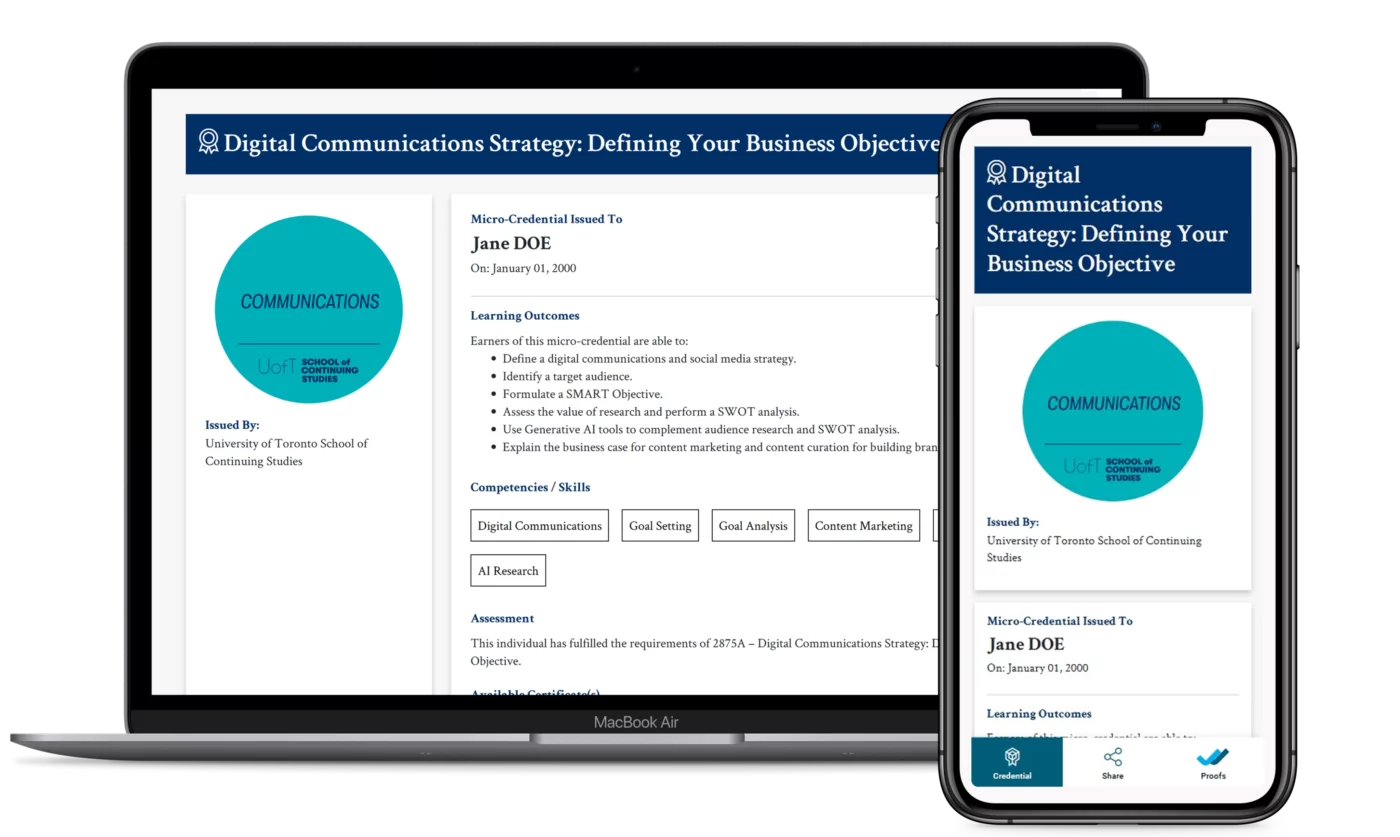
- University of Toronto School of Continuing Studies — Issues blockchain-secured digital micro-credentials for professional development programs in areas such as project management, data analytics, and leadership — each verifiable via a unique URL without requiring a login. BCdiploma is the platform behind this program — see the full case study for how it works in practice.
- eCampusOntario Micro-credential Framework — A province-wide initiative where participating institutions issue standardized, interoperable micro-credentials aligned to workforce needs, enabling learners to accumulate credits across multiple institutions.
Micro-Credentials Examples in Corporate and Professional Training
Enterprises and industry bodies have adopted micro-credentials as a precision tool for upskilling, reskilling, and internal talent mobility:
- IBM SkillsBuild — One of the most widely cited micro-credentials examples in the tech sector. IBM issues digital badges and micro-credentials for competencies in AI, cybersecurity, and cloud architecture — each backed by verified assessment and shareable directly on LinkedIn.
- Google Career Certificates — Short, job-ready programs in fields like UX Design, Data Analytics, and IT Support, issued as verifiable credentials recognized by hundreds of employers across the US and Europe.
- Salesforce Trailhead — A platform issuing role-specific micro-credentials (called “Superbadges“) that validate hands-on mastery of Salesforce tools, used by HR teams as a direct hiring signal.
- Healthcare Compliance Training — Regulated sectors like healthcare and financial services use automated micro-credentials to certify mandatory training completions — such as HIPAA compliance or anti-money laundering modules — ensuring credentials remain current and audit-ready.
Micro-Credentials Examples for Skills-Based Hiring
As skills-based hiring accelerates, recruiters increasingly use micro-credentials as a filter for role-specific capabilities:
- A data engineer presenting a verified Python micro-credential from a recognized provider signals immediate technical readiness — more precisely than a general computer science degree.
- A project manager holding a micro-credential in Agile methodology demonstrates a specific, assessed competency that a broad MBA does not capture.
- A sustainability consultant with a micro-credential in ESG reporting frameworks can prove compliance knowledge that recruiters in regulated sectors actively seek.
These micro-credentials examples illustrate a consistent pattern: the credential’s value is determined not by its length, but by the specificity of the competency it certifies and the credibility of the issuing organization.
Beyond specific platforms, here’s what individual micro-credentials commonly look like in practice, grouped by skill area:
- AI & Technology: Generative AI Fluency, Prompt Engineering, Python for Data Science, Cybersecurity Defense
- Business & Leadership: Agile Project Management, Digital Marketing Strategy, Remote Team Leadership
- Human Skills: Critical Thinking, Cross-Functional Collaboration, Negotiation, Emotional Intelligence
- Healthcare: Telehealth Protocols, Patient Data Privacy, Mental Health First Aid
What Does a Digital Micro-Credential Look Like?
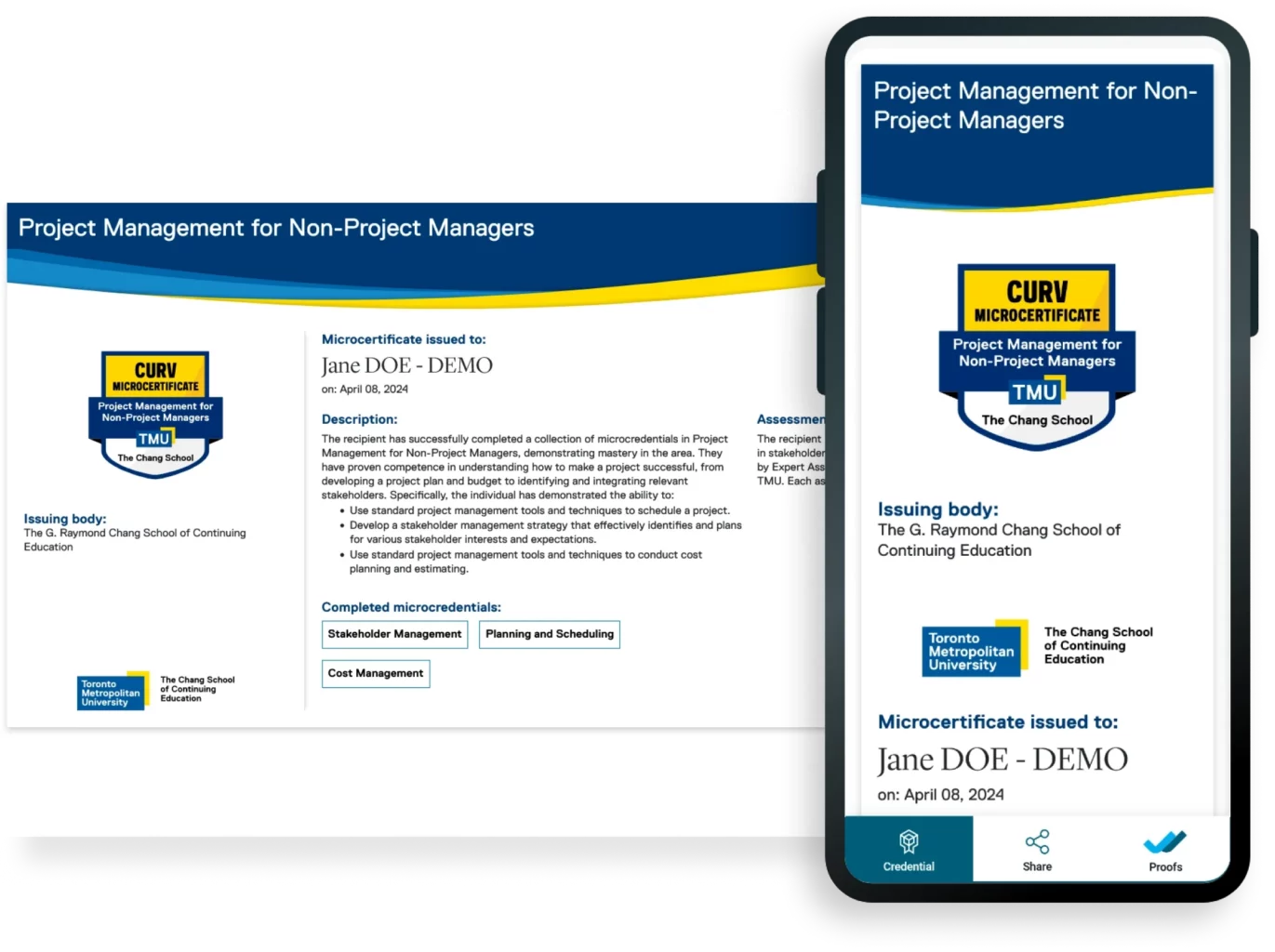
Beyond the subject matter, it is worth understanding what a digital micro-credential looks like in practice. A well-issued micro-credential typically presents as:
- A branded digital badge with a visual design reflecting the issuing institution’s identity
- A unique, permanent URL — accessible without login — that displays the credential’s full metadata to any employer or verifier
- Rich embedded metadata including the issuer’s name, earning criteria, assessment method, issuance date, and credit value
- A blockchain-anchored verification record ensuring the credential cannot be altered or forged after issuance
- A one-click LinkedIn share option, allowing earners to display the credential directly on their professional profile
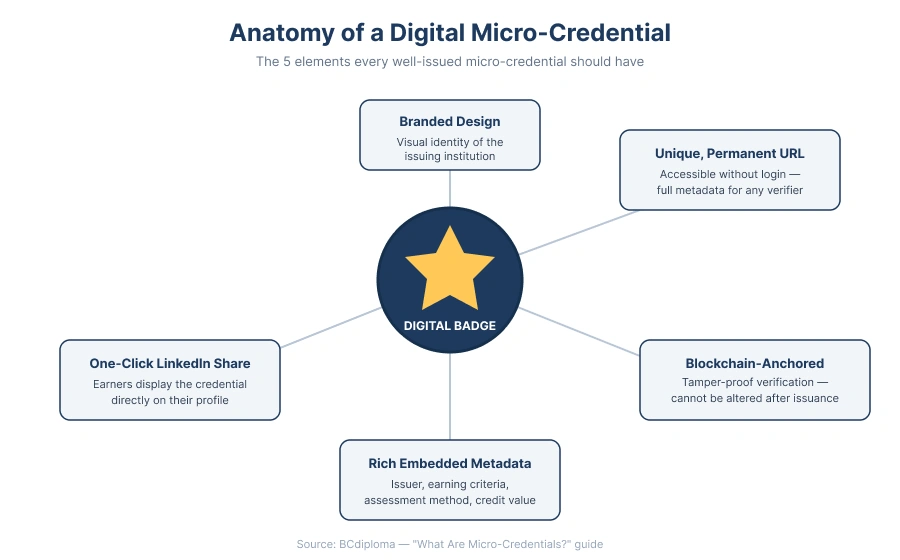
With BCdiploma, every micro-credential issued meets all five of these criteria — combining institutional branding, Open Badges 3.0 compliance, and blockchain-secured verification in a single, automated workflow.
Because most learners earn several micro-credentials over time, many organizations also want a single place to display them alongside traditional diplomas — see how BCdiploma’s Pathway feature brings these together into one verified learner profile.
What are the top benefits of micro-credentials for organizations and learners?
The top benefits of micro-credentials are rapid skill alignment, absolute cost and time efficiency, high market adaptability, and granular employee recognition. Because the labor market in 2026 demands dynamic capability adjustments, this modular format offers unique, high-value returns for higher education leaders, independent training organizations, and corporate enterprises alike.
Table 2: Multi-Stakeholder Benefits of Micro-Credentials
To capture how different sectors leverage these targeted qualifications, Table 2 breaks down the strategic advantages for the three primary decision-makers in the workforce ecosystem.
| Stakeholder Group | Primary Strategic Value | Key Operational Benefit | Micro-Credentials Example |
|---|---|---|---|
| Higher Education Leaders | Institutional agility and new revenue streams. | Unlocks the ability to quickly monetize modular components of existing degrees for lifelong learning. | A university unbundling its Computer Science degree into distinct micro-credentials in Python and AI ethics. |
| Training Organizations | Market relevance and competitive differentiation. | Enables rapid curriculum updates that match immediate regional industry hiring trends. | A private academy deploying a 3-week micro-credential for a newly updated enterprise software suite. |
| Corporate Enterprises & HR | Precision upskilling and lower recruitment friction. | Provides unambiguous, verified proof of technical abilities during hiring and internal talent promotion. | An engineering firm mapping internal promotions directly to the completion of specialized safety micro-credentials. |
| K-12 & Educators | Career-long professional growth without full recertification. | Enables teachers to meet license renewal or salary-advancement requirements through targeted, stackable training. | A school district recognizing a micro-credential in AI-assisted lesson planning toward a teacher’s annual professional development hours. |
Targeted Career Advancement and Personalized Learning
For the individual earner, micro-credentials unlock personalized learning paths. Instead of committing to a rigid, expensive, one-size-fits-all university curriculum, working professionals can mix, match, and stack distinct qualifications to fill specific knowledge gaps. This hyper-targeted approach maps directly onto salary growth potential, as modern hiring managers actively seek out candidates who possess verifiable proof of cutting-edge, role-specific capabilities.
This shift is already visible in how the most selective employers screen candidates. Some competitive early-career programs now accept a smaller share of applicants than elite universities themselves — for example, Goldman Sachs’s graduate programs have reported acceptance rates below 1%, tighter than Harvard’s roughly 3,5% undergraduate admission rate. In that environment, a portfolio of verified, stackable micro-credentials gives a candidate a concrete way to stand out where a single line on a résumé no longer does.
How do micro-credentials work in practice?
In practice, micro-credentialing operate on a lean, three-stage lifecycle: targeted enrollment, competency-based evaluation, and metadata-rich digital issuance. Organizations planning to launch these programs should also consider the operational aspects of micro-credentialing and digital badge implementation, from assessment workflows to automated credential issuance and learner engagement.
The Step-by-Step Earning and Verification Process
- Identification and Enrollment: A learner identifies a precise skill deficit required for their career growth and enrolls in a targeted micro-credential framework provided by an accredited university or trusted training vendor.
- Rigorous Assessment: The participant moves through modular content at their own pace. To successfully graduate, they must pass a robust assessment (such as a practical code deployment, a real-world case study analysis, or a simulated clinical scenario) that explicitly validates mastery.
- Cryptographic Digital Issuance: Upon passing, the issuing institution passes the achievement data to a specialized platform. The earner receives a secure digital badge containing comprehensive, machine-readable metadata that adheres to global Open Badges standards.
Why Rich Metadata Matters for Search Engines, Recruiters, and LLMs
A modern micro-credentialing cannot simply be a static graphic or a baseline text mention. To be recognized by both human recruiters and generative AI search engines, the credential must display deep context within its code.
This immutable metadata package includes the exact identity of the issuing entity, the specific earning criteria, the explicit evidence of work met by the student, and the overall credit value or framework alignment. This structured data ensures that AI agents can effortlessly index, read, and cross-reference an individual’s professional profile, pulling their verified skills into corporate talent-routing algorithms automatically.
How to choose the right micro-credentialing platform
For certifying entities, choosing the right micro-credential platform is the single most critical factor determining the long-term authority and market recognition of their programs. With thousands of digital initiatives launching globally, institutions must audit platforms across three non-negotiable vectors:
- Data Integrity and Cryptographic Security: The platform must issue credentials that are inherently tamper-proof and immune to traditional academic fraud. If a credential can be easily falsified, industry trust vanishes instantly.
- Interoperability and Open Standards: The platform must align completely with global open-source specifications (such as the W3C Verifiable Credentials Data Model or Open Badges 3.0). This ensures the micro-credentials remain vendor-neutral and can easily live inside a student’s personal digital wallet, independent of any proprietary corporate ecosystem.
- LMS and API Integration Architecture: To prevent severe operational overhead, the issuing software must connect seamlessly with existing Learning Management Systems (like Moodle, Canvas, or Blackboard) via robust APIs or automation layers like Zapier, allowing for automated issuance upon successful assessment.
If you’re evaluating how a micro-credentialing platform will fit into your existing systems, see our guide on integrating micro-credentials with your Learning Management System for the specific technical and workflow considerations.
Create a relevant micro-credentials program with BCdiploma
For institutions or training providers aiming to meet these criteria of quality, relevance, and transparency, BCdiploma offers a robust, end-to-end platform for designing and issuing trusted micro-credentials.
Built around the principles of skill recognition and learner-centric pathways, the solution enables organizations to structure their credentials according to clear learning outcomes, competencies, or professional standards—ensuring alignment with both industry expectations and learner goals.
Each micro-credential issued with BCdiploma includes rich, customizable metadata, offering full context on the skill acquired, assessment methods, credit value, issuing body, and links to further learning. Credentials are secured on the blockchain and instantly verifiable, reinforcing trust for recruiters and institutions alike.
With native LMS integration (via API or tools like Zapier), automated issuance, and a visual design studio for creating branded, modular templates, BCdiploma helps institutions streamline deployment while enhancing learner experience. The platform also supports stackable credentials and modular learning pathways, enabling learners to progressively build toward broader certifications—a key feature in today’s evolving professional landscape.
Frequently asked questions
Contact us for more information.
The time required to earn a micro-credential depends on the complexity of the skill being targeted, but they are designed to be vastly shorter than traditional academic paths. Most programs span between 2 to 8 weeks of flexible, part-time study. Because the learning model is strictly competency-based, individuals who already possess baseline familiarity with the topic can often complete the practical assessment much faster.
While both are shorter than a degree, a certificate program typically covers a broader functional area or academic subject and consists of multiple courses over 6 to 12 months. A micro-credential is ultra-focused, targeting one isolated, specific skill or competency, and can often be completed in a few weeks. Furthermore, micro-credentials are deeply rooted in demonstrated performance and outcome-based assessments rather than seat time.
Yes, micro-credentials offer an exceptionally high return on investment (ROI). They allow professionals to rapidly acquire in-demand, cutting-edge skills without the heavy financial and time commitments of a full degree. For industries undergoing rapid technological changes, having a verified micro-credential is often the fastest way to qualify for a promotion, secure a salary premium, or execute a successful career pivot.
In the current global labor landscape, micro-credentials function primarily as a powerful complement to traditional degrees rather than a total replacement. A formal university degree provides a broad, systemic cognitive foundation, while micro-credentials offer the highly dynamic, job-specific layers of technical optimization built on top of that base. However, for professionals executing a rapid career pivot or undergoing continuous corporate upskilling, a curated portfolio of stackable micro-credentials is increasingly accepted by tech and enterprise sectors as an alternative to a secondary degree.
Real-world micro-credentials examples include MIT’s MicroMasters programs, IBM SkillsBuild badges for AI and cybersecurity, Google Career Certificates, Salesforce Superbadges, and university-issued stackable credentials aligned to degree pathways. In regulated sectors, automated compliance micro-credentials are used to certify mandatory training completions in healthcare, finance, and engineering.
Micro-credentialing is the broader process an organization runs to design, assess, and issue micro-credentials — as opposed to a micro-credential itself, which is the individual qualification a learner earns. In practice, micro-credentialing covers everything from defining the competency being certified and building the assessment, to issuing a verifiable digital badge or credential and tracking how it stacks toward a larger qualification over time.